
Daring to Live Like a Family on Mission
Most of us want our families to matter. We want our kids to grow up with faith that actually sticks, and we want our home to be the kind of place people want to be. But somewhere between good intentions and real life, it never quite comes together the way we hoped.
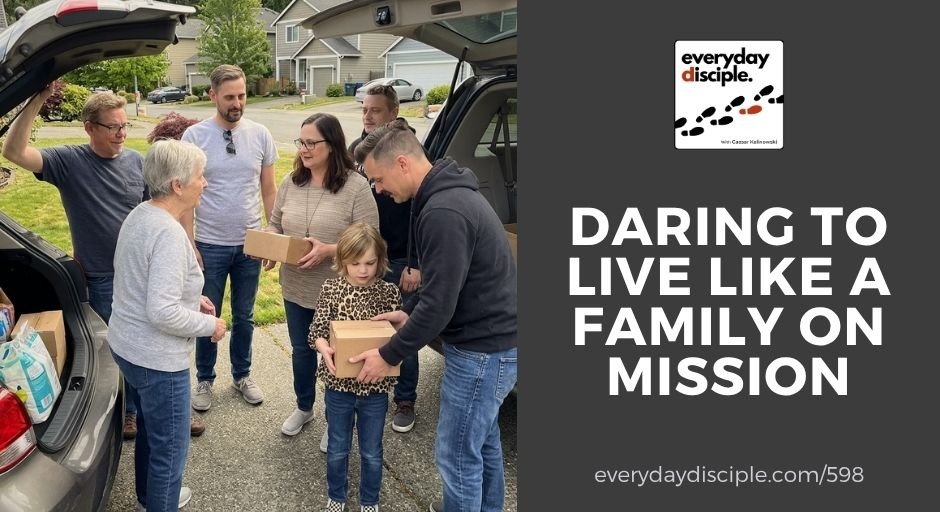
In this episode of the Everyday Disciple Podcast, we’re going to show you how your family’s everyday rhythms — meals, walks, projects, conversations — can become the most natural discipleship environment you’ve ever seen. Not a program. Not a project. Just a family living in a way that others actually want to join.
In This Episode You’ll Learn:
- Why gospel identity is the only foundation for a family on mission
- How to know if your family is living a life others would genuinely want to join
- Simple rhythms you can start this week that open your home to real discipleship
- Why the goal isn’t to do MORE — it’s to invite people into what you’re already doing
From this episode:
“The goal is that your family is living in such a way that discipleship and community naturally grow out of it. We’re not looking to live two lives — an isolated ‘us’ life and then throw a lasso around a bunch of folks once a week. We want to live in such a way that as we invite folks into our rhythms, they are in fact increasingly opportunities for discipleship.”
Each week the Big 3 will give you immediate action steps to get you started.
 Download today’s BIG 3 right now. Read and think over them again later. You might even want to share them with others…
Thanks for Listening!
Thanks so much for joining us again this week. Have some feedback you’d like to share? Join us on Facebook and take part in the discussion!
If you enjoyed this episode, please share it using the social media buttons you see at the top of this page or right below.
Also, please leave an honest review for The Everyday Disciple Podcast on iTunes. Ratings and reviews are extremely helpful and greatly appreciated! They do matter in the rankings of the show, and we read each and every one of them.
Links and Resources Mentioned in This Episode:
Coaching and Apprenticeship in Missional Living w/ Caesar and his wife, Tina
Resources for missional living and group training – Missio Publishing
Get Caesar’s latest book: Bigger Gospel for FREE… Click here.


Transcript
Imagine people saying like, "Okay, so here's what I do.
Speaker:I'm a missionary, okay?
Speaker:But I go to Boeing," "And it's crazy.
Speaker:You wouldn't even believe what a cool deal God set me up.
Speaker:I go to Boeing, right?
Speaker:And there's all these people there." "There's other humans that God wants t- me to love on and show what He's really like."
Speaker:Yeah.
Speaker:"And I glorify Him." Absolutely.
Speaker:"And then, um, I'm thinking, 'That's pretty cool. I don't have to go out and find people, 'cause there's tons of them there.'" Yep.
Speaker:"And then they say, 'Well, this will be your office over here,' and there's other people.
Speaker:And then they give me a desk and all kinds of cool technology and computers to work on.
Speaker:And all day long, I get to talk to people and, and try to live out Jesus' life.
Speaker:And then it's crazy.
Speaker:Every, every couple weeks, I get this envelope shows up, and it's, there's a check in it." "And they freaking pay me to do this." It's cr- it's, it's nuts, you know?
Speaker:Great.
Speaker:So I, I want people to see themselves a- as the starting point for preparation.
Speaker:Do you see yourself as a missionary?
Speaker:Do you see your family as part of God's family already on mission?
Speaker:And it's a matter of have you embraced that?
Speaker:Have you resolved that?
Speaker:Welcome to the Everyday Disciple Podcast, where you'll learn how to live with greater intentionality and an integrated faith that naturally fits into every area of life.
Speaker:In other words, discipleship as a lifestyle.
Speaker:This is the stuff your parents, pastors, and seminary professors probably forgot to tell you.
Speaker:And now, here's your host, Caesar Kalinowski.
Speaker:Hey, Heath.
Speaker:How's it going, brother?
Speaker:Busy, man.
Speaker:Busy week.
Speaker:I mean, here we are.
Speaker:We're recording this... I mean, people know we're not recording it the day we drop this on Monday, right?
Speaker:Mm-hmm.
Speaker:But, uh, we're recording this kinda mid-Holy Week-
Speaker:Yep
Speaker:... weekend now.
Speaker:And, uh, you being- We-
Speaker:a worship leader-
Speaker:Yeah ... you know It's a busy week for us.
Speaker:Yeah, you got a pretty cranking busy week going on.
Speaker:And I know we have, uh, I was just telling you a l- little bit ago as we were setting up, we've got, uh, a more than a house full.
Speaker:Yeah, every room, right?
Speaker:Yeah, spending the night and s- and, and, like, I think we've got three Easter meals included- Yeah
Speaker:in, in the program here.
Speaker:It's
Speaker:fun.
Speaker:Yeah, so.
Speaker:Yeah, we don't usually record even on weekends, but it's early.
Speaker:S- I mean, this is a really early Saturday morning.
Speaker:We're like, "We just gotta do this."
Speaker:Yeah, so I s- if I sound a little bit like a frog- Yeah ... that's 'cause-
Speaker:' Cause we never do it this early.
Speaker:... we're, we never do it this time.
Speaker:But
Speaker:it's the only way we can fit it in this Holy Week.
Speaker:Yeah, it's
Speaker:been s- it's been a holy Holy Week.
Speaker:Hey, I wanted to get to a review, 'cause we haven't done that in a little while.
Speaker:Yeah.
Speaker:But we got a great one that came in from MOliver47, who said, "These podcasts are so inspirational.
Speaker:We're just starting a missional community, and they've been absolutely invaluable in keeping us on track whenever we wanna naturally revert to our previous church culture and helping us see things in a new way.
Speaker:So thanks so much for keeping us grounded, focused, and inspired." Thanks, MOliver.
Speaker:Well, that's awesome.
Speaker:Yep.
Speaker:Yeah.
Speaker:Great.
Speaker:Good luck with that MC.
Speaker:That's...
Speaker:I guess we're hitting the bullseye then, 'cause that's the goal.
Speaker:Yeah.
Speaker:You know?
Speaker:Absolutely.
Speaker:Pretty good summary of things there.
Speaker:Thanks.
Speaker:Yeah, so today we're talking about the, uh, like, whether or not your family's prepared for, for actually missional living and, and, uh, you know-
Speaker:Everything for us, right, kinda leads to mission.
Speaker:Yeah.
Speaker:Right?
Speaker:We see that that's the life we've been given, and, and do we live this as families?
Speaker:And so yeah, we're gonna talk about, like, is our family even prepared to live on mission?
Speaker:'Cause we get so many questions like, "Okay, how do you start?" Right?
Speaker:Yeah.
Speaker:And we're not, like, not talking necessarily preparation to go overseas as a family-
Speaker:Right
Speaker:but how you can actually d- begin to prepare to live life as a family together in community right where you live on mission together.
Speaker:Yep.
Speaker:And not from some sorta like, uh, w- the, I think the purpose of this episode's not some sorta high-level flyover of how to do this, but how you can actually practically start living on mission as a family.
Speaker:Yeah, this is kind of ground prep almost.
Speaker:Yeah.
Speaker:You know?
Speaker:Right?
Speaker:And it's interesting you said, like, this isn't how to prepare to live as a, a family overseas, you know?
Speaker:And, and even though that sounds so corny, and maybe our l- long-term listeners wouldn't even expect that, but I've actually had people that I've known for a while th- thought that as I referenced missional living and, you know, living as a family on mission and all- Yeah
Speaker:that that's what we meant.
Speaker:Oh, yeah.
Speaker:You're like, "Oh, so you help people get ready to, like, be a family of missionaries." That goes overseas.
Speaker:Yeah.
Speaker:Like, yeah.
Speaker:And they, but they meant overseas.
Speaker:Yeah.
Speaker:Like yeah, I remember, like, my sister and her husband lived in Cambodia, you know?
Speaker:Here's... Yeah.
Speaker:Which is awesome, right?
Speaker:But that's, that's not exactly what we're talking about, so.
Speaker:Well, I think it's safe to say, um, that this lifestyle is actually for everybody, not just a select few.
Speaker:Yeah.
Speaker:And that's what we're gonna get to, right?
Speaker:Yeah.
Speaker:I mean, it's not something that goes even in and out of season of like, oh- Right ... sorry, really busy season, I can't be a missionary anymore.
Speaker:Uh- Right ... it's not for those who just have really extensive theological training.
Speaker:So maybe we can again reset the concept that, that everyone listening to this podcast right now is a missionary all of the time.
Speaker:Yeah, that exactly hits it, Heath.
Speaker:That, that kinda underlines it.
Speaker:It's not something we sorta put on, put off.
Speaker:It's not like this idea of living on mission is not like, oh, that's kind of a new way of doing small groups or whatever, right?
Speaker:It's just, this really starts as an identity issue being resolved-
Speaker:Hmm
Speaker:... or renewed.
Speaker:Because, I mean, we're resolving what God already says is true of us, right?
Speaker:Yep.
Speaker:See, we, we have to, like, step back, and this is, like, why we say this is sorta like are you prepared to live on...
Speaker:Do you believe, like, that you are part of God's family?
Speaker:And I think Christians would say, yeah, 'cause I said the prayer, right?
Speaker:But it's like God himself exists in community.
Speaker:Hmm.
Speaker:And i- you know, uh, my, my buddy Mike Breen would say that God actually exists as a family on mission.
Speaker:That's cool.
Speaker:Right?
Speaker:Yeah.
Speaker:And, and you think about it.
Speaker:Father, you know, sends a son to take a bride, right?
Speaker:Yep.
Speaker:Empowered by the Spirit.
Speaker:Actually, in Hebrew, the Spirit's a feminine noun.
Speaker:You know?
Speaker:Yeah.
Speaker:It's like, and so really I think it's, I think it's accurate to say that.
Speaker:And we're created in that image, and we've been a sent people.
Speaker:Jesus says, "As I was sent, so now I send you," right?
Speaker:And then he breathes on them, says, "Receive my Spirit." We know the Spirit's the sending agent.
Speaker:So really this whole thing starts with belief That you, your kids, everybody you know created in the image of God is part of God's family.
Speaker:Hmm.
Speaker:And now in Christ we've been sent.
Speaker:So this is... We have to resolve that.
Speaker:Uh, that's an identity issue.
Speaker:Do you believe you're a missionary?
Speaker:Hmm.
Speaker:And I've told the, you know, I've told the corny story of when I was a kid and seeing the map on the wall- Yep ... you know, and all the pictures, and those are the missionaries, right?
Speaker:But that's kinda how a lot of us really saw it.
Speaker:And even though we go like, "No, no, no, you know, Frank, Frankie," that's my k- that's what I was called as a kid, Frankie, is my middle name.
Speaker:"Hey, Frankie, you're the missionary at school, you know, when you go to school you're a m- " And it's, so they kinda, kinda blurred the lines- Sure ... you know, like to take it that far.
Speaker:But it's like, no, actually at an identity level, just like when, when the Father spoke publicly over His s- "This is my Son who I'm well pleased," and then Jesus starts His mission.
Speaker:It's like Jesus was part of the family.
Speaker:That's family language.
Speaker:"This is my son," right?
Speaker:And He sends His Son basically out on the family business- Hmm ... you know, to take the family business now, and He starts immediately calling others to join Him.
Speaker:Yep.
Speaker:Right?
Speaker:And I, I, I want everybody to see that they, if you're, if you're in Christ, you are a missionary.
Speaker:You're, uh, God already sees everybody as part of His family, right?
Speaker:He created them that way.
Speaker:And I know some are saying, "Well, not, not non-believers, they're not part of God's family." Well, according to scripture they are, you know?
Speaker:Hmm.
Speaker:They're not the redeemed family.
Speaker:Sure.
Speaker:They're not redeemed at that point r- yet, right?
Speaker:They're, they haven't accepted Christ's work on the cross for their redemption.
Speaker:Right.
Speaker:But God still sees them as His kids.
Speaker:Yeah.
Speaker:It's, you know, through all o- all of scripture it says, you know, we are all God's offspring, we all bear the same last name in a sense, right?
Speaker:And I also wanna let people know, too, that they, uh, believe that you are...
Speaker:If you believe like, okay, so I, I hear what you're saying, Caesar, like I'm a missionary, right?
Speaker:But I want you to see yourself as like a full-time paid missionary.
Speaker:Hmm.
Speaker:You know?
Speaker:We, we tell people, like, "Everybody's a full-time paid missionary. You're fully funded." Yep.
Speaker:And they say, "Well, I don't, I don't get paid to do that."
Speaker:It's like, well, l- l- let, can we let God choose how He wants to route the blessings in our life?
Speaker:Hmm.
Speaker:Some people He routes their salary, let's say, through work at a church, right?
Speaker:Sure.
Speaker:And you, you still, that's part of your income.
Speaker:Yeah, part of my income.
Speaker:And I've done that for years, right?
Speaker:I don't currently get paid by a church organization, right?
Speaker:Sure.
Speaker:I'm not... But am I still a missionary?
Speaker:Yeah.
Speaker:Am I fully funded?
Speaker:Well, let's look, let's think.
Speaker:Um, did I sleep sheltered last night?
Speaker:Yeah.
Speaker:Did, do I have clothes on today?
Speaker:Did I eat in the last 24 hours?
Speaker:Yeah.
Speaker:So everybody listening probably could say yes to those three things.
Speaker:Yeah.
Speaker:Right?
Speaker:Fu- you know, they're, they're, they, they slept sheltered, they're clothed, and they've eaten recently, unless they're fasting, you know, intentionally, right?
Speaker:Yeah.
Speaker:Which means God has kept His bargain, like, "I will meet your needs." Hmm.
Speaker:And so what, so if He routes it through working at a factory or y- working at a Starbucks- Sure ... or working at a church or... You see what I mean?
Speaker:Yep.
Speaker:It's all the same thing.
Speaker:And I, uh, and I, I can remember like- Kinda sharing this analogy with some people.
Speaker:Like, imagine people saying like, "Okay, so here's what I do.
Speaker:I'm a missionary, okay?
Speaker:But I go to Boeing, and it's crazy.
Speaker:You wouldn't even believe what a cool deal God set me up.
Speaker:I go to Boeing, right?
Speaker:And there's all these people there.
Speaker:There's other humans that God wants t- me to love on and show what He's really like- Yeah
Speaker:and glorify Him."
Speaker:Absolutely.
Speaker:And then, um, I'm thinking, "That's pretty cool. I don't have to go out and find people 'cause there's tons of them there." Yep.
Speaker:And then they say, "Well, this will be your office over here, and there's other people." And then they give me a desk and all kinds of cool technology and computers to work on.
Speaker:And all day long, I get to talk to people and, and try to live out Jesus' life, and then it's crazy, every, every couple weeks, I get this envelope shows up, and it's, there's a check in it.
Speaker:And they freakin' pay me to do this.
Speaker:It's cr- it's, it's nuts, you know?
Speaker:Great.
Speaker:So I, I want people to see themselves at, as the starting point for preparation, do you see yourself as a missionary?
Speaker:Do you see your family as part of God's family already on mission?
Speaker:And it's a matter of have you embraced that?
Speaker:Have you resolved that?
Speaker:Sure.
Speaker:That is the starting point.
Speaker:And once we can resolve that and say, "Yeah, I do see myself as a mission- I see us as a family of missionary servants," right?
Speaker:Yep.
Speaker:We say that's our identity.
Speaker:Comes right out of the trini- trinity.
Speaker:We're a family of missionary servants.
Speaker:That's the starting point.
Speaker:That's the first of the prep of the prep.
Speaker:Yep.
Speaker:Okay, so let's, uh... I love the identity aspect of that.
Speaker:You know, it's always good to reframe the... Right?
Speaker:'Cause it's so easy to go into the do to be sort of thing, so actually starting- Yeah
Speaker:with who we are-
Speaker:Yeah
Speaker:... and then working out of that, right?
Speaker:Well, how do we get to live, right?
Speaker:Right, right.
Speaker:Is the question we ask.
Speaker:So practically, as people are kinda considering maybe the first steps in living as a family on mission-
Speaker:Yeah, living out of that identity.
Speaker:Yeah.
Speaker:Yeah.
Speaker:Mm-hmm.
Speaker:How, what would you say the starting point might be?
Speaker:Like, how, how would you say this actually begins?
Speaker:Okay.
Speaker:Um, there again, I think this is gonna f- this is gonna... This is a doing sort of thing, but it's really more of a being as well.
Speaker:You know, and I think you framed that really well.
Speaker:I think the initial starting point is to ask yourself, "Do we have a family that others would wanna imitate?"
Speaker:Hmm.
Speaker:We, we've talked about this.
Speaker:If we are part of God's family on mission, and, uh, we bear His identity, we have His Spirit, and we've been sent.
Speaker:Jesus says, "I've been sent, so I send you." And the mission, by the way, of the Church is to make disciples.
Speaker:Then we would certainly assume that, like, the staff at our church and the elders, right, and the pastors and all that would, would really be living lives worth imitating.
Speaker:Yeah.
Speaker:Meaning, like, you wanna know how to make disciples?
Speaker:Boom.
Speaker:Get next to them.
Speaker:Hang out with them, right?
Speaker:So maybe that's the case in your church.
Speaker:Maybe it's not.
Speaker:I, I mean, I, I think it's not too much to ask that the people who lead the mission would actually be on mission.
Speaker:Sure.
Speaker:Yeah, makes sense, yeah.
Speaker:But I, I think we start by asking ourselves that, too.
Speaker:Like, do we have a family worth imitating when- Hmm ... it comes to this life in Christ and living this way?
Speaker:And, and- If not, okay, well then what, what do we need to, like, submit back to God to say, "God, we need you to change this in our family"?
Speaker:And then ask is, is, is your family worth joining?
Speaker:Hmm.
Speaker:Like, like, y- you know, some people don't have a family that you'd wanna hang out with or be a part of.
Speaker:Sure.
Speaker:But they're part of a missional community,
Speaker:you know?
Speaker:Yeah,
Speaker:makes- And it's like, well, let's back up the train a little bit.
Speaker:So as- asking yourself, is our family worth imitating?
Speaker:Would people have better marriages and b- more grace-filled parenting and-
Speaker:Laugh as much
Speaker:and- Yeah ... yeah.
Speaker:Right, and have fun, and, and would grace be extended, and would people see what God is like through our family?
Speaker:Would people wanna imitate that?
Speaker:And then are people sorta trying, like, to get in on the deal, you know, with us, right?
Speaker:Yeah.
Speaker:And like we said, like this, this weekend, part of, part of why we've got a full house, it's not just th- it's not just, you know, our bio kids coming.
Speaker:Sure.
Speaker:It's, like, so many people that are extended family now.
Speaker:Yep.
Speaker:They're Team K. They've just been.
Speaker:They've been grafted in.
Speaker:They've been around, yeah.
Speaker:And they've, they've found their way into the family because they want it, because it's worth joining.
Speaker:It's worth being a part of things, right?
Speaker:Yeah.
Speaker:And so I think as we, we talk about looking for people of peace.
Speaker:In other words, who are those people in our lives that we would begin to build relationships with 'cause they're leaning into relationship with us?
Speaker:Who are those people of peace, right?
Speaker:Yep.
Speaker:I think we have to start by being people of peace.
Speaker:Hmm.
Speaker:That's good.
Speaker:You know, you find people of peace by being people of peace.
Speaker:Yep.
Speaker:Is your household, you know, that house that your kids f- and their friends wanna hang at?
Speaker:Hmm.
Speaker:You know?
Speaker:Like, you've got a basketball team-
Speaker:Yeah
Speaker:at home.
Speaker:Oh, I do.
Speaker:And a bunch of other kids hanging around with your kids, right?
Speaker:Yeah, all the time.
Speaker:'Cause it's, it's a place they wanna be.
Speaker:They want in on the deal, right?
Speaker:Yep.
Speaker:And, and that takes some intentionality.
Speaker:I know w- when Tina and I were young parents, we talked about, um, n- not, not because, like, some fear thing, like we don't want our kids at anybody else's house.
Speaker:That was never the case.
Speaker:They were always out and about and underfoot.
Speaker:But, um, we wanted to make sure that they felt like our home and our household and us as their parents-
Speaker:Yeah
Speaker:... were people they, they felt really good bringing their friends home to.
Speaker:Hmm.
Speaker:And, and, and the rhythm of this, and they could for sure have people over for dinner.
Speaker:I think part of why we've got such a full house this weekend is our kids, kind of independent of us, said, "Oh, and by the way, uh, s- I bro- so-and-so's coming to brunch."
Speaker:Sure.
Speaker:Sunday.
Speaker:Yeah.
Speaker:"And by the way, so-and-so is spending the night. That's cool, right?" You know?
Speaker:Yep.
Speaker:It's like, "Yep, it's cool." So even though they're grown now, they're doing the exact same thing they used to do, you know, dragging people home.
Speaker:Yep.
Speaker:You know?
Speaker:And it, and it was, and it didn't even stop with their friends sometimes.
Speaker:It would be like, "Hey, so-and-so's coming over for dinner, and, um, I, I went ahead and asked his mom, and she's coming too," you know?
Speaker:So it's like- Mixing
Speaker:another 200
Speaker:people in the house, yeah ... it, no, you know.
Speaker:Yeah.
Speaker:So there again, though, it's like, do you have a family- You know, worth imitating and that people wanna join, and are you living as people of peace in your neighborhood?
Speaker:Mm. Do people know you as like, "Yeah, you got a good rep," and pe- the kids wanna be around.
Speaker:I was pretty stoked the other day 'cause I was just sitting on my deck, and it was kinda after, you know, I'd finished working for the day, and I was just kinda sitting on my deck and looking at the birds, and, and boom, all these people and kids cut through the yard with their bikes, right?
Speaker:Yeah.
Speaker:And I was like, "Awesome," you know?
Speaker:Yeah.
Speaker:And then- It's cool ... they stopped, and then they said something to me, and then on they went.
Speaker:And then about 10 minutes later, a whole string of little girls, like, running through that you could see following the bike tracks through the grass, were running.
Speaker:I was like, "You looking for the kids on the bikes?"
Speaker:And yeah, they're like, "Yeah." And then like, "Okay, they went this way," you know?
Speaker:And then they, I- they came back through, and they couldn't find them, and then all of a sudden I heard them playing on the side of my house over here.
Speaker:That's cool.
Speaker:And they weren't freaked out.
Speaker:Like, they would just talk to me like a person.
Speaker:Yeah.
Speaker:Like, I'm not, like, the grumpy old man in the neighborhood you know what I mean?
Speaker:Not yet.
Speaker:It's coming, right?
Speaker:But, you know, so think about, like, are you, are you living as a people of peace in your neighborhood?
Speaker:How about at the soccer field- Yeah ... for, for games or whatever.
Speaker:I'm gonna say soccer, but it might be baseball, or it could be whatever sport.
Speaker:Could be.
Speaker:Or it could be band practice or band camp, you know?
Speaker:Sure.
Speaker:Or, or at your s- kids' school events, you know?
Speaker:Are, are you there, and are you screaming your head off, and do you, do you go with, you know, to other f- see other f- people that you know and their kids and scream your head off for them, too, when they're, like, uh, performing at the talent show or in band or whatever, you know?
Speaker:So, like, are we being people of peace- Yeah ... before we start trying to figure out, okay, who's out there that we're gonna try to rope into our new Missional Community life, you know?
Speaker:You know, it's interesting because one of the things that we hear quite a bit is like, "Man, I'd, I'd really love to live that way.
Speaker:I just can't, man.
Speaker:I'm slammed.
Speaker:I've got this on Monday, and Tuesdays I do this, and Wednesdays I do this." So it, I think almost for some people, too, there's gonna have to be a reformulating or maybe even a rearranging of life in a way that really starts creating avenues of intentional rhythms with others if they're not there yet, right?
Speaker:Yeah, exactly.
Speaker:And, and there again, it, they're intentional rhythms of the things that we're already doing.
Speaker:We, we, we... I'm not gonna get into them today.
Speaker:We've talked about them on other episodes, and I've done deep teaching online for this, but we talk about the six rhythms of life that are just normal and ongoing- Yep
Speaker:and happening.
Speaker:And once we believe our identity and start to live out paying attention to these normal rhythms that we can start including others in, like eating and celebrating and blessing others and all that, s- you know, th- It's not like a matter of adding stuff on, it's a matter of now saying, "Okay, we're living as people of peace.
Speaker:We see ourselves as part of God's family." God's a missionary God, we know that, right?
Speaker:Yep.
Speaker:From the garden forward, "Where are you?" You know, he's looking for Adam and Eve after they have sinned, and they're freaked out and they're hiding, and God's, like, looking for them like, "No, no, why are you hiding?" You know, "Why...
Speaker:Wait, wait, who told you you were naked?" You know?
Speaker:Yeah.
Speaker:And then he sends his son Jesus on a missionary mission, right?
Speaker:I mean, on, on a mission to come and get us, to save us.
Speaker:And so there again, start it... This starts at home.
Speaker:Like, what are, what's the reformulating and rearranging?
Speaker:Just start at home, not with adding rhythms, but thinking like, okay, this is our first mission field.
Speaker:Yeah.
Speaker:And are we living... Like, have we established up, in, out rhythms?
Speaker:And so what I mean by that real quick is, you know, like, is God talked about in our family?
Speaker:Are we growing?
Speaker:Uh, uh, i- you know, is there upward connection to God that's a big part of our family, and it's normal?
Speaker:Or is it like, no, that's what we go to church for when we make it, you know?
Speaker:Yeah.
Speaker:Um, in, up, in, out.
Speaker:Uh, in rhythms, are we including others in the stuff that we already normally do?
Speaker:So it doesn't take any extra time.
Speaker:You say, "Oh man, I'm really slammed." Are you eating dinner tonight?
Speaker:Yeah- Yeah ... you probably, you know.
Speaker:Did you have lunch at work?
Speaker:Was there other humans in proximity to you, you know?
Speaker:Yeah.
Speaker:Right?
Speaker:And so, um, like, I wanna suggest to people start to become hyper inclusive.
Speaker:Yeah, that's good.
Speaker:You know, like, just think about it.
Speaker:Like, like, flip the switch.
Speaker:If, if, if we're God's family, God can afford it, that's for sure.
Speaker:Um, and it's, it's not even a matter about, like, extravagance or anything like that, but who could we start having over for dinner a little bit more regularly?
Speaker:Yeah.
Speaker:Or, um, how about for celebrations?
Speaker:Who could you invite over for Easter?
Speaker:You, by the time you're hearing this, it's too late, but, but starting to think this way.
Speaker:And Christmas isn't just like, "Oh, well, we go to my grandma's, and that's that." It's like, hmm, what else might you do?
Speaker:Part of the reason we have three different meals going on is because not everybody who we wanted to include this year- Yeah
Speaker:in the Easter celebration could make the same exact time.
Speaker:So Team K just is sort of grown into like, well, we'll just spread it out.
Speaker:We do the same thing with Christmas.
Speaker:It's like a weekend of parties, yeah.
Speaker:It's like three days, you know- Yeah ... of kinda doing it, you know?
Speaker:Well, on top of the whole week of stuff.
Speaker:So think about are, you know, are you doing, like, family dinner nights in your own home that are meaningful and connected?
Speaker:Maybe you're doing the story of God with your own kids.
Speaker:I, I mean, do you even do those kind of rhythms that- Hmm ... you could invite someone into?
Speaker:Or is everything gonna be an add-on?
Speaker:And, and like you said, people feel slammed, so don't think add-on.
Speaker:Think about what are we currently doing?
Speaker:Can we... So up, in, are we including others?
Speaker:And then out, like, do we bless people?
Speaker:Do we ever go?
Speaker:Do we take our kids out and live as a blessing to be others?
Speaker:Hmm.
Speaker:Um, I can remember taking my kids, like, well, back when we lived in Chicago when, when the kids were growing up, um, taking them out shoveling, and we'd go around and shovel walks- Oh, yeah
Speaker:'cause there was elderly people, right?
Speaker:Or people that, you know, the husband was out of town, and it snowed like crazy, and the- Yeah ... mom's in the house- Need some help ... with little kids and baby, you know?
Speaker:And so, or raking leaves, or like i- Tina used to take, uh, the girls and a bunch of their friends, this is pretty cute, she would take them to the animal shelter-
Speaker:Okay
Speaker:and pick up kitties.
Speaker:Kittens, right?
Speaker:Okay.
Speaker:They would loan us kittens, and then they would take the kittens and the kids, and they would go to, like, retirement homes-
Speaker:Huh
Speaker:... where there's these people that, and they said, "Oh, yeah, most of these people, no one ever visits." Yes, take them.
Speaker:And they would come, and they'd be like their grandkids, and sit on their laps, and pet the kitties- Aw
Speaker:and they'd pull out their little hard candies for the kids, you know, and all that.
Speaker:Yeah, that works.
Speaker:Right?
Speaker:And so, like, but there again, that was all part of, like, her, uh, my wife being involved in Girl Scouts, and I think it was Brownies at that point.
Speaker:They were really young.
Speaker:So-
Speaker:Hmm
Speaker:... you know, what are the, you know, start at home.
Speaker:What are your rhythms, and are you including others in them increasingly?
Speaker:Now, this is like, 'cause, like, is that what a family, is that what a family on mission does?
Speaker:Yeah, absolutely.
Speaker:Is that what a Missional Community does?
Speaker:Yeah, but not if it's artificial.
Speaker:See, this is what we're saying.
Speaker:It's not something to be bolted on.
Speaker:Sure.
Speaker:It needs to extend from your family outward.
Speaker:So redefine who's your family.
Speaker:Do you see everyone as family?
Speaker:And then who might we, else in our family might we include this year for Christmas or at Thanksgiving?
Speaker:Or, you know, we're planning to do just simple barbecue this week.
Speaker:Yeah.
Speaker:Well, who else might come?
Speaker:And somebody in the neighborhood, or, or, you know, we talk about, like, everybody says, "Well, I'm single." Some people are already tuned out, 'cause, like, "Well, I'm single.
Speaker:This doesn't work for me." Well, that's not the case, 'cause we have constant- There's gonna be a bunch of single people with us this weekend, you know, for this whole schmear of, you know- Yeah
Speaker:Easter events going on around here.
Speaker:And so are you including people because you see them as family, or do they always feel like no, and, and even our churches unfortunately sort of silo people like that- Yeah ... so, like, they have the singles ministry.
Speaker:Yeah.
Speaker:Well, what do singles want?
Speaker:They wanna get m- most of them wanna be married and be in a family, so treat them like family.
Speaker:Include them in your family life.
Speaker:Yeah, bring them in.
Speaker:Yeah.
Speaker:In fact, I'd say even look for that, because how will they know, you're talking about wanna make disciples, how will they know how to live out their life as, as, as adult Christians, as a mother, as a father, if they've never witnessed it?
Speaker:So let's say they didn't grow up that way.
Speaker:Sure.
Speaker:Right?
Speaker:Or they didn't grow up in a family on mission.
Speaker:Maybe their family went to church, but they're really looking for something deeper.
Speaker:Are you including people?
Speaker:Do you see them as family, right?
Speaker:Hmm.
Speaker:So we're not looking to live two lives, like our isolated us, our family life, and then a Missional Community is where we throw a lasso- Around a bunch of other folks once a week and try to get them into artificial rhythms.
Speaker:We, I hope, I hope, I hope the listeners are getting this, that we wanna live in such a way that as we invite folks into our lives and the rhythms that we're living, it, there's increasing opportunities for discipleship, and intentionality within our own family to live as spiritual parents to our kids- Yeah
Speaker:extends then, and must precede us becoming somehow spiritual parents to others.
Speaker:Yeah, so, uh, as you talk about maybe moving into more of discipleship with intentionality, um, how would you begin moving from these big groupings where everyone's invited with meals?
Speaker:I think over time, as you build predictable patterns, and what I mean by that is it's not like, "Hey, remember the time we did the barbecue?"
Speaker:Yeah.
Speaker:Or, "Remember the one time we had someone over for dinner?" Sure.
Speaker:You know, it's like it's a predictable pattern, people are starting to find and become part of the rhythm of your family.
Speaker:They're starting to sense that they're family and be a part of that.
Speaker:Then we are looking to, okay, how do we move to more deeper level spiritual discussions in, in what we would more traditionally consider discipleship or disciple-making?
Speaker:Yeah, we've talked a bit, like, about upping the challenge while keeping the invitation high, right?
Speaker:Right.
Speaker:Yeah.
Speaker:It's, it's this high invitation to our family, that continues, but then, yeah, how do we increase challenge in their life?
Speaker:Now, so there's, there's not one right way.
Speaker:There's not a right one.
Speaker:Sure.
Speaker:Some people do, you know, some people will say, "Well, then eventually I'm gonna invite them to church."
Speaker:Nothing wrong with that.
Speaker:It might not necessarily be the best starting point for their spiritual journey.
Speaker:It might be the perfect one.
Speaker:I don't know.
Speaker:Sure.
Speaker:Um, it might be to s- study the Bible with you.
Speaker:Or who knows?
Speaker:For us, we wanna see their discipleship happen in community.
Speaker:And so for us, one of our, our favorite things is to take people through the story of God.
Speaker:Hmm.
Speaker:And, and we start to pray.
Speaker:We start to establish a weekly rhythm that's natural with people that seem to dig it, and they're leaning in.
Speaker:They've been trying to get into the family.
Speaker:They're trying to be a part of what's going on.
Speaker:They seem to be giving theirselves to that, so we call these people of peace, right?
Speaker:Right.
Speaker:And they're not ... Like, I'm not trying to t- I'm not having to beg them like, "Do you wanna eat?
Speaker:You wanna hang out?" It's like, no, they're like, "Yeah, we're in." You know?
Speaker:Sure.
Speaker:And then we'll start to pray, "Okay, Lord, who, who," just like Jesus did, like, "Who do you have for us to disciple?
Speaker:Like, there's a lot of folks hanging, but we're not a- we're not gonna get to disciple anybody.
Speaker:Who is really leaning into this?
Speaker:And, and, and Lord, show us who to invite." And we're gonna start doing, connected to this rhythm of maybe, say, a weekly meal we're already having together or a weekly barbecue, um, we're gonna start doing the story of God with people.
Speaker:Yeah.
Speaker:And, and, like, we'll just do, like, one or two narratives, you know, they're just a minute or two each and discuss them.
Speaker:And all those resources are on my website, and we can put a link in the show notes to them, too.
Speaker:But that's where I really like to go because I, I, we have just found that, you know, if you, if you just look at, look at your own home, like, this weekend or your Easter table and look around who's sitting there, they're not talking bullet points.
Speaker:Sure.
Speaker:You know?
Speaker:They're not going through a book like, "Hey, how'd your week go? Let me pull it out," and they got notes.
Speaker:They're just telling the stories of life and, and what was Easter like when you were a kid.
Speaker:Sure.
Speaker:"Oh, my God, I remember the first time, you know, that we dipped eggs, and man, we spilled it all over h-" You know, like, people just tell stories.
Speaker:That's normal life.
Speaker:Hmm.
Speaker:And so I like when we kind of then- Take that rhythm of food and meals and hanging, which is gonna be full of story, and move towards doing the story of God with people.
Speaker:I found it to be a pretty easy challenge in that sense.
Speaker:Yeah.
Speaker:It's not ... I think a lot of people think like, "Oh, no one would ever wanna do it."
Speaker:Eh, that's just not been my experience.
Speaker:Yeah, it's actually hard to find... It's hard to find a resource that's better than the story of God for that, for
Speaker:that- For that bridging over.
Speaker:Oh,
Speaker:it's perfect.
Speaker:It's story.
Speaker:Yeah.
Speaker:It's dialogue.
Speaker:It's connected.
Speaker:I, I mean, it doesn't have to be, but, uh, uh, generally it's connected to food.
Speaker:So once we've established that kind of a rhythm of life, to, to move into the story... We just had a conversation with someone who's extended, part of our extended family, part of our Team Kay oikos, right?
Speaker:And, um, it just came up naturally the other day, uh, at... We were actually at a restaurant, and something came up and I said something about story and understanding who God is better through his story.
Speaker:And I, and I mentioned that we were starting to kind of try to put dates on a calendar for next time we're gonna do story of God.
Speaker:And she's like, "Yeah, yeah, yeah, yeah. That's right. I want in on that," you know?
Speaker:Oh,
Speaker:that's cool.
Speaker:" You guys keep bringing that up.
Speaker:It sounds like something I gotta understand better."
Speaker:Yeah.
Speaker:This person wasn't raised going to church.
Speaker:They don't- Yeah ... you know, they're not, like, atheist and they're like, "I don't believe there is a God in the world," although we've done the story with plenty of those types as well.
Speaker:Sure.
Speaker:But it just kind of, it kind of naturally came up, and it was leaking out of our conversations.
Speaker:And what do we do with this particular friend?
Speaker:Well, we just sit around and eat and have lots and lots of family time and tell lots and lots of stories, and they know that our story is preceded, uh, you know, was preceded by God's story.
Speaker:So it's just natural.
Speaker:Yeah.
Speaker:It's almost like you're inviting them into your family history in a sense, you know?
Speaker:Yep.
Speaker:So, and, and people can download all the materials on that, but that, that's where I like to go first.
Speaker:Cool.
Speaker:You know?
Speaker:Some people will do Alpha, some people will do other things, and I'm, I'm cool with it all, as long as it seems like, uh, the next natural step- Yep ... and not like, "Hey, we've been doing this and now all of a sudden that?"
Speaker:Yeah.
Speaker:That seems very... You want it to feel like family together.
Speaker:You know, so one thing I've come across, like, in my life, but also many people, uh, who are close to me have been in the same situation where when you're starting to look at how we're gonna live this out as a family, you've got one spouse that's super gung ho about living on mission and the other one that's not really into it or not quite feeling it.
Speaker:Um, and I know this question primarily applies to married people, and I've got a question for single folks coming up here in a second.
Speaker:But how would you go about working through, uh, this marriage maybe disagreement where there's not total agreement between the two spouses?
Speaker:Yeah.
Speaker:Well, it's a, it's a great question because, uh, there again, if you're not, if you're not living as a family on mission, it's like, it's more like, uh, uh, uh, an isolated part of your life.
Speaker:Your faith's over here.
Speaker:It's on Sunday.
Speaker:But if you... But if it's like, no, you know, we, we do that together, but then our family's our family and it's separate.
Speaker:Yeah.
Speaker:We talk about, we talk about that some families, they have a family and then the, the, there's the mission.
Speaker:And they see that as like, like remember the time we went to Guatemala and we helped build that church building or something?
Speaker:Sure.
Speaker:Right?
Speaker:And that's good.
Speaker:That's a good thing, but it's separate.
Speaker:That's like our family, and then there's the mission, or there's church.
Speaker:And then some families, you, you have a family that h- that sorta has their own mission.
Speaker:You know, like in other words, together annually they go on this trip or they give to this thing- Right
Speaker:or they serve at their church, but as a, you know, as a family unit, and that's, that's their sorta mission together.
Speaker:Sure.
Speaker:The goal is to become a family on mission, like that just lives on mission and sees themselves living out of their identity together.
Speaker:And if, if the s- if the s- couple, you know, if the spouses aren't on the same page, th- I, I...
Speaker:You have to kinda start there.
Speaker:You really do.
Speaker:Yeah.
Speaker:And in other words, like we have to go back to identity, and you have to let the Gospel begin to transform w- what you even think we're here for.
Speaker:Like, why do, why were we created?
Speaker:What did, what did, you know, why did God l- loop us into His family and send us out on His mission?
Speaker:Was it just to sit in a church service?
Speaker:You know, was, was that the goal?
Speaker:And so what I would suggest for couples that find themselves in that is that I would read and discuss key books together.
Speaker:Like I- Hm ... generally, um, I suggest people read Transformed.
Speaker:Yeah.
Speaker:You know, that's f- one, uh, one of the first books I wrote, and it's sort of all narratives of, like, what is, what is it, what's our true identity, and what's it look like to believe that this is what God says of us, and then live it out in normal everyday rhythms of life with our own family and then a, a growing extended family.
Speaker:And so, like, even some of the people, uh, that we're coaching- Yep ... and, and I know some of them are listening to this right now.
Speaker:They say, "Yep, Caesar assigned that to us," you know?
Speaker:Yeah.
Speaker:As a couple.
Speaker:And these are people that are already living on mission, but I'm like, "I want you to wrestle with this idea of our identity and, and how it starts to change what, how we talk with our kids and what's at our table- Sure
Speaker:and what we invite our kids to go do." You know, we talked about up and out.
Speaker:Are we taking our kids to serve?
Speaker:You know- Yeah ... I was mentioning with Tina with the kids and the kiddies and all.
Speaker:And, um, that's a good one.
Speaker:I think, uh, Tangible Kingdom's another great book- Yep ... that, that you could read together just to sort of begin to unearth it.
Speaker:Now, um, if you, if, if you're just like, "Well, listen, my, you know, my husband just doesn't see it this way, and he, you know, he'll, he'll go to church with us, but he's, he's not wanting to do any of this," well, then that's really a question of are you living as spiritual parents in, within your own home?
Speaker:Hm.
Speaker:A- and if you're not yet, start there.
Speaker:Like, you don't really need to worry about starting a Missional Community, but back to my question, do you have a life worth imitating?
Speaker:Are people trying to get in, you know?
Speaker:Yeah, like that's a focus, yeah.
Speaker:Would it be worth joining?
Speaker:Um, if not, I would say put off this idea of trying to throw a lasso around a bunch of people and talk them into missional kinda activity so you feel good about it and it looks like you're doing something.
Speaker:It's really just sort of a, a mini church service, you know- Yeah ... or something on midweek.
Speaker:You, you really do.
Speaker:And, and like you say, "Well, but I, I don't wanna stu- I don't wanna stay stuck there," have you been proactive enough to actually discuss this?
Speaker:I would say another thing is to talk to other couples that live in the way that you wanna live.
Speaker:Like maybe let's say the husband's all, in this case, all on board with this, but his wife's unsure.
Speaker:And, and it might be connected to, like, I don't know about our house or if it's clean enough, or how to, I don't, like, I don't know how to have people over.
Speaker:We didn't grow up that way.
Speaker:Maybe talking to other couples that live that way, that can speak truth and grace and identity into them, and kinda lift the lid, uh, uh, of their life.
Speaker:And maybe hang out with those couples a little bit when they see it so that it's more normalized.
Speaker:Yeah.
Speaker:I think people think it's real mystical and it's real heavy, and it's, it's- It's really not, yeah ... no, it's your normal... Like, this weekend's not a big, heavy deal for Tina.
Speaker:Hmm.
Speaker:Like, house full of people and lots of food.
Speaker:It's like everybody'll help, everybody's family.
Speaker:Sure.
Speaker:We don't treat pe- people like guests.
Speaker:That's a heavy burden.
Speaker:Yep.
Speaker:If we had a house full of, like, guests, like we're running a B&B this weekend, it'd suck.
Speaker:Yeah.
Speaker:But it's a house full of family.
Speaker:Takes the pressure off, yep.
Speaker:Both bio and extended, right?
Speaker:And so they're gonna come that way.
Speaker:So I'd say if, you gotta be on the same page a- and take the time to get there, right?
Speaker:Yeah.
Speaker:And, and start to live this in your own home as a couple, at, with your bio kids, and let those rings go out from there.
Speaker:And, and you just gotta be where you're at.
Speaker:It's okay.
Speaker:If that's where you're at, take the time.
Speaker:But be intentional to say, "Hey, honey, could we, could we read and discuss this book together, just to start to move our hearts in some w- you know, s- down some similar paths?"
Speaker:And l- and, and it's just, it's free to talk, free to dream.
Speaker:Yeah.
Speaker:Right?
Speaker:You know, one other thing we hear is quite a bit from, uh, single people who feel kind of on the outskirts of communities that are primarily based on these family rhythms.
Speaker:But it doesn't seem like being single will exclude you from living intentionally.
Speaker:Right.
Speaker:Like, in fact, even Paul talks a bit about this in 1 Corinthians 7, right?
Speaker:Would you say that single people might even be more primed to be available for life on mission?
Speaker:Well, I think so, because there's a flexibility that comes with I don't have these bedtimes I gotta hit-
Speaker:Yeah, exactly
Speaker:... and bath times, and, and, and, you know, probably my budget in life is a little freer-
Speaker:Yep
Speaker:to be a blessing to other people, 'cause it's not like 98, 9.9% of it's sucked into just keeping these kids fed and, you know, braces and all, right?
Speaker:And so yeah, I think that single people are.
Speaker:And I, and I, and I, I do think this.
Speaker:We probably should do a whole episode on this someday, Heath, about, you know, how, how do you start this.
Speaker:I've known lots and lots of single people who have formed communities themselves because they had that impetus.
Speaker:They wanted to.
Speaker:Yeah.
Speaker:And they didn't have, like, a bio family yet, so they actually, along with other couples- Yep ... and their kids, said, "Hey, can we start living more like family- Cool ... so that we can include others in this?"
Speaker:I wanna remind everybody that Jesus was single.
Speaker:Okay?
Speaker:Wait, what?
Speaker:Yeah.
Speaker:Yeah.
Speaker:So if, if, if, if people, single people say, "Ah, this doesn't really work if you don't have a family," the, I, I gotta point us back to our Lord.
Speaker:I gotta say, "Wait a minute. There was a single guy that went out and collected a family."
Speaker:Yeah.
Speaker:You know, he was part of a family on mission.
Speaker:He's part of the Trinity.
Speaker:He, a- and then he went out and he started to extend his life with others, and, and there was even conversations there, like, "Who's your family?" Yeah.
Speaker:And people are like, "Well, I know that guy.
Speaker:He's your brother." It's like, "Yeah, but that's my brother."
Speaker:Hmm.
Speaker:"And that's my mom. That's my true mom," right?
Speaker:It's like who- Who's living out my life?
Speaker:Yeah.
Speaker:That's, that's who's part of this family.
Speaker:And so I think you can be the impetus as a single person, and you don't have to wait around to be invited in.
Speaker:But let me, let me just close the loop on this.
Speaker:If you're ... And we, we kinda glanced past this earlier when we talked about being hyper inclusive.
Speaker:Start to think about who are the singles in our f- in our life-
Speaker:Hmm
Speaker:... that n- they, they need this.
Speaker:They need to be included in a family.
Speaker:They need to see this model.
Speaker:They have a lot to offer.
Speaker:They have a lot of flexibility- Yep ... to offer, whereas, like, "Yeah, guess what? Uh, w- I gotta put the kids down tonight." You know?
Speaker:Like, I don't.
Speaker:Mine are grown.
Speaker:But, you know, some people are like, "Hey, listen. We can't go and see, you know, the neighbor's kids in a rock band, and they're playing tonight, but I can't go 'cause the kids would be sleeping at that point." But the, the singles can.
Speaker:You know?
Speaker:Yeah.
Speaker:And they can represent the family, or they can help in this way, or they can, they can show up at this event.
Speaker:Like, we've taken groups, literally groups of friends, and a whole bunch of singles to, like, football games, like high school- Hmm ... football games or the kids' soccer games.
Speaker:Yeah.
Speaker:And they come with us.
Speaker:And, and, and they just scream their heads off.
Speaker:And, you know, all our kids' friends are like, "Who's, who's the cheering section up there," right?
Speaker:We just include them in all that stuff.
Speaker:Sure.
Speaker:And you think, "Well, what single person wants to go and watch your kid kick a soccer ball?" Oh, I'm telling you, they wanna be.
Speaker:Yeah, they wanna- And there's food afterwards, and we're having fun with it.
Speaker:And so both invite yourself in or start a community, but start it with other family members and/or be hyper inclusive and look for who you can include, all right?
Speaker:Yeah.
Speaker:That's great, man.
Speaker:All right.
Speaker:Hey, let's get to the big three.
Speaker:And the big three is a free download that people can get by going to 123lifeschool.com/bigthree.
Speaker:Uh, and the download is basically a printout of the three things if we wanted to boil down takeaways that we want you to walk away with from this episode, what they would be.
Speaker:So you can get that again as a download by going to 123lifeschool.com/bigthree.
Speaker:Caesar, what are the big three for this week?
Speaker:So here's
Speaker:the big three, okay?
Speaker:Real, real succinct today, and we're kinda already running late on time here.
Speaker:So s- first, first thing, don't miss this.
Speaker:Believe that you're a part of God's family on mission and that you are a missionary.
Speaker:Hmm.
Speaker:Like, settle that in your heart.
Speaker:You were created in his image.
Speaker:You were grafted in.
Speaker:You were adopted sons and daughters.
Speaker:He ... This is a God who lives in community.
Speaker:This is your identity.
Speaker:Hmm.
Speaker:Okay?
Speaker:Um, stagnant, compulsory church attendance is not the end goal for our life and faith.
Speaker:It's living Jesus' life on his family mission, well, sort of in his family business, on his family mission, as a lifestyle, a pers- you know, out of our identity.
Speaker:It's not just a set of activities that makes us missionaries.
Speaker:Hmm.
Speaker:Okay?
Speaker:That's great.
Speaker:That's who we are.
Speaker:Second, um- I'm gonna just un- underscore this, so don't miss it.
Speaker:Live as a family worth imitating and that others wanna join before trying to create artificial family rhythms with a large group of others.
Speaker:That's good, man.
Speaker:And I know a lot of people, it's just like, "Yeah, I'm in a missional community." It's like, but you look at their family, it's completely se- they're not part of it, and they're like, "Well, how do you include kids?" Well, your kids should see themselves as part of that family and that mission already- Yeah, exactly
Speaker:if you start the way we're suggesting today.
Speaker:And then third is, um, start to see and treat everyone like family.
Speaker:Be hyper-inclusive in the normal rhythms of your life.
Speaker:Often, Tina and I will say there's really not much you do in life that you couldn't include some other people to do- Yeah ... to do with you, other than maybe the marriage bed, and- Yeah
Speaker:or go to your job with you.
Speaker:You know?
Speaker:C- I can't take people to work, and then they say- Sure ... "Who's this guy sitting with you all day?" "Ah, it's just my buddy." You know?
Speaker:Probably gonna, probably not gonna do it.
Speaker:But, but otherwise, be hyper-inclusive in the normal rhythms of life.
Speaker:Yeah.
Speaker:Inviting people to simple meals, uh, yard work, p- uh, walks in the park, uh, to the store with you.
Speaker:These are all things we do and we've done.
Speaker:Yeah.
Speaker:Uh, begin to extend your family life to others, and increase the invitation so they can see faith and discipleship as part of everyday life, not some isolated thing.
Speaker:Yeah, that's great, man.
Speaker:Again, if you want the free download of this week's big three takeaways, you can go to everydaydisciple.com/bigthree, and you'll get those notes right away.
Speaker:If you haven't yet joined the Facebook group, it's growing.
Speaker:Like, last night I was ... I, I checked Facebook before I went to bed, and there was 14 people that wanted to be approved, and I was like, "What is going on?" Yeah.
Speaker:This is- I know, it's wonderful.
Speaker:Yeah, so keep, uh, keep your friends coming.
Speaker:The conversations are getting better there.
Speaker:I love seeing people going, "Hey, I'm in this situation," and now actual people-
Speaker:Yep
Speaker:... listeners are gonna like, "Well, I would suggest this." And in fact,
Speaker:the Facebook group is where we can stay connected.
Speaker:Yeah.
Speaker:Awesome.
Speaker:Thanks for joining us today.
Speaker:For more information on this show and to get loads of free discipleship resources, visit everydaydisciple.com.
Speaker:And remember, you really can live with the spiritual freedom and relational peace that Jesus promised every day.