
Spirituality That Fuels God’s Mission
Mission for God and intimacy with God can often become disconnected and seem like competing priorities and passions. But what if you could cultivate a vibrant and authentic spirituality that doesn’t draw you away from your neighbors, but propels you into the lives of others and the needs of your city?
In this episode of the Everyday Disciple Podcast, Caesar is joined by church planters Jeremy and Monica Chambers as they break down this divide in a way that helps you discover fresh joy in living as a Jesus-follower, and become more fruitful in your everyday mission.
In This Episode You’ll Learn:
- Why there seems to be a divide between deep spirituality and mission.
- Why focusing just on contemplation or just on the mission is incomplete.
- How to cultivate a vibrant spirituality that doesn’t draw you away from others.
- A practice where you’ll discover new ways in which God is truly amazing!
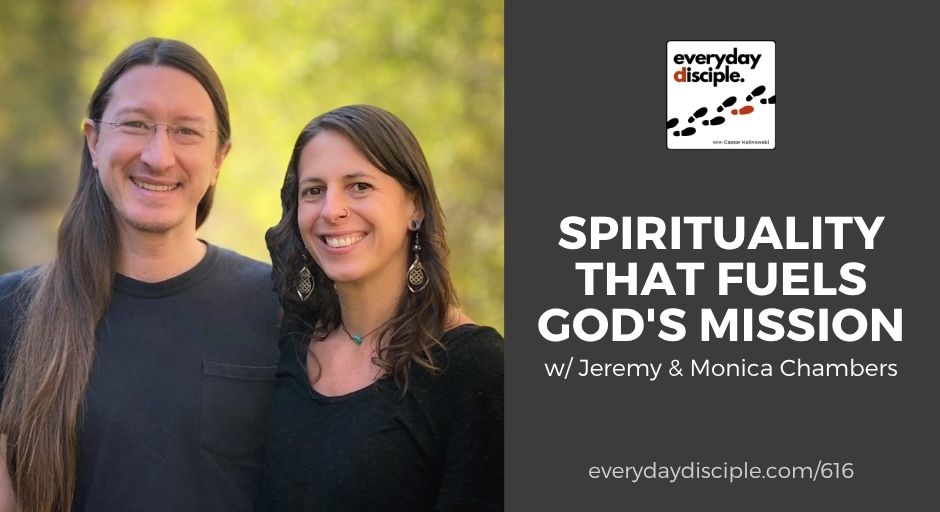
From this episode:
“Don’t get caught up thinking, Oh, if I do this practice, then God’s going to be more pleased with me, or whatever. No! These practices are about you making yourself available to God to connect with him and to be able to receive His goodness and his love.“
Each week the Big 3 will give you immediate action steps to get you started.
 Download today’s BIG 3 right now. Read and think over them again later. You might even want to share them with others…
Thanks for Listening!
Thanks so much for joining us again this week. Have some feedback you’d like to share? Join us on Facebook and take part in the discussion!
If you enjoyed this episode, please share it using the social media buttons you see at the top of this page or right below.
Also, please leave an honest review for The Everyday Disciple Podcast on iTunes. Ratings and reviews are extremely helpful and greatly appreciated! They do matter in the rankings of the show, and we read each and every one of them.
Links and Resources Mentioned in This Episode:
Coaching and Apprenticeship in Discipleship as a Lifestyle w/ Caesar and his wife, Tina
Resources for missional living and group training – Missio Publishing
Get the Discipleship As A Lifestyle Training

Transcript
There's been some times where we may have put the mission in front of the Lord of the mission, just a little, just a little, right?
Speaker:It is, it's insidious.
Speaker:You know, you think you're serving the Lord, but sometimes there's some other heart motives that get in the way.
Speaker:And so a few times I've noticed that, that creeping in for me and in being in the missional circles, I've heard it and seen it in people's lives.
Speaker:in the lives of others that I've teamed with and partnered with and it's become a growing concern.
Speaker:We went through a season of burnout a number of years ago, very serious burnout, like on a scale of one to ten, ten being a heart attack, I was probably at a nine and had to take a few months off and get some counseling and coaching and work through a lot of stuff.
Speaker:And when I came out of I recognized that the practices That rooted me in Christ.
Speaker:The practices that reminded me of who our God is and who I am in Him.
Speaker:Those practices had faded to the back burner.
Speaker:Welcome to the Everyday Disciple Podcast, where you'll learn how to live with greater intentionality and an integrated faith that naturally fits into every area of life.
Speaker:In other words, Discipleship as a lifestyle.
Speaker:This is the stuff your parents, pastors and seminary professors probably forgot to tell you.
Speaker:And now here's your host, Cesar Kalinowski.
Speaker:Hey.
Speaker:Hey.
Speaker:Okay, back together again.
Speaker:Thanks for being here.
Speaker:I am feeling pretty great and excited.
Speaker:I'm still kind of on a buzz.
Speaker:from Cigars and Theology live here at the house just a few days ago.
Speaker:Depending on when you hear this, we dropped this episode on a Monday.
Speaker:Friday night and Saturday, we had a whole bunch of y'all fly in for Cigars and Theology here at Team K Ranch at the house with some of my local buds.
Speaker:And what a cool experience.
Speaker:It always is.
Speaker:We do it here on the regular, but it was great having some of you all come and join us here.
Speaker:And we got to have food and drinks.
Speaker:And then do the whole process and then on Saturday we unpacked it and all of that and sent you home with resources I loved it.
Speaker:So i'm going to thank everybody who came i'm not going to thank you by name You know who you are, but we had a great time By the way, we're planning to do it again coming up here in the fall So depending on when you're hearing this go ahead and check out everydaydisciple.
Speaker:com forward slash theology We're going to be doing cigars and theology and the whole process here at the house again coming up in the fall.
Speaker:So go to that link everydaydisciple.
Speaker:com forward slash theology.
Speaker:If it's live, that means there are spaces and you'll get all the information you need so you can go ahead and register.
Speaker:Be sure to do that right away because it is limited and we are offering a little early bird special right now coming off the other one.
Speaker:So anyway, hope to see you for that.
Speaker:I want to invite you to join us over on Facebook.
Speaker:We have the Facebook group Everyday Disciple in there and I ask questions and people ask me questions and I get ideas for new episodes and I hand out resources and drop videos and all that stuff in there.
Speaker:If you've not joined us, would you do so?
Speaker:Go to everydaydisciple.
Speaker:com forward slash Facebook or just look it up on Facebook.
Speaker:You'll find it.
Speaker:Love to have you join us there.
Speaker:Now I want to get to my guests.
Speaker:I want to bring them on here, Jeremy and Monica Chambers.
Speaker:I'm going to ask them to tell a little bit about themselves.
Speaker:They wrote an amazing book called the Art of Missional Spirituality, and they're going to unpack that a little bit and the importance of spiritual disciplines that lead us out on mission, not either, or not hiding from people and going deep, but then not making disciples or not just teaching people.
Speaker:Busy, busy, busy, but falling far short of our relationship with God.
Speaker:I love this book so much.
Speaker:I want to go ahead and bring him on right now.
Speaker:Jeremy and Monica, thanks for being on today.
Speaker:I'm really glad we finally got this worked out and we're able to be together here.
Speaker:Yeah.
Speaker:Grateful to be here.
Speaker:Yeah.
Speaker:Thanks for having us.
Speaker:I'm excited about this because I think you've found a little bit of a unique niche here with your book and we're going to talk all about that.
Speaker:I think this might be my most book forward episode ever.
Speaker:Generally we sort of talk around the edges, but I'm pretty enamored with this.
Speaker:We're going to talk about all that stuff, but I am really excited for this book and I think it's very needed.
Speaker:Let's start off by you just tell a little bit about yourselves a little bit about your life I'm guessing you guys are married.
Speaker:You have the same last name now, and I know you're not brother and sister So just tell us a little about your own life and what you're up to these days
Speaker:I'm originally from Costa Rica and Jeremy's originally from Pennsylvania and my family moved from Costa Rica to Pennsylvania as missionaries to the US and And so, um, yeah.
Speaker:Um, and we like, they, there's a lot of connections still with Latin Americans.
Speaker:And my parents started a Latin American church in Pennsylvania and Lancaster.
Speaker:That's connected also to a bigger, like
Speaker:Lancaster.
Speaker:Yeah.
Speaker:Home of Wilbur Buds.
Speaker:It is.
Speaker:Is that crazy?
Speaker:And our listeners won't know at least Wilbur Buds.
Speaker:Hersey's chocolate kiss, but different and better.
Speaker:Yeah.
Speaker:Yeah, it
Speaker:is.
Speaker:It's better.
Speaker:So yeah, Jeremy grew up in Lancaster and so that's where we met.
Speaker:Um, and his family had done a lot of missions work, um, throughout.
Speaker:The, the world in a lot of different ways, different church planting stuff.
Speaker:And so, um, we had a lot of connections in that sense.
Speaker:And then we were called to go to Richmond, Virginia, and we did like micro church planting for 10 years there.
Speaker:Um, and now we've been two years in, uh, Denver, Colorado area.
Speaker:Um, especially connecting and resourcing missional practitioners with one another.
Speaker:And also just.
Speaker:Um, seeing ourselves as sent ones here in the city and allowing the Lord to connect us to neighbors and co workers and things like that.
Speaker:And so we're just very, um, seeing how the Lord moves us here.
Speaker:Awesome.
Speaker:And you're picking up some slack from my friends, uh, the Halters who moved out of Denver several years ago.
Speaker:And so now you guys are picking up some slack there.
Speaker:That's awesome.
Speaker:Yeah.
Speaker:Yeah.
Speaker:We're friends with them through, uh, Forge.
Speaker:I bet.
Speaker:Yeah, awesome.
Speaker:Great, great guys.
Speaker:Everybody in FORGE, I love them.
Speaker:We've worked over the years together many, many times.
Speaker:Well, Alan and Deb Hirsch, who are also really good friends of ours, Tina and I were just there at their home in Australia in the fall, like in November.
Speaker:They wrote of your book, The Art of Missional Spirituality, they wrote, to be missional, As many of us have come to realize, requires a dance between contemplation and action.
Speaker:And in this dance, many of us have felt the absence of deep contemplative rhythms that sustain our action and mission.
Speaker:I love this, and I completely agree.
Speaker:How well does this articulate your own missional journey?
Speaker:Yeah, Al and Deb are great, aren't they?
Speaker:They are.
Speaker:They actually really encouraged us to move forward with our writing project, so like, we're grateful to them.
Speaker:Good friends.
Speaker:There have been like, abs and flows, I would say, in both of our journey where there's times where just the zeal and ambition to live a missional life drives you forward and you get really, really busy and it's great.
Speaker:And you see awesome things happening and you see the Lord at work and, uh, it can almost become this like, kind of like a little bit of a habitual cycle of like, well, I'm doing all this stuff and all this, I'm making these things happen.
Speaker:When we, and we start to actually lose perspective of what the Lord is actually doing.
Speaker:And, and so the, then there's that, that pendulum swing back into, uh, yeah, there's that pendulum swing back into like, okay, wait, let's.
Speaker:Let's rest, let's be with the Lord, the the one who's in charge of the mission.
Speaker:Um, and so yeah, it is a dance.
Speaker:Um, it's, it's easy to lose, get outta balance with it too.
Speaker:And we see it almost like a breathing in and breathing out.
Speaker:Like you, if you're always breathing out, you're gonna hyperventilate.
Speaker:And if you're always breathing in, you're gonna suffocate in a lot of ways.
Speaker:And so how, as we're doing.
Speaker:the mission that we're called to or whatever work that God has called us to, how are we doing outflowing things that are also inflowing?
Speaker:Um, and we are keeping a better balance between both.
Speaker:And often people will lean towards one, end of the spectrum and stay there much more than on the different one.
Speaker:And our goal with this book was to say, you don't have to be very far on each end.
Speaker:You can actually have a better dynamic of doing both much more equally and it will promote better practices in general as you're doing both of these together.
Speaker:Yeah, I couldn't agree more.
Speaker:We, we use the phrase due to be, due to be a lot here on the podcast.
Speaker:This idea that what we do equals who we are, but we say that's the biggest lie.
Speaker:That's the, that's the original temptation to do something, to be who God created you to be, you know, and so I love this aspect of.
Speaker:It's, it's both and that we get to be and out of our being flows our doing, but I also know that as you live on mission, it changes how you dig into the word and spend time with the Father because you need it differently and all that.
Speaker:So I love that.
Speaker:Um, what, what ultimately or originally, I guess, led you to write a book specifically about missional spirituality?
Speaker:and, and the in contemplative practices versus just writing about the spiritual end of it, like, but why missional spirituality?
Speaker:That's been a big drive in our life is that, that missional thrust.
Speaker:Uh, we're always thinking about context.
Speaker:We're thinking about how are we being incarnational?
Speaker:How am I loving the people around me in a way that they feel truly loved?
Speaker:And how am I truly being a servant and participating in the missio day?
Speaker:And so that, I mean, that's, One of our biggest priorities, uh, but there's been some times where we may have put the mission in front of the Lord of the mission.
Speaker:Just a little, just a little, right?
Speaker:It is, it's insidious.
Speaker:You know, you think you're serving the Lord, but sometimes there's some other heart motives that get in the way.
Speaker:And so, a few times we've, you know, I've noticed that.
Speaker:that creeping in for me and in being in the missional circles, I've, I've heard it and seen it in the lives of others that I've teamed with and partnered with.
Speaker:And, um, and it's, it's become a growing concern.
Speaker:Um, we went through a season of burnout, uh, number of years ago, very serious burnout, like on a scale of one to 10, 10 being a heart attack, I was probably at a nine.
Speaker:Um, and had to take a few months off and get some counseling and coaching and work through a lot of stuff.
Speaker:And when I came out of that, I recognized that the practices that rooted me in Christ, uh, the practices that reminded me of, of who our God is and, and who I am in Him, those practices had, had faded to the back burner.
Speaker:And so I wanted to bring them up to the forefront, but I noticed that in some circles.
Speaker:you'll get spiritual formation only and they almost push out the mission.
Speaker:And so I didn't want to like pendulum swing and be like, okay, now I'm going to, you know, be a hermit up in the mountain for the next 10 years and never help anyone.
Speaker:Right.
Speaker:So what does that balance look like?
Speaker:Um, I'm, I'm big on church history.
Speaker:So I mean, there's the number of people throughout church history who've brought together contemplation and action.
Speaker:Um, and so John Cassian, Benedict of Nursa, right?
Speaker:Like these are some of those old, like people from thousands of years ago, but they were, they were bringing both together and inspired me to think like, this can be done.
Speaker:It doesn't have to be one or the other.
Speaker:So that's, that was some of the force behind it.
Speaker:Yeah, and I think that's what drew me to it because certainly while I have my own spiritual disciplines and practices, the way I'm wired at least, I've never wanted them to like lead me to just go live on a mountain alone and say, well, I look how close to God I am and no one else is getting to know him or find out about the love of Christ or any of that.
Speaker:And I think contemplation about these things that doesn't lead to action.
Speaker:A depth of learning or meditation that doesn't change some part of our understanding of who God is and what he's created us to be and do in the world.
Speaker:It seems, and this might sound strong, but it seems selfish to me a little bit.
Speaker:A little self motivated, a little self focused.
Speaker:If it doesn't lead to a different type of life, what's your thoughts on that?
Speaker:Yeah, I think so.
Speaker:And I think it becomes a bit incomplete, you know, so either one, I think if it, if the focus is just on the contemplation or if it's just on the mission, then it's incomplete.
Speaker:And I think what, what we are then expressing to the world is not fully complete.
Speaker:who we are created to be, but also not fully who we are wanting to communicate God being.
Speaker:I think there is something to say with it of like there are still, um, like ebbs and flows.
Speaker:I think for some people, like for us, when we did go through burnout, Because it was intense, uh, we were able to take three months off and like really heal and, and we got into a lot of these practices and it, they really helped.
Speaker:But even after that, it was a, it wasn't like we went back to that full thrust that we had been in because we were still healing.
Speaker:And so to be able to accept that sometimes our formation, even though we were still, You know, we were still technically church planting.
Speaker:We were still, uh, doing mission with our neighbors and a lot of like very intentional friends that we had.
Speaker:It was still something that we were having to go to accept that we were being formed by God in a different way there than we had before.
Speaker:And so we had to accept some slowness.
Speaker:We had to accept some, just having to be patient with the journey a little bit more than we were, um, leaning into before.
Speaker:And so I think there's an interesting dynamic of then though, the cool thing that God does of even in our slowness, And in our times, maybe spending more time praying for our friends, we then saw God doing some amazing things that we never could have like done ourselves.
Speaker:And yet, and it was because we were spending that time, let's say in prayer and intercession or whatever, um, or developing our own, You know, patience with other people.
Speaker:And so then we could actually interact more graciously with someone who maybe had been pushing our buttons before and just like seeing those little changes that actually formed us in a way that we were also living out the good news in an even better and deeper way than we had before.
Speaker:Yeah, wow.
Speaker:Isn't it surprising to us?
Speaker:And why, and why is it so surprising that while we're doing all this ministries even and it's become so, you know, others focused, okay, good, you know, that we, we somehow assume that God's not just as much in love and at work and our hearts and lives exactly at the same time.
Speaker:Yes.
Speaker:Tina and I, we coach a lot of people in missional living and disciple making, and everybody's focused on the neighbors and all this and new relationships and making disciples and all.
Speaker:And it's, and we get to sit in a seat where we can see, hey, at least 50 percent of what we see going on is God working on your hearts right now.
Speaker:You know what I mean?
Speaker:Changing your lives.
Speaker:And some of it, some of it's not fun.
Speaker:Some of it's hard.
Speaker:Some of it's very painful at times.
Speaker:And yet you go, I don't know how you get forward without that.
Speaker:Isn't that love?
Speaker:Isn't that pruning?
Speaker:And pruning's hurtful.
Speaker:You know, my wife's a, Tina's a huge gardener and she loves it and she says, but whenever I have to go after like the fruit trees and I prune them back so far, I'm always like, that's it.
Speaker:I killed them.
Speaker:You know?
Speaker:And like, look at all the fruit the next year.
Speaker:So it's a, it's, it's a beautiful picture you paint there.
Speaker:It's a beautiful picture.
Speaker:I love it.
Speaker:Let, let me, uh, let's dive into a few of my favorite parts of the book.
Speaker:Um, in chapter eight, you take us, uh, into, uh, a practice.
Speaker:It's called Acts of Kindness.
Speaker:And I want to read a paragraph from that, that chapter.
Speaker:Um, it's in the reoccurring section of missional spirituality and, uh, that part of the focus of it.
Speaker:And so I love it.
Speaker:And, uh, let me just read this.
Speaker:It says, What witness is there without love?
Speaker:What witness is there without deeds that back up the claimed values of the doer?
Speaker:Oh, boy.
Speaker:That's so good.
Speaker:We can talk all day about generosity, but until people see tangible acts of love, they won't know we're sincere.
Speaker:The saying goes, actions speak louder than words.
Speaker:An action can clearly and potentially communicate a significant amount of our beliefs, values and convictions without requiring words.
Speaker:In mission, we must demonstrate the love of God and the coming of his kingdom as well as share words of his good news.
Speaker:Our words must be full of life, love and wisdom, but our actions must demonstrate character and integrity to back up our words.
Speaker:I love that.
Speaker:I love it so much.
Speaker:I really do.
Speaker:Can you share an example of how this has worked itself out with others in your own life?
Speaker:Years ago, and I was just a teenager, I was doing some work overseas.
Speaker:And, uh, there was a team of us, uh, we were in, you know, a small town in Santiago, Chile, and we were really doing some serious work, helping out with a small church plant there.
Speaker:Connecting with all sorts of people in the neighborhood.
Speaker:And, um, there was this lady, one of the guys in our group went and he was, he was preaching something to her.
Speaker:And she said to him, I don't think you believe a word you're saying.
Speaker:And he just froze.
Speaker:And, um, yeah, she, she proceeded to say this message, this Jesus, everything.
Speaker:I'm looking at you.
Speaker:I'm reading your body language.
Speaker:You look like you don't want to be here.
Speaker:You look like you don't care about it.
Speaker:I don't, I don't believe this message because you're, you don't seem very convicting, right?
Speaker:So this guy comes back, he shares it with the group.
Speaker:He's kind of panicked.
Speaker:And he says, He had this moment where he was like, do I even believe this?
Speaker:Right?
Speaker:And so it was just a crazy faith check for him.
Speaker:Someone else in the team went out.
Speaker:Um, and you know, we, we all kind of took his lesson to heart.
Speaker:So it was like the next day, um, And we said, let's just slow down with people.
Speaker:Let's ask them how they're doing.
Speaker:Let's get to know people.
Speaker:Let's see if there's any way we can serve them.
Speaker:Um, and then if so called preaching happens, uh, it's, it's being accompanied with acts of love and kindness and, and, and a tone and a body posture.
Speaker:And we're looking people in the eyes and we're really trying to discern how we can care for them.
Speaker:Um, and so that next day, many of us return with stories of of people who were in tears and sort of saying, wow, how, why are you serving me?
Speaker:How are you, you know, what, what brought you to care about me?
Speaker:We don't know each other sort of thing.
Speaker:And so, I mean, man, I must've been, I was like 14 or 15 years old when that happened and it's never, it's never, um, left my, you know, convictions, right?
Speaker:Like, and, and, and how we serve in our neighborhood, we try to be the same way.
Speaker:We want to genuinely love, um, and for people to know that.
Speaker:Whatever we're doing, it's not transactional, and it's not like a, oh, I need to get a notch on the belt, which a lot of people in our culture are fearful that that's what most people are pursuing, right?
Speaker:Well,
Speaker:and that, like, just to be honest, that's what a lot of churches are actually doing as they turn out the bodies, like, this is, you're entering your mission field as you drive down the driveway and leave, you know?
Speaker:Because it's about measuring numbers and attendance, and who did you get to come to Easter?
Speaker:And that people think, Oh, come on, are people still doing that?
Speaker:Listen, I heard a sermon last, on Good Friday.
Speaker:Okay.
Speaker:So, you know, a little bit ago and, uh, it, the, the big wrap up was, so are you getting people here on Easter?
Speaker:Like, what are you doing?
Speaker:What do you need to lay down and sacrifice so you can get more of your friends?
Speaker:You know, it's like, if that doesn't turn people into a target, into a transactional relationship, right.
Speaker:Oh my goodness.
Speaker:Of course it does.
Speaker:And that's, That's just not the heart of God, I believe at all, and, and, uh, and for very good reason, people don't respond very well to it.
Speaker:Right.
Speaker:Yeah.
Speaker:Yeah, and we've seen, like, we had this one moment where, um, there was like a shop close to where we lived, and we would walk by it often, and one of the days, we had something, like, it was like, a packaged food thing.
Speaker:You know, I don't remember exactly what it was.
Speaker:Um, and we just said, why don't we just go in and give this to the person who's like at the front desk?
Speaker:And so we just go in and we're like, Hey, we walk by here a lot, like, hope you're having a good day.
Speaker:Here's, we just wanted to give you this thing.
Speaker:And the look on the person's face was just so shocked of like, almost like, Being like, what do you want from me or whatever?
Speaker:And we were like, just really like, no, nothing.
Speaker:Like literally we just had this and thought we would give it to you kind of a thing.
Speaker:And then their, their whole body.
Speaker:just changed to be like, really appreciative and just like, Whoa, this is really random, but like, thanks so much for actually caring about me.
Speaker:And it was like a really small thing, you know, but it really meant something to them.
Speaker:Um, and, and so I think that's like with that act of kindness, like chapter, it's focusing on that, like, how can we be people who are like, almost thinking ahead to being intentional about saying, I know I walk by this shop often.
Speaker:Why don't I actually intentionally take this to this person?
Speaker:Or I know this person really likes this thing and I can just grab it at, while I'm at the grocery store and then just give it to them or whatever.
Speaker:And it's, it can be very simple, but those little acts of kindness actually mean a lot to people.
Speaker:They certainly do.
Speaker:And I think that our days are actually filled with those opportunities if we'd but have our hearts tuned.
Speaker:To the father's heart, it sees them all, right?
Speaker:One of the things that we practice and that we coach to and then we disciple the people to is living in a rhythm of blessing where we look to bless people, maybe three people a week in either, uh, you know, uh, words, actions, or gift.
Speaker:you know, small gift or a word blessing.
Speaker:And, and like the other day I had opportunity with someone who has a cash register, was at a sporting event and it's as busy as heck getting food and drinks and all that.
Speaker:And I seen this lady so many times and she was always calm about it, moving people really quickly.
Speaker:She's running two registers at once.
Speaker:It's amazing.
Speaker:And so I just took the time, even though the line was busy, just to tell her all this and say, you are a rock star.
Speaker:Like we need to do a TV show about how to do this.
Speaker:So you could see her whole countenance Just as she absorbed it.
Speaker:And I was like, so thanks.
Speaker:I'm gonna let you get back to work.
Speaker:You know, and off we went.
Speaker:Now I go there all the time because we have season tickets to this rugby and I can't wait to see Jane again.
Speaker:I got her name and looked her in the eyes.
Speaker:And so I can't wait to see Jane again.
Speaker:Just, you know, see how that goes.
Speaker:You know, now she doesn't live near me.
Speaker:I probably won't get a chance to disciple her any long term, but who knows what God's up to.
Speaker:Right.
Speaker:Right.
Speaker:Yeah, and I think that's the beauty of those acts of kindness where we're just saying we're going to do something good and God can do the rest.
Speaker:And it might be with someone that we might never see again, but that act.
Speaker:is still, it still counts.
Speaker:And we're, we're becoming the sort of, we're becoming the sort of people who love to do good things to others, right?
Speaker:That's, that's part of the goal.
Speaker:It's like we're forming into a person who just loves to do wonderful things to people.
Speaker:Yeah, like,
Speaker:like our father.
Speaker:right?
Speaker:Yeah,
Speaker:I know.
Speaker:I love it.
Speaker:I love it.
Speaker:It's great.
Speaker:Uh, what are some of your favorite practices that you've included in the book?
Speaker:And I know there's 31 just to let our listeners know, there's 31 different ones and it's all over.
Speaker:It really is very, I think, comprehensive in that sense.
Speaker:But, um, and I'm not going to read them all.
Speaker:They can go and get the book for sure.
Speaker:We're going to put a link in our show notes for, it'll make it real easy for folks to get your book.
Speaker:Um, but.
Speaker:Uh, what are some of your favorite practices that over time, obviously these came out of your real life and all that.
Speaker:What are some of your favorite practices?
Speaker:I mean, I would say for me, like silence and solitude is, uh, it's a, it's a practice that gives life, especially because I, I am inclined towards extroversion, so I can be out there and not alone and loud.
Speaker:And so silence and solitude counters that.
Speaker:I can't
Speaker:imagine a person like that.
Speaker:It helps me to just get perspective.
Speaker:Um, I mean, another, another practice that I really appreciate.
Speaker:I practice it like at least a couple times a year.
Speaker:It's so, I just call it an Ecclesiastes Day.
Speaker:Um, where I kind of spend a day, um, reading through Ecclesiastes and getting perspective and, uh, it's, uh, most of these like really pivotal moments in my life, Ecclesiastes, the Lord has used to speak clarity and guidance in crazy ways, like almost every major decision.
Speaker:I kind of read Ecclesiastes just to get my eyes off of myself and kind of think differently and um, it's a strange book because a lot of people kind of put it on.
Speaker:It is a strange
Speaker:book.
Speaker:Kind of too existential and pessimistic or, but actually it's, I would say it's, it's an extremely encouraging book for those who are really wanting to know the Lord and go deep.
Speaker:And so for me, the Ecclesiastes days.
Speaker:Awesome.
Speaker:How about you, Monica?
Speaker:What are some of your favorite practices that are included in the book?
Speaker:Yeah, um, the praying or the like examine.
Speaker:We have a modified examine.
Speaker:What is examine?
Speaker:So examine is basically and how we have it is like there's a It's like a little prayer time, but you're really examining your day, especially.
Speaker:And if you're doing it at the end of the day, it's, you're looking at the whole day, or if you're doing it at the beginning, you're looking at the past day.
Speaker:And you're just, one, thanking the Lord for all the things that he has done in that day.
Speaker:Um, two, you're asking him to like reveal, uh, where he was.
Speaker:um and all of yourself that maybe you weren't aware of, and then you're taking a time, both to confess where you maybe didn't listen to him or didn't, you know, act in line with how you know he's calling you to to live, and then you confesses.
Speaker:Spent some time saying, where were you?
Speaker:And where did I see you?
Speaker:Um, and that, especially that portion was just really helpful for me because it made me, when I first started it, I just noticed I didn't notice.
Speaker:I was just like, where did I, where was God yesterday or this earlier today?
Speaker:Where did I see him?
Speaker:And it took me.
Speaker:Um, I took a few days of doing it to really then be intentional of, of looking for him in my day and that then affected how I was living life.
Speaker:It actually helped me to make some really helpful and important decisions that I needed to make that I was putting off just because I wasn't taking the time to really examine where I was with all of it.
Speaker:And so that practice, um, I have found to be very, very important.
Speaker:Um, the other one is actually.
Speaker:One of my favorites is Communion and, uh, it's one that for me in the last several years, I just have, it's been such a helpful, tangible, which is why Jesus chose to make it this way, a tangible way of connecting.
Speaker:For me recently, it's been a lot more of a like connecting with just all the Christians that have celebrated through this means.
Speaker:What Jesus did.
Speaker:And it's just been so amazing to me, even though I've been doing it since I was young, uh, it's been invigorated in many ways for me.
Speaker:And so, um, yeah, I, I feel like those two are especially the ones that have been highlighted for me recently.
Speaker:I love it.
Speaker:I love it.
Speaker:Thank you.
Speaker:Hey, could you give us a picture, a bit of a, you know, the bigger picture of how the book plays out?
Speaker:I found it to be really interactive, actually, as you lead us through very specific process and a pattern.
Speaker:Each of the 31 practices, they are written out in with a bit of a pattern.
Speaker:Could you explain it to folks so they know?
Speaker:Because this isn't just a bunch of your ideas.
Speaker:It really is quite interactive.
Speaker:And that's another one of the reasons I loved it.
Speaker:One of the central paradigms for this whole book is Psalm 37, 4, about delighting in the Lord.
Speaker:And I think that gets quoted a lot and perhaps it gets quoted and everyone's thinking it's, oh, delight in the Lord and you'll get the desires of your heart.
Speaker:And it's almost like a transaction.
Speaker:It becomes a transactional thing because of how it's often.
Speaker:Maybe overly quoted, but it hit me one day, you, you can't delight in something that's not delightful and the Lord is truly delightful.
Speaker:How many of us live as if that's true?
Speaker:Are we taking delight in the Lord or not?
Speaker:That as a central paradigm is that these practices enable one to discover ways in which God is truly.
Speaker:amazing and good and loving and delightful and invigorates then you and also your, the mission that you're called into.
Speaker:And each of the chapters though follows a pattern.
Speaker:There's, there's segments.
Speaker:Explain a little bit of how that's playing out.
Speaker:We have it so that if you only had 10 minutes to really look over this to just get an idea of what the practice was and then go do it, you can do that.
Speaker:So we have like the purpose of the, of the practice and then we have a portion that's like where you can understand a little bit more.
Speaker:So it's like, it's says go deeper.
Speaker:And so you get more of an explanation of what that is.
Speaker:And if someone just wanted to get that idea and then go practice it, that's awesome.
Speaker:They can go do that.
Speaker:We do, we did try to make this so that it was less time reading and getting the theory and more, um, of like just giving enough so that the person can then just go and actually practice it, because that's really the point of this.
Speaker:Do the practices, don't just read the book.
Speaker:And so then we have a portion of the missional spirituality focus, which is a lot more focused on like, why is this practice helpful when you're on mission?
Speaker:And then it moves into savoring the beauty, which we, it goes to the delight.
Speaker:Yeah.
Speaker:The delight part.
Speaker:Yeah.
Speaker:Yeah.
Speaker:And then at the end we have like, again, the, a reaffirmation of like what the practice is and how a few suggestions of how you could go practice it.
Speaker:Um, and then there's a bit of a portion where people could journal if they wanted to within the book.
Speaker:And for each day we also provide key resources like there's a scripture, but also then there's additional, you know, someone's like, whoa, this was great.
Speaker:I want to explore this.
Speaker:There's plenty of resources.
Speaker:So, yeah, amazing.
Speaker:It can be a great launching point.
Speaker:It's so well thought out.
Speaker:It's a unique book in that sense.
Speaker:Also, you, you give away to use these 31 practices like, uh, across, uh, um, a month, or you have a 52 week plan.
Speaker:You even have a weekly rhythm.
Speaker:So there's all kinds of ways to engage.
Speaker:I also found it really helpful.
Speaker:You're clearly equippers because you've broken this down to make it with so many handles.
Speaker:And, and there again, that's unique because usually when you get into books about Contemplating, and Spiritual Disciplines, and all this, it is so lofty, and it's so uplifting.
Speaker:I have some authors that I actually love in that, but that doesn't get down, nearly the handles and the practicality, and I, so I love that.
Speaker:So, how are you hoping this book will affect the folks who go on this journey with you?
Speaker:In either, uh, the week long version, the 31, the 52 week, what are you, what are you hoping for effect on people?
Speaker:We really are hoping that people can re discover, that the Lord is good and worthy to be enjoyed.
Speaker:And we also want for people who are feeling called into the Lord's work in one way or another, we're hoping that they can be sustained.
Speaker:And that people are recognizing that, like, they are loved.
Speaker:You don't have to do all this work to earn something or, or prove yourself to God, rather than just receive from the Lord and then out of that overflow of His love, you can do the mission.
Speaker:Um, so that, I mean, those are little paradigms, but they make a huge difference.
Speaker:Yeah.
Speaker:Yeah.
Speaker:That's so good.
Speaker:Thank you.
Speaker:I want that for myself and our team and our people that we are coaching as well.
Speaker:I want them sustained, but in the love of the Father and not because look, our numbers are up or whatever, you know, right?
Speaker:Yeah.
Speaker:Yeah.
Speaker:And We tried to remind people throughout the book, cause even different practices can lean somebody towards suddenly being like, Oh, if I do this practice, then God's going to be more pleased with me or whatever.
Speaker:And we tried to really remind, like, no, it's not about what you're doing.
Speaker:These practices are just you making yourself available to God, to connect with him and to be able to often in many of the practices receive.
Speaker:His goodness and his love and in a lot of the practices also be able to share it with someone else too.
Speaker:And so it's something where, yeah, we're wanting people to just come back to that realization and, and remember the shift of these practices are not for you to, uh, earn his favor, but they are ways for you to open up opportunities to connect with him.
Speaker:Great.
Speaker:Thank you.
Speaker:Unfortunately, I got to start to wrap things up a little bit for our time and today at least, but we like to wrap up with what we call the big three.
Speaker:It's the big three takeaways for everyone listening.
Speaker:If nothing else, we don't want you to miss these three.
Speaker:We always write these down.
Speaker:You can get these at everydaydisciple.
Speaker:com forward slash big three, make it pretty easy for you.
Speaker:Jeremy, Monica, what do you think are the big three things you'd want people to take away from our discussion today and, or, or Ultimately from your book,
Speaker:the first would be that the Lord really is worthy to be delighted in.
Speaker:And, uh, it's an adventure to pursue and explore the relationship with the Lord.
Speaker:Um, I, I would hope that no one would miss.
Speaker:That's that point.
Speaker:Yeah.
Speaker:Great.
Speaker:How about you?
Speaker:Uh, I would say that the, um, as you are doing these practices, allow them to be moments of shaping that you're allowing God to shape you in different ways.
Speaker:And as we said earlier, to receive his love and to offer your love back to him.
Speaker:Right.
Speaker:Those are both powerful.
Speaker:Got a third one.
Speaker:Third of the big three.
Speaker:I'm curious what you think.
Speaker:I think you said it almost in your wrap up, you said, doing these practices doesn't earn God's love for you, it's a privilege, it's an opportunity to be with Him, and out of that outflow your life changes.
Speaker:greatly, but with great joy and peace and knowing, uh, you know, having a center of what this really is all about and it's God and his glory.
Speaker:So I heard that and I was like, Oh, my heart needs to be reminded of that so often.
Speaker:So
Speaker:I probably didn't say it just as well, but it is a, it's a summary.
Speaker:Big three is, Oh, there you go.
Speaker:Perfect.
Speaker:Cool.
Speaker:Thank you so
Speaker:much.
Speaker:This has really been fun and I hope people will go and get the book.
Speaker:And again, we will put links to that in our show notes, make it very, very easy for people to find.
Speaker:Yeah.
Speaker:Well,
Speaker:thank you too.
Speaker:This is great.
Speaker:Yeah.
Speaker:Thank you for having us.
Speaker:Before you go, would you just stop for a second and subscribe to the podcast?
Speaker:I'd really appreciate that.
Speaker:That way you won't miss an episode.
Speaker:We've got so much coming.
Speaker:You're not going to want to miss that.
Speaker:Please join us again next week and we'll hopefully continue to help make discipleship and mission a whole lot easier for you.
Speaker:It's great
Speaker:doing this together.
Speaker:I'll talk to you soon.
Speaker:Thanks for joining us today.
Speaker:For more information on this show and to get loads of free discipleship resources, visit everyday disciple.com and remember, you really can live with a spiritual freedom and relational peace that Jesus promised every day.