
Asynchronous Discipleship: The Future Is Already Here
Most of us grew up with one assumption baked into discipleship: real community means being in the same room. Online connection was a backup plan — a compromise when you couldn’t do it the right way. But what if that assumption is costing us the very relationships we’re supposed to be building?
In this episode of the Everyday Disciple Podcast, Caesar breaks down the startling case for asynchronous and online discipleship — and why some of the most powerful disciple-making happening today is taking place outside the walls of any building. Plus: practical ideas for using hybrid and digital methods to release more people into leadership than ever before.
In This Episode You’ll Learn:
- Why online gatherings are not a “forsaking of the gathering of the saints”
- How God has always given us new ways to build relationships and stay connected
- The difference between synchronous, asynchronous, and hybrid discipleship — and why all three matter
- How digital methods can actually release more people into leadership
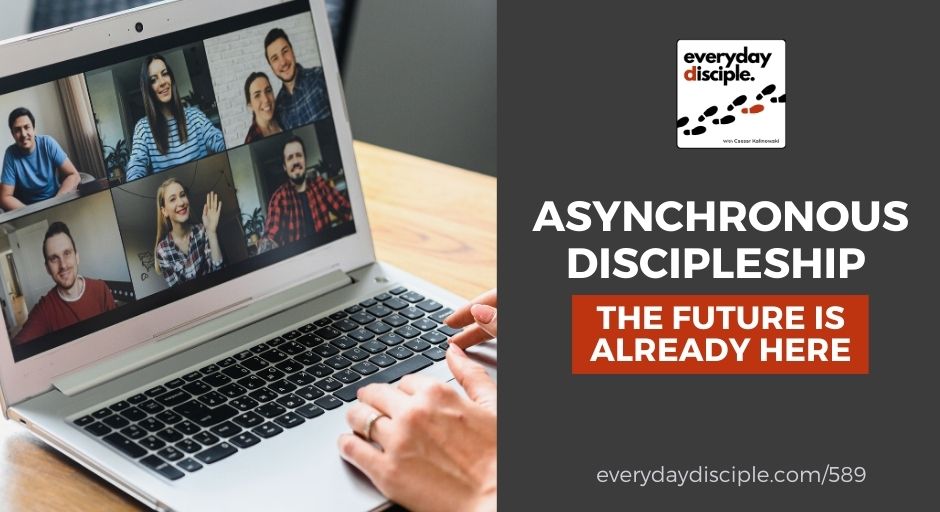
From this episode:
“I know there is some fear or pushback from certain people… It turns out that there are actually some pretty startling advantages to all of this.”
Each week the Big 3 will give you immediate action steps to get you started.
 Download today’s BIG 3 right now. Read and think over them again later. You might even want to share them with others…
Thanks for Listening!
Thanks so much for joining us again this week. Have some feedback you’d like to share? Join us on Facebook and take part in the discussion!
If you enjoyed this episode, please share it using the social media buttons you see at the top of this page or right below.
Also, please leave an honest review for The Everyday Disciple Podcast on iTunes. Ratings and reviews are extremely helpful and greatly appreciated! They do matter in the rankings of the show, and we read each and every one of them.
Links and Resources Mentioned in This Episode:
Coaching and Mentorship in Missional Living by Caesar and his wife Tina
Resources for missional living and group training – Missio Publishing
The Gospel In Everyday Life Workshop Register Now FREE

Transcript
And I know there's some fear or pushback from certain people.
Speaker:Often those who are not raised in the current online or social media and social connection times that we're living in.
Speaker:But they say that online relationships and interactions are not real relationships or that people online only.
Speaker:You know, they hide their real self and only show the parts of 'em they want you to see.
Speaker:But a few years back, pew Research conducted an extensive study on the debate over whether authentic relationships could be built and nurtured online.
Speaker:It turns out that there are actually some pretty startling advantages to all of this.
Speaker:Welcome to the Everyday Disciple Podcast, where you'll learn how to live with greater intentionality and an integrated faith that naturally fits into every area of life.
Speaker:In other words, discipleship as a lifestyle.
Speaker:This is the stuff your parents, pastors and seminary professors.
Speaker:Probably forgot to tell you.
Speaker:And now here's your host, Caesar Kalinowski.
Speaker:Hey, Heath.
Speaker:Good to be back with you, man.
Speaker:How's the week working out so far?
Speaker:It's good, man.
Speaker:We, uh, just beautiful day kids.
Speaker:Uh, we had a birthday of our, of our child, one of our, our, actually our oldest turned 11 last week.
Speaker:11. Are you kidding me, man?
Speaker:You know what's funny?
Speaker:How
Speaker:fast is 11 years going?
Speaker:I know.
Speaker:So fast.
Speaker:Wow.
Speaker:Uh.
Speaker:And it was so funny because I'm like, my son is like me.
Speaker:He is a sucker for infomercials.
Speaker:And so my 11-year-old boy who's an active soccer fan, active, I mean, you know my son, he's all energy.
Speaker:Yep.
Speaker:They
Speaker:all, you know what he, for his birthday,
Speaker:yeah.
Speaker:He wanted a My pillow.
Speaker:Oh yeah,
Speaker:that's it.
Speaker:That's
Speaker:all you want.
Speaker:We probably have extra ones around.
Speaker:Here am I, Tina got sucked into all that big,
Speaker:so do my 11-year-old son.
Speaker:I was like, buddy, you could have like a bike or aboard.
Speaker:Okay, I gonna say this about the MyPillow.
Speaker:Okay, I gotta say this about the, they actually are pretty comfortable once you get used to 'em.
Speaker:But here's the crazy thing, and they don't tell you this in the commercial.
Speaker:Whatever that fill is that special made in America a moldable fill.
Speaker:It's so wonderful.
Speaker:When I sleep on my MyPillow, my hair in the morning is sticking straight out like I've been, you know, like when you're a kid, you'd rub the balloon satic put,
Speaker:yeah,
Speaker:I, I'm not joking.
Speaker:Like I literally laugh in the mirror at my hair.
Speaker:Every morning's
Speaker:I
Speaker:this and I have a different pillow I kind of switch up and when I sleep on that one, my hair's just normal kind of bedhead.
Speaker:But on my MyPillow it's come.
Speaker:That is really funny.
Speaker:Isn't that weird?
Speaker:I'm sure everybody tuned in to hear about that.
Speaker:Anyway, so what
Speaker:He got a MyPillow.
Speaker:Hey, let's look at some reviews we got, man.
Speaker:Yeah, man.
Speaker:Let me cheer you up with two reviews.
Speaker:One of 'em is from To Live and Die in la, which I think is Lower, Alabama, which says The Everyday Disciple Podcast consistently offers foundational theological insights with a accompanying practices.
Speaker:That always leads me to new ideas for more effectively moving towards people.
Speaker:With the Gospel.
Speaker:It's a regular part of my Monday mornings, so,
Speaker:alright.
Speaker:Thanks to Live and Die in LA and then zero
Speaker:five stars too.
Speaker:Thank you.
Speaker:And then another five stars from zero two SK that says this is an excellent resource for inspiration to dig into.
Speaker:Jesus calls us to, I found this podcast after going through the Gospel primer with our community group and found it so real.
Speaker:These guys cover almost every topic you could think about.
Speaker:How to live life as a Disciple of Jesus, trying to Disciple others around you.
Speaker:Great stuff.
Speaker:So O2, sk.
Speaker:Thank you as well.
Speaker:Thanks for that.
Speaker:I wonder who that is.
Speaker:Okay, maybe jump on our Everyday Disciple Podcast group on Facebook's and uh, let us know who you are.
Speaker:O2 sk, probably know him.
Speaker:Yeah, if you, if you haven't subscribed to the various platforms that we're on, you can do that by going to everyday Disciple dot com slash subscribe and that'll open up a bunch options.
Speaker:There's
Speaker:a bunch, bunch of
Speaker:stuff there.
Speaker:Yeah.
Speaker:Well, today we got something special because we're using probably the biggest word that we've ever had in a show title.
Speaker:Asynchronous, right?
Speaker:We're talking about asynchronous discipleship, and, uh, we always find it helpful to kind of define definitions here so that we're all on the same playing field at the beginning.
Speaker:Yeah.
Speaker:So maybe let's define, uh, that word to get us started and make sure we're on the same page.
Speaker:But especially how it pertains to discipleship.
Speaker:Yeah, it Okay, I will.
Speaker:And asynchronous is not a word that, uh, most of us use in a sentence in any given day.
Speaker:That's right.
Speaker:And, and just in the course of kind of researching this and kind of writing down some of my thoughts, I had to type out the word asynchronous, like about a hundred times.
Speaker:It's not an easy one, bro.
Speaker:Yeah.
Speaker:No, that's not easy.
Speaker:Thank God for autocorrect, you know, in this case.
Speaker:But, uh, so here's what asynchronous means.
Speaker:Okay.
Speaker:Technically, and then I'll explain.
Speaker:It's like two or more interactions or events not existing or happening at the same time.
Speaker:Okay?
Speaker:Okay.
Speaker:Meaning something could be going on and you and I both participated in it, but not at the same moment.
Speaker:Or we both did something, but in different times it wasn't synchronized.
Speaker:It's asynchronous.
Speaker:Ah, right.
Speaker:So,
Speaker:yeah.
Speaker:Um, so in, in, in connection to discipleship, it means that, um, instead of us all have to be sitting at the same table, we're in the same circle in a living room or at the same building, you know, in a room, right.
Speaker:And watching the same video, or listening to the same speaker or whatever.
Speaker:What if we were to engage that?
Speaker:But at different times, and maybe even slightly different manners, but still engage it fully.
Speaker:Hmm.
Speaker:But asynchronously, in other words, not synchronized, it's like when I was a kid, uh, television was completely synchronous.
Speaker:Meaning if you wanted to watch Batman, it came on at a certain night, at a certain time.
Speaker:Boom.
Speaker:If you wanted to watch all in the family, you know, uh, so I'm dating myself, right?
Speaker:Or let, let's just jump ahead like friends, you know, or whatever, you know, or Seinfeld, it was on a certain time and a certain night.
Speaker:That's it.
Speaker:Was everybody in the country in the world watched it at the same time, on the same night it was synchronous.
Speaker:Hmm.
Speaker:And then you talk about it at work the next day or whatever.
Speaker:And then we started, you know, having.
Speaker:VCRs or you know, or Beta Max or whatever, right?
Speaker:And then eventually able to digitally record all this stuff and TV started to slip asynchronous, meaning, Hey, I watched that show, but I don't watch it on the night that they release it.
Speaker:We usually watch TV on.
Speaker:Fridays or, or whatever, right?
Speaker:Sure.
Speaker:And or you could say, Hey, a bunch of us friends are getting together to watch 24, but I went ahead and taped it or I recorded it and we're gonna watch it on this night.
Speaker:'cause that's when we're all available.
Speaker:So all of a sudden TV slipped to asynchronous.
Speaker:Okay,
Speaker:so what if discipleship.
Speaker:Which is the process of moving from unbelief to belief in every area of life, which includes learning, right?
Speaker:Mm-hmm.
Speaker:But it's not just about knowledge acquisition.
Speaker:We've talked about that a lot on, on the show.
Speaker:Um, what if we could start doing aspects of it, asynchronous.
Speaker:Meaning we could learn and even interact and give thoughts and ask questions, but we didn't all have to be in the same room at the same time.
Speaker:Or even now as people are experimenting with more online stuff, we didn't even have to be sitting in front of the screen at the exact same time.
Speaker:So that's what I want to talk about today, is the, the, there's really a value, I believe, and this is not actually new to.
Speaker:To everybody.
Speaker:Um, I remember the first time I heard that those two words put together asynchronous discipleship, and it was from my, my buddy Mike Breen.
Speaker:Okay.
Speaker:And we were both experimenting with various things and I was like, oh, I love that you've defined it because what if, you know, what if we don't have to do every bit of discipleship, uh, all sitting, you know, on a clock at the same, you know, but I, I'm not saying we can do the whole thing that way.
Speaker:Sure.
Speaker:Right.
Speaker:Because there's a life on life.
Speaker:Life and community.
Speaker:Life on mission aspect of the true discipleship.
Speaker:We talked about that last week a lot, right in the last episode about the, the need for a gospel community in community on mission together.
Speaker:But there are aspects now that we, I think, are wise to start to experiment with and introduce
Speaker:Yeah,
Speaker:asynchronously, uh, and through different means.
Speaker:Both live and online.
Speaker:So yeah, that's kinda what I want to talk about today.
Speaker:'cause I think we've, we get to, you know, and, and we've had great, actually great luck and benefit and blessing from that.
Speaker:And it's not brand new to us, but we're really starting to lean into it as a, as a family.
Speaker:And as you know, as we coach people and train people and all that.
Speaker:You know, it seems like this is actually the way we're seeing a lot of churches, uh, starting to stream their Sunday services, you know, and some of their folks engage or watch at different times.
Speaker:But it seems like that might be a, a, an example of asynchronous communication when it comes to the gathering of the church.
Speaker:Is that right?
Speaker:Exactly.
Speaker:Our Sunday services have moved from primarily synchronous, right?
Speaker:With everyone in the building at the same time, listening to the same music and sermon all at the same time.
Speaker:Um, even if you had different services, you still had to pick which one to go to, right?
Speaker:You know, and we all sat there and did it.
Speaker:Um, if you missed it, you missed it.
Speaker:Now people can engage or consume this service at a time and place.
Speaker:Of their own choosing.
Speaker:And I even have heard, you know, wink, wink, some people go, well, we, we've been tuning in to the stream, you know, of our church, so, sure.
Speaker:But, um, we actually don't tune in at nine.
Speaker:Uh, we like to sleep in a little now that we can and we don't feel guilty about it.
Speaker:And, uh, we fast forward through.
Speaker:Parts of it.
Speaker:You know what,
Speaker:yeah.
Speaker:So, you know, is that evil or is that okay?
Speaker:Is that maybe, uh, being a better steward of your time?
Speaker:I don't know.
Speaker:I mean, and I'm not here to determine that for everyone, but you're right.
Speaker:I think that some, in some ways with maybe even without knowing it, uh, a lot of churches have started to, uh, experiment with asynchronous aspects of their ministry.
Speaker:And I would assume that like.
Speaker:With this change, there's probably some, both good and bad implications of this, right?
Speaker:I think so.
Speaker:Yeah.
Speaker:'cause there again you, you know, if we don't have any way to uh, sort of ensure that the family is engaging ever because it's asynchronous, then maybe that's not great.
Speaker:Right?
Speaker:Sure.
Speaker:Or if it's not done well.
Speaker:'cause we're gonna talk about this.
Speaker:I think there's good ways to do asynchronous and online and.
Speaker:Bad ways, just like live, you know?
Speaker:Sure.
Speaker:There's good training and teaching and preaching and there's not so good.
Speaker:Right.
Speaker:But, uh, I think there's aspects of it that it's actually an advantage because I think we can, and I think we're probably seeing a little bit of this even, you know, with participation in our gatherings through, you know, the fact that more and more and more streamed, it's like some churches are telling me like, I think we have more people engaged than before too.
Speaker:Because it used to be if they were busy or wanted to go golfing, or it's like the only day it didn't rain.
Speaker:So they're working on the yard, they missed the whole thing.
Speaker:And so that's why, you know, we see 'em 1.7 times per month, an average Christian or something that comes to, you know, a service.
Speaker:Yeah.
Speaker:But now we feel like, you know, we're kinda looking at the streaming numbers now, that's not for everybody.
Speaker:I know some churches are knocking outta the park and some are going, uh, no one's tuning in, you know?
Speaker:Sure.
Speaker:And whatever.
Speaker:But I think that they are, and I think there's both good and bad.
Speaker:Implications, uh, of for how we do this and how we get to do this?
Speaker:For sure.
Speaker:Yeah.
Speaker:So like when it comes to discipleship, the way that we teach and model this is a lifestyle, right?
Speaker:We say that, that, yeah, that discipleship is a lifestyle.
Speaker:Would true life on life discipleship actually be able to happen asynchronously and for that matter, even online or, or not even face-to-face at all?
Speaker:You know?
Speaker:I really do believe it can.
Speaker:I, I do, I think that, I think that life on life and lifestyle can, because think about how, how much of a life's part of our lifestyle now, our phones have become, I, I don't know what the, uh, exact, uh, statistic is, but it's something like.
Speaker:85% of North Americans, or maybe it's 90 or something like that, are never more than three feet away from their phone at all times.
Speaker:24 hours a day or something like that.
Speaker:Geez.
Speaker:It's some crazy number.
Speaker:And, but when I've heard it, I go, yep, sounds about right.
Speaker:You know what I mean?
Speaker:Yeah.
Speaker:Like, 'cause you know how it is, it doesn't even matter if you're using, it's like, where's my phone?
Speaker:Where did I put my phone?
Speaker:Right.
Speaker:Sure.
Speaker:And those phones aren't phones anymore.
Speaker:It's funny 'cause we call it a phone.
Speaker:It's really a computer that also does some phoning and I hate when it rings, you know what I mean?
Speaker:But I love it.
Speaker:I love using it for most everything else.
Speaker:And I love my laptop even more, you know?
Speaker:'cause it's got a bigger screen and I'm old.
Speaker:Right,
Speaker:right.
Speaker:So I really do think though that, that this ability to engage in content and even interact with some of my friends and community.
Speaker:Asynchronously knowing not at the same time, um, has already become part of people's lifestyle, but it hasn't necessarily been embraced in to a full degree with, within discipleship.
Speaker:Right.
Speaker:Okay.
Speaker:But think about it.
Speaker:Almost no.
Speaker:Well, I, I know some people are listening go, like, I hate all those things.
Speaker:I don't use any social media.
Speaker:It's like, I get it.
Speaker:But you, you could, you know, but think about like, generally when you look at Facebook, you're not looking at it like, I have to be watching just in case, you know, Caesar starts typing in something.
Speaker:You know exactly like, no, you later on, you know, whenever like you're laying around, the kids are in bed, or well, you got a minute 'cause you're waiting for the guy to come out and tell you your, you know, your muffler got replaced or whatever, you know, and you look at your Facebook and you go, ding, there's a couple of notices there And go, oh, Caesar posted something.
Speaker:What's he got going?
Speaker:Oh, he answered that guy.
Speaker:Yeah, I was gonna too, you know, it's asynchronous.
Speaker:And same with Twitter and same with Instagram.
Speaker:And all kinds of stuff.
Speaker:Right?
Speaker:And so I think it's already become part of a lifestyle, meaning it's part of our relationships.
Speaker:Yeah.
Speaker:And um, I, you know, I know there is some fear or pushback from certain people, you know, often those who are not raised in the current online social media and social connected times that we live in, right?
Speaker:And they say that online relationships and interactions, they're not real relationships.
Speaker:But, but yeah, I guess if I joined a chat group or something with a bunch of strangers, maybe, but most people engage.
Speaker:Socially asynchronously with people they know and maybe they meet new people, right?
Speaker:Sure.
Speaker:But it's not just, you know, stranger Fest for most people.
Speaker:You know what I mean?
Speaker:Yeah,
Speaker:you're right.
Speaker:Right.
Speaker:And, and people think, well, they're not real relationships.
Speaker:People can, you know, hide their real self.
Speaker:They only showed the parts of them they want you to see, you know?
Speaker:But you know what, a few years back, pew research was huge.
Speaker:They conducted a, a pretty extensive study.
Speaker:On this debate over whether authentic relationship could be built and nurtured online.
Speaker:Okay.
Speaker:And it turns out there's some pretty amazing, some startling stuff like the survey found that the internet has the opposite of an isolating effect on most users.
Speaker:Wow.
Speaker:They report that like email has helped people improve their, you know, social relationships and expand their social networks.
Speaker:And in general, internet users, people who frequent it, it's part of their life, uh, have robust social lives, in fact, more robust than non-users.
Speaker:Because why?
Speaker:Because they stay connected more often.
Speaker:So it's not like, you know, it used to be how often do you talk to your sister that lives, you know, like six.
Speaker:1500 miles away.
Speaker:Well, you know, I write her and then, you know, she gets the letter about a week later, two weeks later, and then she gets around to writing me back.
Speaker:And it can be a few interactions a year, you know?
Speaker:Sure.
Speaker:Or your friends if like, if I don't see them at church or I don't make an appointment to see them, I really don't connect.
Speaker:Yep.
Speaker:People who are pretty used to now and or choosing to engage in social, some of the social stuff, they're like, I don't know.
Speaker:I talk to my friends all the time.
Speaker:I was looking at my own, um.
Speaker:Just my text, you know, app.
Speaker:Sure.
Speaker:You know, messages in my phone the other day, maybe it was this morning and I was like, oh, I gotta, I gotta text Heath, so let me scroll down.
Speaker:Like, it was just like, gotta be like one or two down.
Speaker:And you and I talk all the time.
Speaker:Yeah.
Speaker:And text all the time.
Speaker:And Facebook all the time.
Speaker:And All right.
Speaker:Yeah.
Speaker:I was like, scroll, scroll, scroll, scroll.
Speaker:Oh, there's Heath, and, and it was yesterday, but it was like, oh my gosh, look how many people I've just touched base with said hi.
Speaker:Answered a question, checked in on,
Speaker:yeah,
Speaker:sent something funny.
Speaker:I think you find you love this song.
Speaker:You know what I mean?
Speaker:Yeah.
Speaker:It's a lot more than some of us think and, and people routinely are integrating, you know.
Speaker:Like social and, and asynchronous forms of communication with each other a lot.
Speaker:And they move between their phone, the computer, in person, almost effortlessly without thinking about it.
Speaker:Like, were you and I talking about that?
Speaker:Or did you text me that?
Speaker:No, I sent you that link, but then when I saw you, we watched it again.
Speaker:We were laughing our guts up, you know?
Speaker:Right.
Speaker:Yeah, exactly.
Speaker:It's all right.
Speaker:And so.
Speaker:It's not as scary, I don't think.
Speaker:And in fact, I think there's a lot, there's a lot going on there that we get to embrace instead of just go, well, it's part of life, but it's not part of discipleship.
Speaker:I it, you know what?
Speaker:And as someone who has kind of embraced it, it it is and it's, I like it actually.
Speaker:I like it.
Speaker:And I think it, it helps us, um, move beyond.
Speaker:They're like, well, everyone's too busy.
Speaker:Well, they're too busy to fit on your schedule, but maybe they're less too busy if they could access some aspects of our community life.
Speaker:Like that, you know where it fits in.
Speaker:Right.
Speaker:So,
Speaker:dude, that's really a great, great point.
Speaker:I was noticing yesterday, I was talking to a guy who I used to tour with, I mean 10 years ago and we haven't really caught up.
Speaker:Occasionally we'll text, but it just was so much easier to go, Hey, what about next Monday?
Speaker:You wanna get on Zoom?
Speaker:You know, kids are in bed.
Speaker:Let's, I haven't seen you in 10 years.
Speaker:Let's talk.
Speaker:And so there's a lot more of that actually happening.
Speaker:And I've talked to a lot of people, Heath, who say the exact same thing.
Speaker:Like Tina and I, we've done a ton of virtual.
Speaker:Meetups and virtual happy hours with people and all that stuff.
Speaker:And I've talked to a lot of people say, my personal interaction with both neighbors and new friends and old friends way up in the last two months.
Speaker:Great.
Speaker:It's good, but let's be, let's be proactive about it.
Speaker:Let's be intentional about how we use that, right.
Speaker:As the church and as, I mean, and by the church, I don't mean like organizationally, I mean as the people of God, God's family we get to.
Speaker:Yeah.
Speaker:Well, let's talk about how this actually, uh, meshes well with Disciple making, because I'm kind of curious, what are some ways that you have seen.
Speaker:Or even have, maybe have been using asynchronous learning and discipleship and training both in person and online to be, to be effective during this current situation.
Speaker:Yeah.
Speaker:Great.
Speaker:And it's, and it's not even just currently, but I'm learning too.
Speaker:I'm, you know, we're, we're kind of failing forward in some new stuff, right?
Speaker:Yeah.
Speaker:But I'm actually suggesting.
Speaker:Is that savvy leaders who grasp this amazing opportunity that the recent change in our social lives and schedules has provided that really wanna embrace a mixture of synchronous Okay.
Speaker:Stuff we do at the same time.
Speaker:'cause, you know, it's life and life, um, asynchronous and, and maybe some hybrid mediums in their discipleship today, both in person and online.
Speaker:So let me just kind of like, I'm kind of thinking out loud here.
Speaker:Because it's a lot of, it's new, but I'll give some real examples of actual things we're doing.
Speaker:But, so here, first sort of category in my brain is it's live in person or online, but it's micro.
Speaker:Okay?
Speaker:Mm-hmm.
Speaker:So instead of thinking like, well, you know, we wanna do this with our people, so we gotta get everybody to do it.
Speaker:Sure.
Speaker:Well, here's the beauty of this asynchronous stuff, and, and, or even if it is synchronized, but think micro meaning segmented by stage of life or particular needs.
Speaker:Okay.
Speaker:Or like, especially with your leaders, you know, think about, you know, I don't know if I can do a whole giant training like we wanted to, but I bet I could get these eight or these 20 leaders, you know, to line up their schedules and we're gonna do some training.
Speaker:Sure.
Speaker:Right.
Speaker:So, um, I think also kind of to extend that line of thinking now is the time to be moving volunteers, quote unquote, uh, in the church to leaders.
Speaker:Think of them as leaders of little dispersed micro communities and discipleship groups.
Speaker:You know, let them try new things and take ownership of things that they're passionate about.
Speaker:They get to, you know what I mean?
Speaker:Yeah.
Speaker:So you got people that have a passion around this area of life, or homeschooling or parenting or how the gospel applies to marriage or whatever.
Speaker:Go for that.
Speaker:Sure.
Speaker:Let 'em do it.
Speaker:And, and maybe because, well, they're doing it at nine o'clock at night or eight 30 at night when all the, you know, uh, parents are available, great.
Speaker:Then let 'em own that.
Speaker:But I think too many leaders think of anything I have to introduce, I have to do.
Speaker:And, and I'm, and I'm just so busy and I've heard a lot of guys go, I'm so busy.
Speaker:I'm online all day doing stuff.
Speaker:Well, don't, like, it's time to, this is like never before handoff.
Speaker:Sure.
Speaker:And start thinking of your quote volunteers as, as leaders of dispersed micro communities, you know?
Speaker:Yeah.
Speaker:And, and they're not forever.
Speaker:They might be for six times or four times.
Speaker:For the next three months, or who knows?
Speaker:Right.
Speaker:Um, our own coaching cohorts utilizes a hybrid of online and in-person and synchronous and asynchronous tools.
Speaker:It's like we use Voxer, you know, to stay connected like daily with all our folks.
Speaker:It's asynchronous.
Speaker:People are leaving messages from all over the world.
Speaker:We're sleeping.
Speaker:My phone doesn't make a noise till after a certain time in the morning.
Speaker:I'm just set it to do that.
Speaker:Right?
Speaker:Yeah.
Speaker:Then I get up and I take a look and I scroll through some of 'em and I, some of 'em I read, some I hear and I leave a few messages, stuff like that.
Speaker:There's videos.
Speaker:If you can't make a live call, you can watch it later, drop an email.
Speaker:So it's a hybrid, but it that what that's done is that's allowed more people to engage it, not less.
Speaker:Yeah,
Speaker:exactly.
Speaker:And it takes all the pressure off of me.
Speaker:It's like if I wanna, if I wanna have this, this, and that happen.
Speaker:I have to make sure everybody's on at the exact same time, or it won't ever, I'll give you an example.
Speaker:Uh, we were on a coaching call yesterday and I got through this whole thing and some people didn't make it and, and they'd already texted in, Hey, can I get the link to that live?
Speaker:Yep.
Speaker:It's right there where it always is.
Speaker:You can watch that.
Speaker:Um, but I forgot to give out the homework.
Speaker:I guess like normally if you had like everybody showing up at the church building and you forgot that part of it, you know?
Speaker:Yeah.
Speaker:You know, it'd be like, oh dang.
Speaker:Right.
Speaker:All I did was pick up the Voxer went, boop, ah, forgot to tell you this.
Speaker:Let me know you heard it and that you're on it, and over the next like six hours.
Speaker:And then when I woke up, there was a few more.
Speaker:I got everybody going.
Speaker:Yep, got it.
Speaker:Heard it on it, did it already.
Speaker:You know what I mean?
Speaker:Yeah.
Speaker:So there's, there's this.
Speaker:Like micro aspect to it.
Speaker:Uh, both either live in person or online and it's asynchronous, but it's also hybrid.
Speaker:So blood, I want people to think through ways they could do it.
Speaker:DNA groups, you know, which we have had in community for years.
Speaker:Sure there are three or four people.
Speaker:Um, you can do that in person.
Speaker:That's how we started doing them.
Speaker:But I started noticing when, 'cause I travel a lot, I don't wanna miss my DNA with my guys, man.
Speaker:You know, it's weekly.
Speaker:Yeah.
Speaker:I just.
Speaker:I just bomb in versus, uh, via Skype or Zoom or something.
Speaker:Right?
Speaker:Yeah.
Speaker:Um, specific trainings done live, but made available to others.
Speaker:You could stream 'em live a, you know, but then peoples can watch it when they want to asynchronously.
Speaker:But here's where I say there's a difference between doing that and going, man, I don't know if anybody did it.
Speaker:Sure.
Speaker:We'll close the loop with people.
Speaker:Meaning, um, ensure that key people have engaged it because you've given 'em homework and they have to do it and send it to you, right?
Speaker:Yeah.
Speaker:And they'd say, Hey, listen, you know, by Saturday, I'd really love to hear back from you all of your thoughts, what you thought of the video.
Speaker:Answer these few questions.
Speaker:Then, you know, they have, they've engaged it.
Speaker:I mean, that's how we did the, uh, everyday Disciple challenge, right?
Speaker:A few weeks ago in the workshops, it was on live four times.
Speaker:That week, and then I did a few bonuses, right?
Speaker:Well, not everybody could make it at 11:11 AM Pacific, but they watched it later and I could tell who was engaging consistently because we did homework posts and I gave out some prizes for people, right?
Speaker:And I, I used online interaction that way, asynchronously.
Speaker:But some people were doing it live right while I was on asking questions.
Speaker:And we answered, some left their questions, some sent me emails or messages, see how it's hybrid.
Speaker:Yeah,
Speaker:but it was super effective.
Speaker:Oh my gosh.
Speaker:So many thousands of people got to engage it.
Speaker:Sure.
Speaker:But I, I was online about a half hour a day doing it, and then, but answering the messages and stuff, yeah.
Speaker:But when I had time, see, it wasn't like, okay, I gotta do it on their dime.
Speaker:They weren't expecting like, I hit send, like, you better answer me.
Speaker:Like right now, no.
Speaker:Maybe the next day they got an answer.
Speaker:It was all good.
Speaker:That's
Speaker:so good.
Speaker:Right?
Speaker:And isn't it crazy how technology is a, I mean, it is a, I know so many people that look at it as kind of this like, well, it's the next thing to distract people from the faith.
Speaker:And you're like, no, if you actually utilize it, well it, this has potential the beast,
Speaker:the internet
Speaker:much more.
Speaker:Yeah,
Speaker:yeah,
Speaker:yeah, yeah, yeah.
Speaker:No, I don't think so.
Speaker:So here's another category, right?
Speaker:Prerecorded stuff.
Speaker:Okay,
Speaker:so you record it at your own leisure, right?
Speaker:Or, or you type it out and send it to folks you know, and, and, and that could either be micro or macro.
Speaker:It could go to the whole, you know, congregation or it could go just to leaders, or it could go just to people in your community group or whatever, right?
Speaker:With an online discussion, live later.
Speaker:Hey, I'm gonna send this out on Mondays and then, um, uh, on, on Wednesday night at, you know, uh, at five o'clock and then Thursday at like nine o'clock I'll be on and we can discuss it.
Speaker:So whatever time works for you,
Speaker:Hmm.
Speaker:Right.
Speaker:That's great.
Speaker:And I'll make those available as well.
Speaker:So if you can't, you can even watch the discussion and then we'll have a private Facebook group and you can drop in some stuff there.
Speaker:By the way, that's where I'm gonna be doing it, so I don't even have to record it.
Speaker:It'll just be recorded in the group.
Speaker:Dig it.
Speaker:Yeah, that's
Speaker:cool.
Speaker:Um, I had a buddy of mine, Brandon Hatmaker.
Speaker:He said the most like engaged bible study he ever did was he would send out a pre-written outline of scripture reading they were gonna do.
Speaker:So like they would pick a book, let's say.
Speaker:Break it into an outline.
Speaker:You can find every book of the Bible, a thousand outlines on online.
Speaker:You know, just go look.
Speaker:Sure.
Speaker:Right.
Speaker:And then all the guys who engaged it, they agreed to read the daily reading and then within the next 24 hours, so before the next day, they would post their thoughts and observations like, and I think they just did it in an email thread.
Speaker:It was nothing fancy.
Speaker:And I think maybe they eventually moved it to a Facebook group and he said, so.
Speaker:Some guys got up real early and then boom, you know, by the time I woke up, they had their reading and they had the, here's, ah, this is weird to me, or I, you know, it made me think of this, or This is what God spoke to me or what, or, I have a question about that.
Speaker:But before they all went to bed, they agreed to do it and he says, man, it was a high level of engagement.
Speaker:We, we learned a lot and grew a lot and.
Speaker:You know, but it, it fit into everybody's life in the time that it worked in their day.
Speaker:But it was daily.
Speaker:So instead of even a weekly Bible study, it was a daily Bible study, but, and think about how many touches and interactions you have, and then side comments that came up and side like, I mean, I don't wanna call and talk to you about that.
Speaker:You get to right.
Speaker:Absolutely.
Speaker:Um, some of the folks from three DM and the, and the Brains again, they have the Michel Institute.
Speaker:Now they're doing, you know, uh, their huddles and teaching via video in those huddles.
Speaker:Right.
Speaker:With the ability for people to log in though and watch that at their own convenience.
Speaker:And they can even leave little video comments and questions in the group.
Speaker:So it'd be like, you know, you'd log in, I did a little training and go like, Hey, I just watched this.
Speaker:Here's my thoughts.
Speaker:This is what I'm thinking.
Speaker:And then the leaders then, or other people in the group, they can not only watch the training, but everybody else's video messages and respond at their own.
Speaker:As long as they know it's by, by next week, I want you to have done that.
Speaker:And so you can log in a day early and go, Hey, I noticed you didn't, you know, get on yet.
Speaker:So try to tighten that up, you know, so a little bit of accountability, but it's not like I had to check it every five minutes.
Speaker:No.
Speaker:Yeah.
Speaker:Loads of interaction without the hassle aligning everyone's schedule.
Speaker:And you could, you can pretty much do that all online, you know, like a Facebook group, you know what I mean?
Speaker:Yeah.
Speaker:Like it's, there's so many easy peasy ways to do that now.
Speaker:You know, it's crazy.
Speaker:I remember like when I was doing a, working in the the institutional church and it was.
Speaker:It was like, well, how do we do this membership class and we gotta do food and babysitting and it's maybe they took four Saturdays, four eight hour days on Saturdays for a month, and then they're members, right?
Speaker:And I'm like, guys, there's so many easier ways to do this.
Speaker:Like, what if you made, what if you made it digital where somebody can do it once their kids go to bed and they, what if
Speaker:they don't pay attention?
Speaker:And I don't know, they listen.
Speaker:If they care, they're gonna do it.
Speaker:Exactly.
Speaker:And if they don't show at all, 'cause your Saturday morning thing is when the only time they have a day off or whatever, you know.
Speaker:Exactly.
Speaker:Then you're not gonna see 'em ever and there's no option.
Speaker:So it's like, well I guess next time, next month or next quarter or next year when we do it again.
Speaker:Right.
Speaker:Yeah.
Speaker:Here's the other thing, and I was talking about, you know, like starting to really engage more quote unquote volunteers to let them manage things.
Speaker:What about like a recurring online community with hosts?
Speaker:So like people in your.
Speaker:Church or mean you could do it too.
Speaker:Leaders can do it, but I mean like why not hand this stuff out where they have a topic that they just dig and they really feel like versed in and they're gonna start an online community just to get together and discuss that.
Speaker:Like a book study, like I was talking about, a Bible study or maybe, hey, we're gonna read a book together and we're gonna discuss it and, and myself and this other person's gonna host it.
Speaker:I can't make it every time.
Speaker:They can't make it every time.
Speaker:But one of us will.
Speaker:You know, or like we talked about in our last episode, going through the gospel primer or TK primer together and someone's hosting it, right?
Speaker:And, uh, you know, we got on, we talked through some stuff together.
Speaker:Hope you can make it live, but if you can't, it'll be there.
Speaker:Just leave your comments and thoughts, you know, in the next couple days.
Speaker:Sure.
Speaker:Or maybe you're doing, uh, uh, an online community on parenting in light of the gospel or a set of marriage classes with discussions or your recovery group.
Speaker:Why not?
Speaker:Yeah.
Speaker:You know, now I think that this is where like gospel fluency would be critical.
Speaker:You want hosts that aren't just moving info, but are, you know, able to maybe help people move from unbelief to belief.
Speaker:That's the point of discipleship, right?
Speaker:But think about it, if your community, you know, think about how many people say, well, you know, we kind of have a Missional Community, but it's kind of just a weekly meeting.
Speaker:Well, what if even in the future, hey, our lifetime is spent really being in each other's lives and having fun with our kids and having meals and praying for one another and you know, laughing and all that stuff.
Speaker:And some of our learning though, is all these things that we've been talking about.
Speaker:And so we've got two or three other things, the rhythms that people can engage in based on their interest and need and time, but it, they can fit it into their own schedule.
Speaker:And so that once a week, we don't even, it's not about learning, it's about being family.
Speaker:Just for instance, I'm saying, right.
Speaker:So I, I think, I think if people can embrace both, uh, asynchronous and synchronous online and face-to-face, even now, you know, in microwaves and all that, I think they're gonna realize that the vistas for, uh, discipleship and Disciple making and passing it on, and the amount of people that can be involved in leading these kind of things.
Speaker:It's like, it's so much bigger right now and I think the top has been popped off and people are willing to and actually liking it, you know?
Speaker:Yeah.
Speaker:You know, I hope, I hope that's the case.
Speaker:'cause I see a lot of, I have a, you know, I see a lot of pastor friends and I have a buddy who is a pastor of a church of almost 30,000 people in Texas.
Speaker:And his whole, his whole thing is like, can't wait to be back together where we don't have to do this anymore.
Speaker:And uh, and I hear a lot of pastors talking like that, and I'm like,
Speaker:I'm guessing though, that's not a Disciple focused church.
Speaker:Yeah.
Speaker:It's a, it's a gathering, worship, gathering, focused church again.
Speaker:Yeah.
Speaker:People in the room.
Speaker:What we're talking about here today is for those people in churches and leaders that are really, they wanna be Disciple making focused, which is the only mission Right.
Speaker:That Jesus gave
Speaker:us.
Speaker:Yeah.
Speaker:That's why I say, that's why I think like, take advantage of this time and let it actually like influence the way that we move forward and navigate the future.
Speaker:Absolutely.
Speaker:I hope so.
Speaker:We are.
Speaker:I love it.
Speaker:I, I, I'm, I love it, man.
Speaker:I love it.
Speaker:Well, let's get to the big three because, uh, we always wanna leave people with big three takeaways from today's topic, where if nothing else, uh, things we don't want people to miss.
Speaker:And you can get this as a free download by going to everyday Disciple dot com slash big three.
Speaker:That's everyday Disciple dot com slash big three.
Speaker:So what would you say the big three are for this week?
Speaker:Alright.
Speaker:Uh, first thing I I, it's not a forsaking of the gathering of saints.
Speaker:Right.
Speaker:You know, scripture talks about don't forsake the gathering of saints.
Speaker:Yep.
Speaker:It's not a forsaking of that when we gather online or even asynchronously.
Speaker:Okay.
Speaker:That's good.
Speaker:God has given us new ways and tools to connect as humans throughout history.
Speaker:And we can embrace these things.
Speaker:We didn't used to have cars, but people would eventually got cars and could, you know, do things right.
Speaker:You know?
Speaker:Yeah,
Speaker:exactly.
Speaker:And we got, we got radio, oh my gosh.
Speaker:And then TV and all that.
Speaker:So stop seeing the internet either as an enemy or as only a way to stream your old programs in preaching.
Speaker:Many people today could not even imagine how their relationships would suffer if they didn't have things like Facebook and Snapchat and Instagram or Twitter to stay connected with friends and family throughout the day.
Speaker:Embrace that for the sake of the gospel.
Speaker:Yeah, that's good,
Speaker:right?
Speaker:It's, it's, it's part of life and it's not evil.
Speaker:Twitter's not evil.
Speaker:Facebook's not evil.
Speaker:What we do with it can, you know, can be awesome.
Speaker:Yeah.
Speaker:Second thing, number two, the kingdom of God moves at the speed of relationship.
Speaker:Probably heard me say that before.
Speaker:Oh yeah.
Speaker:Building trust with others, whether it be in person or online or asynchronously or at the same time.
Speaker:But building trust is key to making disciples of Jesus.
Speaker:So removing any barriers to the growth of these relationships is honoring to God.
Speaker:Yeah.
Speaker:Ask the Spirit.
Speaker:Ask the Holy Spirit to help you move past your own preferences or past experiences or traditions, and start to engage in new forms of discipleship.
Speaker:Love that man.
Speaker:Love that.
Speaker:Alright, number three.
Speaker:Number three.
Speaker:Um, this is sort of like the rubber hits the road, part of the three always, uh, head, heart, hands.
Speaker:Sure.
Speaker:This one's the hands.
Speaker:Pick one or two new asynchronous or hybrid models to try out in your discipleship mix this week.
Speaker:Just pick one or two things to try.
Speaker:Right.
Speaker:You know, we're not porn cement here.
Speaker:And don't forget to empower more and more of your quote unquote volunteers.
Speaker:You know, your, your family, the church.
Speaker:Yeah.
Speaker:To take initiative and ownership of new types of online and asynchronous communities within your larger church body.
Speaker:Give permission for people to lead and Disciple others in areas of their lives that they're mature in and have passion for.
Speaker:How awesome will that be for you?
Speaker:Even as things progress back to a new normal and we're all getting to gather up and worship and sing our guts out and all, but imagine if, but now there's all these other ways that discipleship's happening and people are more engaged and more connected than ever.
Speaker:You know what's, as you were just saying that too, I was thinking about how beneficial, we've talked a lot on the on, on the show in the past about really allowing youth and children to help lead us and man, this would be a really great area for us to look towards some of the younger people in our communities and go Totally agree.
Speaker:Hey, you guys get tech.
Speaker:Teach us like we wanna learn from you.
Speaker:And they'll say, I mean, they have apps and all that.
Speaker:We don't even know if my kids are coming up with stuff I've never heard of that could read.
Speaker:Be kidding.
Speaker:Beneficial.
Speaker:Yeah.
Speaker:Yeah.
Speaker:Pull on your kids during this time.
Speaker:No kidding.
Speaker:Alright, this
Speaker:big three, man, those again are available as a free download, but to everyday Disciple dot com slash big three.
Speaker:Alright, and that is it for today, my friend.
Speaker:Okay buddy.
Speaker:Thanks for joining us today.
Speaker:For more information on this show and to get loads of free discipleship resources, visit everyday Disciple dot com.
Speaker:And remember, you really can live with a spiritual freedom and relational peace that Jesus promised every day.