
What Makes a Community Feel Like Family
Most church Small Groups follow the same pattern — ya meet, do the study, go home. And after a while, something starts to feel hollow. Not fake, not wrong, just… thin. Like it should be more than this. If that’s where you are, this episode is going to name something you’ve been feeling.
In this episode of the Everyday Disciple Podcast, we’re going to redefine what a missional community is actually supposed to be and do together — and it’s simpler than you think. Not more programming. Just a different posture: living like a family with organized and organic rhythms that make room for real discipleship and real life together.
In This Episode You’ll Learn:
- A clear biblical definition for what a missional community actually is
- What the real mission of a missional community has always been
- The organized and organic rhythms that turn a group into a family
- 6 natural rhythms any MC can adopt right now that fit every context
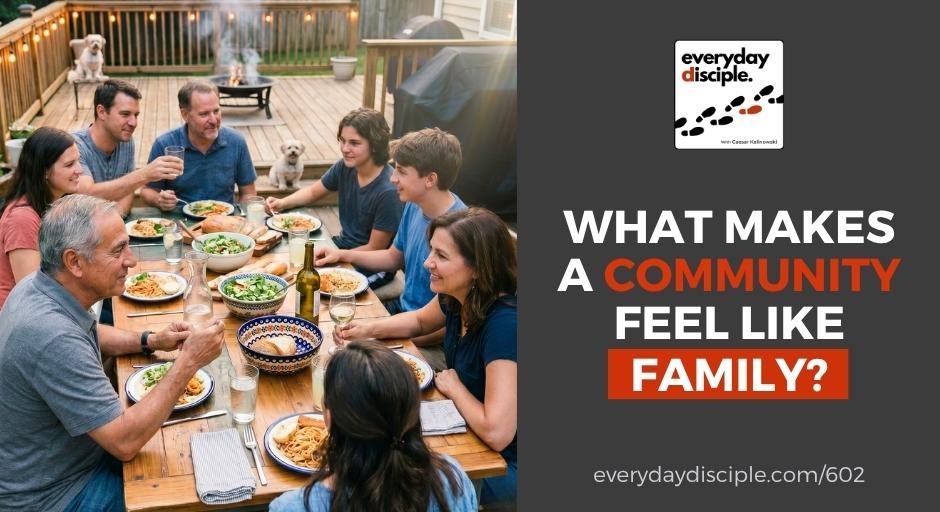
From this episode:
“Structuring your missional community life and time like a family with family rhythms takes into account the needs of everyone. A few organized family rhythms will perpetuate and facilitate numerous organic opportunities to BE a family and do a lot of normal life stuff together. Don’t over-complicate things!”
Each week the Big 3 will give you immediate action steps to get you started.
 Download today’s BIG 3 right now. Read and think over them again later. You might even want to share them with others…
Thanks for Listening!
Thanks so much for joining us again this week. Have some feedback you’d like to share? Join us on Facebook and take part in the discussion!
If you enjoyed this episode, please share it using the social media buttons you see at the top of this page or right below.
Also, please leave an honest review for The Everyday Disciple Podcast on iTunes. Ratings and reviews are extremely helpful and greatly appreciated! They do matter in the rankings of the show, and we read each and every one of them.
Links and Resources Mentioned in This Episode:
Coaching and Apprenticeship in Missional Living w/ Caesar and his wife, Tina
Resources for missional living and group training – Missio Publishing
Get Caesar’s latest book: Bigger Gospel for FREE… Click here.


Transcript
What does your family do?
Speaker:You're like, "Okay, way too many things- Yeah ... over time to even list," right?
Speaker:That's what life in a Missional Community is gonna be like, too.
Speaker:You're gonna do all kinds of stuff together that normal families do.
Speaker:Yep.
Speaker:Eat, play, fight, forgive, watch movies, learn stuff, study, maybe go and worship together.
Speaker:You're gonna serve each other.
Speaker:You might go on vacation.
Speaker:You might go on trips together.
Speaker:Yeah.
Speaker:Y- you might just hang out and do nothing.
Speaker:You might cry.
Speaker:You might pray.
Speaker:You might hold each other.
Speaker:You might go and serve a friend of a friend that you don't even know because they're dear to this person, right?
Speaker:Yeah.
Speaker:All that stuff that normal families do is gonna start happening in Missional Community life.
Speaker:Yep.
Speaker:Not like a light switch.
Speaker:Over time, just like, you know, families change and grow.
Speaker:So I, I, uh, this is, these are helpful handles that I, that I was taught.
Speaker:Just like in a normal family, you have organized activity- Yep
Speaker:and you have organic activity.
Speaker:Welcome to the Everyday Disciple Podcast, where you'll learn how to live with greater intentionality and an integrated faith that naturally fits into every area of life.
Speaker:In other words, discipleship as a lifestyle.
Speaker:This is the stuff your parents, pastors, and seminary professors probably forgot to tell you.
Speaker:And now, here's your host, Caesar Kalinowski.
Speaker:Thanks a lot.
Speaker:Thanks for rubbing that in.
Speaker:What- You're in a bit of a turn today.
Speaker:What, what happened, man?
Speaker:I, we didn't do a vacation.
Speaker:It's been a- Okay?
Speaker:I don't know if we've talked about this.
Speaker:We should do an episode of work from rest.
Speaker:Sure.
Speaker:But Kina and I try to calendar out our vacation and sort of just hanging out time and rest- Yeah
Speaker:before we say yes to speaking gigs and, you know, all kinds of work and writing books and all that.
Speaker:Sure.
Speaker:Try to work from rest.
Speaker:And, uh, so yeah, our last vacation just got kapoofed.
Speaker:It just- Hmm ... yeah, didn't happen.
Speaker:It was just so much probably sinful- Yeah ... unbelief in my own heart.
Speaker:I would just, you know ... And I, we were just like, "Nah, we're just, we're staying home.
Speaker:We'll stay home, and maybe we'll do a, you know, this or that." And so we did a little bit of, you know, day trippy kinda stuff and, but not ... Yeah, I don't know.
Speaker:But- Yeah ... thanks a lot.
Speaker:Thanks for bringing that up.
Speaker:How was yours, man?
Speaker:Yeah, you know, I'm actually supposed to go on one next week, and, uh, we got rid o- we sold it.
Speaker:Like, we have this property, and we, we decided to sell it off, and so we made all our money.
Speaker:So we're just gonna stay home, but we made money off of it, so.
Speaker:All right.
Speaker:I didn't
Speaker:sell anything.
Speaker:I made nothing, and I still wanna go to Hawaii, so.
Speaker:You know where I wanna go?
Speaker:I wanna go to England again because, you know, I have a passion for England, and- Mm-hmm.
Speaker:Mm-hmm ... speaking of England, Karen Flowers from- Nice connection ... the UK- Yeah ... wrote a nice review where she says, uh, "I love these podcasts so much. They really speak life into so many everyday situations. The range of topics is diverse, and I love the casual manner in which these guys bring big ideas into the living room."
Speaker:As it were As it were ... the way she would say it, I would, uh, suppose She said
Speaker:living room too, so I don't know.
Speaker:That's nice.
Speaker:They call it that over there in the UK.
Speaker:Thanks, Karen.
Speaker:Uh, we're gonna keep being casual guys that bring big ideas into your living room- Yeah.
Speaker:Here's what you get ... with a cup of tea.
Speaker:You get what you
Speaker:get.
Speaker:This is it.
Speaker:There's no pretense or extra polish here needed or required or available, sorry.
Speaker:Hey, so I love this.
Speaker:We're, like, we haven't officially called it a two-part series, but last week, if you haven't listened yet, do Missional Communities actually work in every setting?
Speaker:And the concept was, of course they do, because it's a family of Christians getting together, or it's a family of people getting together.
Speaker:Well,
Speaker:we, we broke out why, though.
Speaker:Exactly.
Speaker:And maybe what some of the reasons if you think it can't- Yeah ... might be, right?
Speaker:And I've heard tons of excuses like, "Oh, yeah, we tried it, didn't work." I'm like, "Well, you're not doing it right." Maybe there's
Speaker:some shifts in understanding that need to occur first.
Speaker:Absolutely.
Speaker:And, and I really believe that.
Speaker:I think there's some foundational stuff that if we don't understand, we'll go, "Yeah, that wouldn't work."
Speaker:Yeah.
Speaker:Well, kinda misunderstanding what God's up to.
Speaker:Yeah.
Speaker:A- and one of the things that we hear a lot of feedback from, from our listeners is, okay, we're, we're being convinced that it can work in every setting.
Speaker:What is it supposed to look like on a week-to-week basis?
Speaker:Is there- What do
Speaker:you do?
Speaker:Yeah.
Speaker:How- What do you do, man?
Speaker:Like, what am I supposed to do?
Speaker:Like, tell me.
Speaker:Give me the boxes to check.
Speaker:I'll check 'em.
Speaker:Yeah.
Speaker:Tell me what are the, this, the symptoms.
Speaker:But
Speaker:there again, we've been sort of pre-programmed to think that, you know?
Speaker:Like, what do you do?
Speaker:Well, you go at a certain time, and you show up at a certain place, and you sit in a certain seat, and you sing a certain amount of songs, and you listen for a certain amount of time, and you raise your hands a certain amount of times.
Speaker:Yeah.
Speaker:You know, right?
Speaker:Very rigid and- That's just, I mean, that's just what we're taught.
Speaker:Yeah.
Speaker:That's how faith works itself out.
Speaker:But, uh, as we're gonna, as we're gonna dig out here a little bit, that's a Missional Community being a family.
Speaker:Hmm, that's not, that's, that's not even what a Missional Community is about.
Speaker:Sure.
Speaker:It's, it's not a... Oh, I'm gonna give us today some real practicals dos.
Speaker:Yeah.
Speaker:Um, basically I'm gonna give you some categories for you to fill in the dos.
Speaker:Yeah.
Speaker:That's really- Then you guys figure it out together.
Speaker:Yeah, that's where we're gonna...
Speaker:So we have a lot of, of listeners who would admittedly say that they're moving out of maybe a traditional, like quote unquote, "way" of gathering or structure, whether it be a missional community or a small group or a community group.
Speaker:Moving towards those kind of things?
Speaker:Yeah, yeah, abs- yeah, sorry.
Speaker:Right.
Speaker:How do, how do we go about detoxing, in a sense, our mind as we approach this new way of living and being?
Speaker:Yeah.
Speaker:Well, I talked about a little bit last week, and, and I, and I'll drop them on us again here in a second.
Speaker:Um, th- there's, there's some shifts in our focus, things that I grew up so focused on.
Speaker:Like, you know, for instance, when I was a kid, you focused on I have to get everybody to church or I'm a horrible Christian.
Speaker:Sure.
Speaker:And God probably doesn't love me, and in the particular d- denom and faith practice that I was raised in, and you can lose your salvation.
Speaker:It was horrible.
Speaker:You know what I mean?
Speaker:Yeah, he's pissed off at you.
Speaker:So I was out- Yeah ... seriously door-to-dooring it, you know, with the little leftover Sunday school pamphlets and little coloring things- ... uh, with a verse on the back, uh, to my neighborhood kids because, you know, I didn't wanna lose my salvation.
Speaker:You know, I didn't wanna go to hell and all that.
Speaker:Sure.
Speaker:So, you know, like, b- 'cause our focus was on sin, and it was on doing, and then, then God's happy.
Speaker:And so, um, I think there are some shifts- Sure ... in our focus that need to happen, and it takes time.
Speaker:Like, uh, just in hearing them even doesn't necessarily fix this.
Speaker:But l- again, I, I just wanna lay out, in case, you know, you didn't hear last week's episode, um, a definition here.
Speaker:A missional community, okay, so what do you do in a missional community?
Speaker:First off, let's start with a definition.
Speaker:A missional community is a family of missionary servants sent as disciples who make disciples, okay?
Speaker:Yeah.
Speaker:And, uh, let me just do a little exegesis on that.
Speaker:Let me unpack that a little bit, okay?
Speaker:So a missional community, call it what you want, okay?
Speaker:First off, let me just say that.
Speaker:Call it a missional community, call it a small group, call it a community group, call it a Go group.
Speaker:I- Call it whatever you wanna call it, right?
Speaker:But if you're in Christ, this is actually true of you.
Speaker:You're a f- you're part of a family, okay?
Speaker:Yeah.
Speaker:If we have the same father, you, and he calls us sons and daughters, Jesus says, you know, he considers us brothers and sisters.
Speaker:That makes us a family.
Speaker:Not sort of in an analogy of a fam- we are a family.
Speaker:Just like, you know, I have three sisters.
Speaker:We're part of a family.
Speaker:Like, it's not like, "Oh, like a family."
Speaker:Sure.
Speaker:No, like we are, okay?
Speaker:We just are.
Speaker:However you choose to engage it or not, it's still true of you, okay?
Speaker:So a missional community is a family of missionaries.
Speaker:Why are, why is that true of us?
Speaker:Well, it's part of our, it's part of our identity in Christ because think about it.
Speaker:We have a missionary God who, who right at the first, you know, s- fall of mankind goes looking for Adam and Eve.
Speaker:"Where are you?" Yeah.
Speaker:He's on a journey.
Speaker:He sends his son later on a missionary journey to, to seek and save the lost.
Speaker:That's me.
Speaker:That's us.
Speaker:Um, and then Jesus says, "As I've been sent, so I send you." So the Church is inherently sent.
Speaker:We're missionaries.
Speaker:Right.
Speaker:Okay?
Speaker:And we've been sent like our Lord Jesus, who came as a servant.
Speaker:Now, he said, "I didn't come to be served, but I came as one who serves." Well, that's us, too.
Speaker:We're servants.
Speaker:Mm. Well, I, I don't know.
Speaker:Sitting in a seat- And hearing a really rocking sermon doesn't ... I, I don't get to exercise my identity as a servant very well.
Speaker:Well, you could usher.
Speaker:Well, I could, you know?
Speaker:Ush with the best.
Speaker:Yeah.
Speaker:Yeah.
Speaker:Okay.
Speaker:And then s- we're ... So we're a family of missionary servants sent as disciples who make disciples.
Speaker:Well, is everybody a disciple?
Speaker:Well, if you're a Christian, you are.
Speaker:Yeah.
Speaker:But most Christians I know have not been discipled, and they've not made a disciple.
Speaker:Yeah.
Speaker:Right?
Speaker:And you can't make a disciple, by the way, alone.
Speaker:That's a community, sort of team sport.
Speaker:Sure.
Speaker:Um, you can have times when you're alone with someone that you're discipling or they're discipling you, um, that one-on-one sort of activity, but you'll never make a disciple alone.
Speaker:Okay?
Speaker:Right.
Speaker:So again, a, a Missional Community is a family of missionary servants sent to make disciples who make disciples.
Speaker:Okay?
Speaker:And, um, again, discipleship is the process of moving from unbelief to belief i- in the Gospel- Yep ... like what's true of God and now what's true of us because of Christ and how we get to live, uh, in every area of life.
Speaker:That's the goal.
Speaker:And so ... And the reason I lay that out first, Heath, is because understanding who we are, what a Missional Community is, family of missionary servants sent as disciples to make more disciples, and that's helping people move from unbelief to belief in the Gospel, that will then inform what we do.
Speaker:Yeah.
Speaker:Does that make sense?
Speaker:Absolutely.
Speaker:So I know a lot of our listeners are wanting to say, like, "Tell us how often we should meet, and how long it should be." And I get those kind of questions, like, "Do we eat first?
Speaker:How long does the meal take?
Speaker:Then do you ask three questions?
Speaker:Do you ask two questions?
Speaker:Then do you do the story of God?
Speaker:Do you do study?
Speaker:How long does it take to do the Gospel Prayer?
Speaker:What if people have to leave?" It's like- Do you pray?
Speaker:Do you pray if there's non-believers
Speaker:there?
Speaker:Who do you pray to
Speaker:God?
Speaker:It's all do to be, do to be.
Speaker:And all those are legit questions.
Speaker:Sure.
Speaker:They really, really are.
Speaker:But there again, we talk about some shifts in focus that we need to make.
Speaker:We need to believe our identity, and we need to understand what's the mission.
Speaker:Discipleship, the process of helping people move from unbelief to belief.
Speaker:That then begins to speak into, okay, so then as a family, what do we do?
Speaker:Yeah.
Speaker:What will we do?
Speaker:Will it change?
Speaker:Does everyone ... Does ... You know, we talked last week, like, does every Missional Community, i.e.
Speaker:family on mission, do they all do and look the same?
Speaker:No, because they're all at different s- ages and stages- Yeah ... of life, different giftings, different preferences.
Speaker:They're in different contexts.
Speaker:It gets late here.
Speaker:It's hot here.
Speaker:It's cold there.
Speaker:All, all that stuff affects what you'll do.
Speaker:But if you don't, if you don't first understand your identity and what the mission is of a Missional Community, make disciples, th- then we don't have a foundation.
Speaker:Yeah.
Speaker:Okay.
Speaker:So though I've been in enough Missional Communities to understand that this is a trick question, but I, I gotta ask it.
Speaker:What do you think a Missional Community needs to do every single week?
Speaker:All right.
Speaker:It is a trick question.
Speaker:Okay.
Speaker:But here's how I'll answer that.
Speaker:What does a healthy family do every week?
Speaker:Yeah.
Speaker:Like, if- Get together ... if like you had a buddy of yours, he's like maybe considering getting married, and he's like, "Man, what ... I don't... What do you do?" Yeah.
Speaker:"What do you mean, what I do?" What do you do to be a family?
Speaker:Uh, like you share meals together It's almost like a ... You're like, "What?" Yeah Yeah.
Speaker:So let me just ask you.
Speaker:Yeah.
Speaker:Let's, let's just play that out.
Speaker:Seriously, as corny as this'll seem- Yeah ... since a missional community is a family, what does a healthy family... I like to say a healthy family has, you know, God as their daddy and Jesus their brother, but how about just your nuclear family?
Speaker:Yeah.
Speaker:What does your family do every week?
Speaker:Yeah.
Speaker:We do meals together every week, right?
Speaker:Every day.
Speaker:Okay.
Speaker:Two times a day.
Speaker:How often do you eat?
Speaker:Every day.
Speaker:Okay.
Speaker:Yeah.
Speaker:Dinner every night together.
Speaker:We, uh, spend time, like- Do you eat the same thing every night?
Speaker:No way.
Speaker:Okay.
Speaker:Sometimes.
Speaker:Kathleen likes chicken.
Speaker:But I'm like, "Come
Speaker:on, mix it up, lady." No, but you're not just like, "Well, yeah, we have pizza every single night."
Speaker:You know?
Speaker:I know.
Speaker:Change it up.
Speaker:Yeah.
Speaker:Sometimes w- the kids decide, sometimes we decide, sometimes we go out.
Speaker:Kids help?
Speaker:Yeah.
Speaker:Like- Sometimes they
Speaker:don't want to, sometimes they
Speaker:do ... like tonight we're doing, uh, make your own pizzas, right?
Speaker:Where the kids got to go pick all the toppings and- Oh,
Speaker:I just said pizza and you, yeah, you're going there.
Speaker:Yeah, I'm going I am going there.
Speaker:Make your own
Speaker:pizza.
Speaker:Love it.
Speaker:You know, sometimes we try new things.
Speaker:We go out to restaurants we've never been to.
Speaker:Sometimes we make new meals we haven't been- What else besides eating?
Speaker:What do you do?
Speaker:We, uh, we spend Friday and Saturday together.
Speaker:Friday they have school, but on S- Friday, Saturday is my off days.
Speaker:Every Saturday morning, we're up doing an activity together.
Speaker:We go out.
Speaker:It's either exploring, it's at the park.
Speaker:We shut our phones off.
Speaker:Uh- You guys ever argue?
Speaker:Of course.
Speaker:You ever
Speaker:fight?
Speaker:You ever forgive each other?
Speaker:All the time, man.
Speaker:Right?
Speaker:So- Yeah ... so you think about, and, and our listeners are probably picking up on this now, like what does your family do?
Speaker:You're like, "Okay, way too many things-" Yeah ... over time to even list," right?
Speaker:Yeah.
Speaker:It just, there just is.
Speaker:Um, you know, what do you do during the summer?
Speaker:Well, there's sports and there's, there is.
Speaker:Well, we're out of school.
Speaker:S- does your schedule change, or do you just, do you force the kids to get up and pretend like it's school?
Speaker:Well, of course not.
Speaker:Not at all.
Speaker:Well, that's why, 'cause there's a different rhythm in that season of life.
Speaker:Yeah.
Speaker:What happens when school kicks back in and school sports and all that, or band camp or this or that?
Speaker:Well, then it changes.
Speaker:Wow.
Speaker:That's what life in a missional community's gonna be like, too.
Speaker:You're gonna do all kinds of stuff together that normal families do.
Speaker:Yep.
Speaker:Eat, play, fight, forgive, watch movies, learn stuff, study, maybe go and worship together.
Speaker:You're gonna serve each other.
Speaker:You might go on vacation.
Speaker:You might go on trips together.
Speaker:Yeah.
Speaker:You, you might just hang out and do nothing.
Speaker:You might cry.
Speaker:You might pray.
Speaker:You might hold each other.
Speaker:You might go and serve a friend of a friend that you don't even know because they're dear to this person, right?
Speaker:Yeah.
Speaker:All that stuff that normal families do is gonna start happening in missional community life.
Speaker:Yep.
Speaker:Not like a light switch.
Speaker:Over time, just like, you know, families change and grow.
Speaker:So I, I, I... This, these are helpful handles that I, that I was taught.
Speaker:I think Mike Breen told me these originally.
Speaker:Um, just like in a normal family, you have organized activity- Yep
Speaker:and you have organic activity.
Speaker:So some things you have to organize.
Speaker:Um, what are things that you know if you didn't organize in your family, they might not happen, so you just organize them every month?
Speaker:Yeah, I mean- Well, I, I think finances.
Speaker:I could Okay.
Speaker:Yeah.
Speaker:Gotta pay the bills.
Speaker:Yeah.
Speaker:They don't accidentally get paid.
Speaker:Oh, huh.
Speaker:Yeah.
Speaker:They accidentally got paid this month.
Speaker:Thanks, you know?
Speaker:Yeah.
Speaker:No, you, you- Chores.
Speaker:I mean, that's also good stuff, yeah.
Speaker:Chores, homework, laundry.
Speaker:Yeah.
Speaker:All right, there's, there's, there's a handful.
Speaker:But I would, I would venture to say for every organized activity in your family life, there's probably 100 organic things that just happen.
Speaker:Yeah.
Speaker:You just do.
Speaker:Well, it's like I said, for dinner, you know, we're having dinner.
Speaker:The organic is, guess what?
Speaker:Everyone's picking their own food, and we're gonna have a fun party tonight.
Speaker:There you go.
Speaker:There you go.
Speaker:So it... just like there's, in a family life, there's organized activity, there's also organic.
Speaker:Missional Community, there's organized things.
Speaker:Like, "Hey, we're gonna have family dinner night- Yeah ... on, on Wednesdays." "Oh, it doesn't work every Wednesday," or, "Come fall, so-and-so's got school." "Well, let's have family dinner night on a different night." Mm-hmm.
Speaker:Just like we changed it for my kids' soccer, we'll change it for your school now, you know?
Speaker:Yeah.
Speaker:That's what a family does.
Speaker:Yeah.
Speaker:So you're gonna have certain organized things, just a handful probably, and then a lot of organics through intentionality and affection starting to form- Sure ... and relationships growing.
Speaker:There'll be a lot of organic things.
Speaker:And, and really, I'll tell you, that it's in the organics where the sort of the stuff of life really happens.
Speaker:Yeah.
Speaker:And I've heard it said that if, if all you have in a family or a Missional Community is organized stuff, it's gonna feel like a bad job.
Speaker:Sure.
Speaker:And but if all you have is organic, like, we don't really plan anything.
Speaker:It just sort of- Yeah ... happens.
Speaker:Like, "Hey, what time do your kids go to bed, Heath?" "I don't know, man.
Speaker:Whenever they feel like it," you know?
Speaker:You, you pay your bills, like, on the first?
Speaker:"Ah, sometimes, man." Like, "I don't even know if we paid them this month." There's consequences for that, yeah.
Speaker:But good luck.
Speaker:Is that why they're, they're evicting you?
Speaker:You know, it's like... And so if you only have organic stuff, like our Missional Community doesn't really have a rhythm.
Speaker:We don't like to do any kind of studies.
Speaker:We don't, we don't like doing the same thing or... Probably, if you're only organic, you're probably not getting, you're not making disciples.
Speaker:Sure.
Speaker:You're probably not maturing disciples, seeing new people of peace come into the family.
Speaker:Yeah.
Speaker:It takes both organized and organic activities to form the rhythms of a family.
Speaker:Sure.
Speaker:Yeah, and, and you
Speaker:need them both.
Speaker:You need them both.
Speaker:J- I know I'm jumping off script a bit, and we've talked about this a little bit, but it just does play into also the foolishness of the system of, like, Missional Communities don't take summers off, right?
Speaker:And like, "Hey, see you guys in three months," 'cause families don't do that.
Speaker:Like the- You don't take
Speaker:off the s- family, summer family with your kids.
Speaker:Yeah.
Speaker:Like, "Mom and Dad will see you in the fall," you know?
Speaker:Hey, you might reassess and go like, "Hey, summer's coming up. What are we gonna do?" Like, does the dynamic still work?
Speaker:Bedtimes change, uh, chores maybe change.
Speaker:You don't have as much homework.
Speaker:Activities might change.
Speaker:All that
Speaker:stuff, yeah.
Speaker:Yeah.
Speaker:So do you think it is wise occasionally to step back, though, and reconsider and reassess the priorities of the group?
Speaker:Or you think it's not important to worry about that?
Speaker:Should that be on the, uh- The role only of the leaders to do?
Speaker:Do they naturally adapt and morph over
Speaker:time?
Speaker:Well, again, I'd say, like, w- you know, let's ask ourself what's a healthy family do?
Speaker:Um, healthy families talk about, like, "Hey, how, how, how was summer?" Or, "How was family dinner night this week?
Speaker:You know, we had some pretty deep conversation, and so-and-so got a little offended, but then we kinda worked through it.
Speaker:What'd you guys think of that?" You know?
Speaker:Yeah.
Speaker:And so a healthy family is gonna do some reassessing.
Speaker:Like, does our, does our rhythms as a family need to change?
Speaker:Like, "Hey, we've been getting together and having family dinner night, but there's a handful of us that feel like we really wanna do some deep study of, in the Bible and in the Word."
Speaker:Okay, great.
Speaker:Now, can that happen with those who are interested in that particular book study, and not everybody, and be valid?
Speaker:Like- Yeah ... yeah, I don't really have time right now to add another time of study, but you know what?
Speaker:These six people in our Missional Community do.
Speaker:Huh.
Speaker:Just like I've had times where I've read a book with my son, and we've discussed it over time.
Speaker:Yeah.
Speaker:But, but
Speaker:my sons, sis- you know, my daughters, they didn't do it.
Speaker:The sisters didn't do it.
Speaker:Sure.
Speaker:Just my son and I did.
Speaker:Did that invalidate it somehow?
Speaker:Was it still not valuable to he and I?
Speaker:Of course not.
Speaker:Yeah.
Speaker:And so, yeah, you, you reevaluate.
Speaker:You're constantly looking at, there again, back to the question of what's a healthy family do, what are the needs of the family, and how are we preferring one another to meet those needs?
Speaker:Schedule, what's fun, who we're gonna serve, how often we're serving.
Speaker:Like, what's it costing?
Speaker:How are we paying the bills?
Speaker:Are we collectively covering each other?
Speaker:Sure.
Speaker:Are we making sure there's not some people who are, like, fat and happy, and other people are scraping in our family?
Speaker:Yeah.
Speaker:You wouldn't do that.
Speaker:Well, you wouldn't do it in a Missional Community either.
Speaker:And so, yeah, you're gonna do some reassessment.
Speaker:I wanna, I want, I just wanna drop this in before I forget to, is that this, this ongoing sort of organized and organic that becomes a family on mission together, a Missional Community, it's not like a light switch, Heath.
Speaker:Yeah.
Speaker:Uh, you know, people, people will often see a, a, a healthy, functioning Missional Community that's very mature, so they've been together for years- Sure ... and they'll go, "I want that." To me, that's akin to seeing, like... You know, people see Team K right now.
Speaker:Our kids are grown.
Speaker:Right.
Speaker:They all love God.
Speaker:They love people.
Speaker:They're raising babies well.
Speaker:We have a blast together.
Speaker:People see our family, and they go, "Man, I'd like to have a family like that someday." By God's grace.
Speaker:Sure.
Speaker:But you can't say, "So I got married yesterday, and I expect it to look just like that next week." Yeah, right.
Speaker:Good luck.
Speaker:Well, good luck.
Speaker:That's impossible.
Speaker:You, you don't even know your bride yet- Yeah ... or your husband very well.
Speaker:You haven't had any kids yet.
Speaker:You live in a one-bedroom apartment.
Speaker:You know, it's just a different life, okay?
Speaker:Yeah.
Speaker:And so, uh, you know, think about it.
Speaker:When you first met Kathleen- Yep Right?
Speaker:He's like, "Oh, kinda like her." You know, she's like, "Yeah, I like that guy."
Speaker:Right?
Speaker:And then you start dating.
Speaker:Yeah.
Speaker:The rhythm changed a little bit 'cause now you start hanging out a little bit versus I, you know, I knew her from, you know, work or I knew her from- Yeah, sure ... newspaper, whatever.
Speaker:And then you get to a point where you're like, "I think we're in love," and you get engaged.
Speaker:Yep.
Speaker:Oh, so now you start working on the wedding and wedding prep, okay?
Speaker:Then you get married.
Speaker:Yeah.
Speaker:Oh, now your rhythm changes.
Speaker:You're sleeping in the same bed every night.
Speaker:Yeah.
Speaker:You're starting to... You have a common budget.
Speaker:It's very, very different.
Speaker:Yep.
Speaker:Oh, is it, is it wrong?
Speaker:Were you wrong before?
Speaker:Before you were dating, you didn't have a common...
Speaker:No, we weren't- Different season ... we weren't married.
Speaker:Different season of life.
Speaker:Yeah.
Speaker:Okay, now you have some babies.
Speaker:Now babies come.
Speaker:Yeah.
Speaker:Right?
Speaker:Does life change when the babies come?
Speaker:Yeah.
Speaker:Oh, yeah.
Speaker:Does it get to you?
Speaker:Of course.
Speaker:D- should it?
Speaker:Yeah.
Speaker:Then you get to school age, it changes.
Speaker:Then you get to teenagers.
Speaker:Oh, f- now they're borrowing the car.
Speaker:I don't even have a car.
Speaker:What's going on?
Speaker:He crashed the car.
Speaker:You know.
Speaker:Yeah.
Speaker:Then, then you become empty nesters.
Speaker:That's where Tina and I are at.
Speaker:The kids don't live here anymore.
Speaker:Huh.
Speaker:Right?
Speaker:And so your Missional Community is gonna have s- ages and stages of life just like that.
Speaker:Guess what happened?
Speaker:Now we have grandkids.
Speaker:Now there's a crib over here in this room.
Speaker:Yeah.
Speaker:And I'm looking right where we're recording right now, 'cause we record at my house, I'm looking at a whole bunch of baby gear and kids toys- Yeah ... that wasn't here three years ago.
Speaker:Well, now we're adjusting.
Speaker:The rhythm of the family's changing again.
Speaker:It changes.
Speaker:It's a little bit... Your Missional Community's gonna be just like that.
Speaker:You will begin to meet the needs and do the things that meet the needs of your family.
Speaker:Remember, all in light of that foundation we laid, making disciples, which is helping people move from unbelief to belief in every area of life, and because we're a family of missionary servants sent on mission, we're always looking for who else can we invite into this family.
Speaker:It's not just about us, 'cause that's not who God is.
Speaker:Sure.
Speaker:God, you know, the Gospel s- i- is, and the Church is, is an organization, is a family that exists for the sake of others to God's glory.
Speaker:Yeah.
Speaker:And as you mature and the rhythms of your family change, that's gonna become more and more a reality.
Speaker:And those, those what do we do changes that happen are gonna be very natural and very embraced because we love each other.
Speaker:So in light of that, we had, uh, one of the listeners write in, and this, this actually kind of answered itself in its last question, but the question was how do you balance kids' needs with living a life on mission?
Speaker:Like, for example, kids' activities like soccer, dance, and then fitting family dinners and core group nights into a weekly schedule.
Speaker:Like...
Speaker:Yeah.
Speaker:If you saw, if you see everybody as family, then you see it all as one, one continuum.
Speaker:Hm.
Speaker:In other words, i- if I see my Missional Community, like, you know, as like, oh, that's the church, and so we do church life and we do family life.
Speaker:Hm.
Speaker:I do work life and I do family life.
Speaker:Sure.
Speaker:I do family life and I do gym, you know?
Speaker:Yeah.
Speaker:And so we see this super bifurcated, separated lifestyle.
Speaker:But what, what would happen, what would change if you go, "You know what? Because God sees everybody as family, I'm gonna see and try to treat everybody like family." So when, uh, family dinner night for the Missional Community is going on, the kids are around for that.
Speaker:But when we decide it's time to Uh, really talk about something that's serious, it's adult level- Sure ... or do some study and we don't want a ton of ir- interruptions, we're gonna plan a time when maybe the kids aren't there for that.
Speaker:Yeah.
Speaker:One of the- Just like
Speaker:if we have a date night,
Speaker:it's without the kids, right?
Speaker:Just like you have a date night, or you feel like having some sex, or, you know, or what- Yeah.
Speaker:No, exactly ... right?
Speaker:And so here's what happens, and people will say, very often they'll say, "So what do you do with your kids in a Missional Community?" And what they mean is, "What do you do with your kids on the one night a week that you hang out with the people from your church in the thing you call a Missional Community?"
Speaker:Sure.
Speaker:See the difference?
Speaker:Yeah.
Speaker:And it's generally when I hear that question, I go, "Wait a minute, how often is your Missional Community hanging out together?" Yeah.
Speaker:I'm not talking about everybody all the time, but I'm saying, what's the iteration of family life?
Speaker:How often is it?
Speaker:"Oh, we kinda get together on Tuesdays.
Speaker:We take the summers off." Yeah.
Speaker:It's like, okay, so that's not a Missional Community.
Speaker:That's a weekly meeting.
Speaker:Well, and that's- And so if that's all you have, then you're trying to be like the clown car.
Speaker:Yep.
Speaker:I have to do everything on Tuesday nights.
Speaker:We gotta eat, we gotta pray, we gotta study, we gotta m- entertain the kids, so someone'll be downstairs doing- Yeah
Speaker:a little Bible study thing.
Speaker:We're up here, we're doing that, we're watching this, we sang two songs, we prayed, we held hand... You know, it's like, wait a minute.
Speaker:You could never... You know when, remember a little while ago when I was saying, "So tell me some of the stuff you guys do as a family." Yeah.
Speaker:And you listed off a ton of stuff.
Speaker:What if you had to do that all in one night?
Speaker:Yeah.
Speaker:Good luck.
Speaker:Like, it's Tuesday night.
Speaker:We're gonna make pizzas, we're gonna pay the bills, we're gonna do homework, we're gonna go clothes shopping, we're gonna do some discipline, we're gonna clean the house, we're gonna go buy a new car.
Speaker:Like, it- And then die
Speaker:it has to happen on Tuesday night.
Speaker:How does that all fit?
Speaker:Yeah.
Speaker:It can't.
Speaker:It doesn't, 'cause you know what?
Speaker:That's not how family works.
Speaker:Yeah.
Speaker:Well, and I think that's part of, part of this question, too, is we've seen it even in some of our Missional Community aspects, is we try to find even a date to get together, and it's like, "Okay, well, uh, I'd love to do Tuesday nights.
Speaker:Does that work for everyone?" Well, you know, the Joneses over there Monday, Wednesday, Friday have kids in soccer, and then, you know, so-and-so has school on Tuesday, Wednesday, Thursday.
Speaker:And those are very
Speaker:real.
Speaker:Absolutely.
Speaker:Those are very real, but in a family, what do you do?
Speaker:Do you prefer one another?
Speaker:Yeah.
Speaker:Do you bend, say, "You know what?
Speaker:Like, maybe we shouldn't do that." Yeah.
Speaker:"Because that eats into everything else." The truth is, what keeps most people from living on mission and living in a community on mission is p- self-preference.
Speaker:Yeah.
Speaker:I love me, and I love my schedule and my calendar and my time and my preferences and my stuff way more than I love you- More than anyone else
Speaker:and God's glory.
Speaker:I just did.
Speaker:It's just truth.
Speaker:I know that's hard.
Speaker:That's hard language to hear, but I've never seen a group of people who are like, "We completely laid our life downs for one another for the sake of the cross, for the sake of Christ, for people coming to understand who God is- Yeah ... be discipled into faith in every area of life, and, and, uh, and we just c- we just couldn't make it work."
Speaker:Yeah.
Speaker:I just, you know- Yeah, it doesn't work ... I've, I've just never seen it.
Speaker:It actually reminds me of an episode we recorded a while back.
Speaker:It was how to say no to things that you might have already said yes to, and that sounds like a lot of, a lot of Missional Community- Yeah ... situations are like- Maybe for the sake of the group, you step back and say, "No, I'm not doing this anymore."
Speaker:Tina and I didn't
Speaker:travel this summer, like bare minimum.
Speaker:Sure.
Speaker:Like, there was like a wedding I had to do.
Speaker:You know, there's a bare minimum stuff, um, because we wanted to be in our neighborhood- Yeah ... and do all the stuff with the community and neighbors and people of peace, and all the stuff that God is like just, psh, you know, fruit hanging off the trees.
Speaker:And guess what?
Speaker:In previous years, we kinda filled up the summers with traveling 'cause, you know, ministry slows down a little bit- Yeah ... and the inbox isn't as full.
Speaker:Now's the time to party.
Speaker:Yeah.
Speaker:And so we're like, "Wait a minute. We are not..." So we, we had to choose to say no to a whole lot of stuff so that we could say yes to what God had for us- No, it's important
Speaker:and our community.
Speaker:And guess what?
Speaker:Our relationships, man, have flourished, brother, this, this summer.
Speaker:So cool.
Speaker:Across the board.
Speaker:Across the board with friends- It does, man ... neighbors, kids- When you're able to take time and-
Speaker:All of it.
Speaker:All of it.
Speaker:Every bit of it, yeah.
Speaker:So what do you think that... There's gotta be some bare basics or maybe even bare minimums that folks in a Missional Community should look to be doing together weekly or in a rhythm of their family and community life, right?
Speaker:Yeah.
Speaker:Um, I, I
Speaker:think so.
Speaker:I, I, I, l- There again, I'm... Sorry, I'm gonna keep breaking the mold here to go back to, like, so what, what would be the bare minimums of a family?
Speaker:You gotta eat together.
Speaker:When I hear about, you know, a Missional Community that's like, "No, we don't do a m- a meal together.
Speaker:It's too much of a hassle.
Speaker:No one could show up on time," it's like, that's just selfish and immature.
Speaker:Sure.
Speaker:That's what that is.
Speaker:Yeah.
Speaker:You know?
Speaker:Like, it just is.
Speaker:Yeah.
Speaker:I'm just gonna call it what it is.
Speaker:And so... And, and are people there?
Speaker:Yeah, they really, really are.
Speaker:That's why we need a Missional Community- Yeah ... because we, because we aren't mature, because we don't prefer others above ourselves, you know?
Speaker:Mm-hmm.
Speaker:So meals.
Speaker:Minimally, you know, minimally try to have a family dinner night.
Speaker:Now, I would hope that throughout the week, just like with your kids- Yeah ... you're gonna have a meal here.
Speaker:You're gonna catch a coffee over here with someone in the community, a person of peace, another, you know, couple, gal in the community, whatever, right?
Speaker:Sure.
Speaker:But at least have, like, I like to say three minimum touches as a community, okay?
Speaker:Yeah.
Speaker:Now, this is once you're mature.
Speaker:This isn't day one, talk everybody into this, and if they don't do it, they suck.
Speaker:Yeah.
Speaker:Right.
Speaker:Okay?
Speaker:Try to have a family meal together.
Speaker:No, no giant agenda.
Speaker:Don't try to... Don't make it the clown car, we gotta do everything you do in a church service, but we gotta do it, you know, on family dinner night.
Speaker:Have a meal together.
Speaker:Sure.
Speaker:I mean, f- let the Spirit guide.
Speaker:You feel like we need to pray 'cause it came up, pray.
Speaker:Yeah.
Speaker:You know?
Speaker:Like so and so, like in their devotional time, learned something, great.
Speaker:But don't try to make your family dinner night have to fit in every bit of your spiritual growth and walk.
Speaker:And it's impossible.
Speaker:It's just, it's goofy.
Speaker:Yeah.
Speaker:But have a family dinner night, okay?
Speaker:Try to have that weekly minimally, okay?
Speaker:Um, I think that as you mature, to get into triads of, like, DNA groups- Mm ... where you're meeting one time a week besides having family dinner night, I'm also meeting with a couple other guys- Yeah
Speaker:or, like, women do it with women, um, for growth and accountability.
Speaker:Mm. 'Cause, 'cause, you know, when we're having a meal and the kids are going nuts, and it's laugh- we're laughing, and we're playing YouTube videos and cracking up, and we're having fun as a family, not a good time to like, "I gotta talk to Heath about something," you know?
Speaker:Yeah.
Speaker:Like, there's this- Gets weird ... something I've seen in his life, you know, and I just, I know the Spirit prompted me to ask him a couple questions.
Speaker:It's like, I'm gonna do that in front of everybody, you know?
Speaker:Yeah.
Speaker:And the kids.
Speaker:Like, nah, probably not.
Speaker:So we have these DNA groups.
Speaker:We say, you know, and, like, live in triads.
Speaker:Now, you're not gonna have that day one, but that would be, that would be a minimum rhythm- Sure ... I think, for folks in Missional Community.
Speaker:And, um, I think also being part of a larger family gathering or a church service where you get to experience the greater gifts- Yeah ... the collective gifts of your Missional Community, or multiple Missional Communities, or just a church you're a part of.
Speaker:Yeah.
Speaker:Now, I know some of our listeners are saying, "Well, you know, we're not part of a big other church. We're in a Missional Community." It's not really a home church.
Speaker:We don't try to make everything happen, like on a little Sunday church service in our living room.
Speaker:Sure.
Speaker:But we're living in a rhythm of life on mission together.
Speaker:Um, I'd say, you know what, it's still good to be a part of another community.
Speaker:Mm. And if you say, "Well, um, they don't even believe in what we're doing," then go there and serve them.
Speaker:Yeah.
Speaker:Go and be a servant.
Speaker:Teach them, yeah.
Speaker:Those are brothers and sisters.
Speaker:They might see things differently than you.
Speaker:Maybe you are the enlightened ones and they're not.
Speaker:Who knows, right?
Speaker:Yeah.
Speaker:But that's not the point.
Speaker:The point is, I think that's good.
Speaker:For most of our listeners, they're part of a church.
Speaker:Sure.
Speaker:And so even if their church condones Missional Communities, or they're just kinda doing it rogue, or if it's completely, "No, my church is all about Missional Communities," I'd say those three touches minimum as you mature, family dinner night, little DNA accountability groups, and getting together on the weekend to serve, to use your gifts, to experience the better gifts- Yeah
Speaker:of teaching and service, and maybe in worship and all that stuff, I think those are minimum as well.
Speaker:And there again, that's, that's a part of healthy and maturing rhythms of a Missional Community.
Speaker:When you're first getting together, what are the rhythms I wanna do with people?
Speaker:I wanna have a meal.
Speaker:Yeah.
Speaker:And I wanna get to know their story, because I'm looking for where is their unbelief lie?
Speaker:Mm. Because what's the goal of this ultimately?
Speaker:Help them move from unbelief to belief in every area of life.
Speaker:So I want a lot of high touch, and so we talk about high invitation- Yeah ... to your life.
Speaker:Low challenge at first.
Speaker:"Hey, let's hang out." Yep.
Speaker:"Let's get to g- know each other. Let's hang out a lot." That's why we throw happy hours in the neighborhood.
Speaker:That's why we, you know, put the bar out front on Halloween.
Speaker:Sure.
Speaker:It's like, that's why we have a yard full of kids half the time.
Speaker:It's like we wanna get to know people.
Speaker:Where does their unbelief lie?
Speaker:Yeah.
Speaker:Are
Speaker:we gonna be able to be a part of helping them move from unbelief to belief, i.e. discipleship?
Speaker:I hope so.
Speaker:Yeah.
Speaker:Believers and not yet believers.
Speaker:Um, that's, that's a healthy movie.
Speaker:But as, as, as they start to mature, "Hey, you know what'd be good? Let's, let's start going through the story of God together." Are we gonna do that on family dinner night?
Speaker:No, it probably wouldn't fit.
Speaker:Yep.
Speaker:We'll probably need another night.
Speaker:Or it could fit, but we might have to back that time up.
Speaker:Let's have dinner a little bit earlier.
Speaker:And maybe after dinner.
Speaker:Could you push the babysitting a little bit, a little bit later so we have time to go through the story?
Speaker:This'll be a great time of learning, you know?
Speaker:So those things are gonna change as relationships are built and trust is, is, is gained.
Speaker:Yeah.
Speaker:So we like to say that the Kingdom of God moves at the speed of relationship, and the Gospel moves along the lines of trust.
Speaker:Mm. That's gonna be the truth for believers and not yet believers, or if you have a community that's all but just believers at this point, or mostly your friends are not yet believers, the k- the Kingdom of God moves along those lines of relationship, and the Gospel moves at the speed of trust.
Speaker:That's good, man.
Speaker:It, it
Speaker:really
Speaker:does.
Speaker:You know, I'm, I'm thinking about people that might be listening now going, "How do we, how do we get some coaching in this sort of thing?" And I know that even last week you said you've got a couple spaces left for some, some coaching you're doing.
Speaker:Why don't you share about that?
Speaker:Yeah,
Speaker:so, um, I'm, I'm constantly in coaching, okay?
Speaker:We constantly... But come fall, uh, is usually when it starts up, and so we've got a f- we've got a handful of spots, uh, still available in coaching, and, um, there's three different actually groups of people that we're gonna coach too this year.
Speaker:Okay.
Speaker:Okay?
Speaker:So I'm just gonna real quickly do it, and if you're listening to this, you know, this isn't any kind of a hard sell.
Speaker:It's just, I, you know, I am, I am... We offer coaching to help walk with people.
Speaker:Um, I know in my life the things that have been, uh, I've seen the biggest breakthrough in spiritually, uh, emotionally, in my marriage, uh, at work, uh, i- in ministry, all of it, I've always been tied to someone coaching me, someone mentoring my life.
Speaker:It just has.
Speaker:Hmm.
Speaker:'Cause, like, you get to all that collective wisdom.
Speaker:Or you can just keep muddling through.
Speaker:So here's three different sets of people and the type of coaching that maybe, you know, people might fall into, okay?
Speaker:Okay.
Speaker:So, um, if you're like just, you know, you're a married couple, you're parents, um, and you realize, "You know, I don't know that we're really discipling ourselves or our kids very well outside of just going to church."
Speaker:Right.
Speaker:Um, I'd love to coach you on how to move discipleship from Sunday only uh, to, like, your dinner table and beyond.
Speaker:Hmm.
Speaker:Okay?
Speaker:Like, I know y- you're probably, a lot of you listening, you go like, "I really want that, but I really don't have a process for doing that, and I know my kids don't." Yeah.
Speaker:"And what are they gonna reproduce when they get married?"
Speaker:So that, we're gonna, we're gonna take a group of people through that.
Speaker:Another thing might, another group of people that we're gonna coach would be, uh, maybe you're in a small group, you're a small group leader or, or maybe you work on a church staff and that's your job, and your problem is, like, uh, our small group's, our community's kinda dead, and it's pretty inward focused.
Speaker:It's not producing a lot of growth.
Speaker:And so here's what we're gonna coach you to, is how to move your small groups to vibrant Missional Communities, everything we have been talking about today, how to have your people living more like a real family.
Speaker:Sure.
Speaker:How do we get there?
Speaker:How do we... And take those organized and organic rhythms and have people...
Speaker:And what do we do when people don't wanna do it, and all that stuff.
Speaker:We'll coach you through all that, okay?
Speaker:And then the third group we're filling up is anyone who wants to... They already know they wanna start or maybe restart Missional Communities from scratch, but they wanna do it this time with health.
Speaker:Sure.
Speaker:They wanna do it correctly, and we can help you either start or relaunch a Missional Community from scratch.
Speaker:And we'll start right at the beginning with you, and over the course of several months, we'll help you get all the right rhythms in place and some core teachings and tools.
Speaker:It'll be yours then for life.
Speaker:So- That's cool ... if you're interested in coaching at all, I'd love to coach you.
Speaker:There, again, there's not a lot of slots.
Speaker:Sure.
Speaker:You know, they fill up quick.
Speaker:But if you wanna get into some coaching over the next several months with us, you gotta pretty much act now.
Speaker:Yeah.
Speaker:Right?
Speaker:And the way you do that is by going to
Speaker:EverydayDisciple.com/Coaching.
Speaker:While we're giving out links, let's get to the big three for this week.
Speaker:How's that?
Speaker:Oh, yeah.
Speaker:Uh, you get this free download this week by going to EverydayDisciple.com/BigThree, and these are the big three takeaways we want you to walk away with, if nothing else, from this episode.
Speaker:Caesar, what are the big three for this week?
Speaker:Okay,
Speaker:I'm gonna go through them pretty quick, 'cause, uh, I ran a little long here.
Speaker:Sorry.
Speaker:Uh, first one, a Missional Community is not a weekly meeting, okay?
Speaker:So when you're like, "What do we do? What do we do?" Sure.
Speaker:It's not just a weekly meeting.
Speaker:If you're trying to fit everything into one m- into one night or something, or two hours, well, you're not gonna.
Speaker:Yeah.
Speaker:So enjoy that, but it's not a Missional Community.
Speaker:A Missional Community is a family of missionary servants, like we said, sent to make disciples who make more disciples.
Speaker:Yep.
Speaker:So helping each other and new People of Peace move from unbelief to belief in the Gospel, that's the goal.
Speaker:Hmm.
Speaker:Okay?
Speaker:And that takes a h- pretty high intentionality for that to happen.
Speaker:So we, you know, that we don't, we don't just become nice people who run a s- a Christian social club out of our homes once a week.
Speaker:Sure.
Speaker:Okay?
Speaker:That's not the goal, okay?
Speaker:Second thing, don't, don't miss this, God has always desired to have a family that would represent who he is and what he's like to the whole world.
Speaker:That w- that was what was going on with Israel, then they got all inward focused, it was all about the temple, and they were, uh, like, excluding outsiders, and that, that was the, that was, that was the fall, right?
Speaker:Hmm.
Speaker:And so this is what it means when the Bible says that God desires to fill the world with his glory, okay?
Speaker:Yeah.
Speaker:Our time spent as a family inviting others to walk in the ways with Jesus, with us, to eat with us, to serve with us, that's how people are gonna best experience life in Dad's household- Hmm ... the kingdom, and what he's really like, and that's always been his desire.
Speaker:Okay?
Speaker:So don't miss that.
Speaker:Third, structuring your missional community like a family with family rhythms takes into account the needs of everyone.
Speaker:So a few organized family rhythms will perpetuate and facilitate all kinds of organic opportunities to be a family, God's family, and do a lot of normal life stuff together.
Speaker:So don't overcomplicate things.
Speaker:Keep ac- keep asking that question that I've asked day, over and over today, what would a healthy family that has God as their daddy and Jesus as their brother be doing?
Speaker:Mm-hmm.
Speaker:That'll answer your questions.
Speaker:Yeah.
Speaker:Thank you for those big three, man.
Speaker:And again, if you want some coaching- That makes
Speaker:sense ... how to re- really start to implement this, and what are first steps, and how do I invite people to even do this and all that- Yep ... I, I'd love to do that.
Speaker:Again, everydaydisciple.com/coaching, and you get some information there, and fill out a little form, and we'll try to get you started.
Speaker:That'd be awesome,
Speaker:man.
Speaker:What a good time.
Speaker:So again, if you want the big three, you get those by going to everydaydisciple.com/bigthree.
Speaker:The coaching is everydaydisciple.com/coaching.
Speaker:We also want you to join our Facebook group.
Speaker:That's where Caesar and I jump on there, as well as the rest of you guys, you smart folks out there, and, uh, go back and forth on topics, and every week we post the new episode and have a bit of a discussion there.
Speaker:You can get there by going to Facebook, up in the search bar, typing in Everyday Disciple Podcast.
Speaker:Caesar or I will approve you.
Speaker:As long as you're not a total jerk, we let you stay in the group forever- ... and contribute.
Speaker:Thanks for joining us today.
Speaker:For more information on this show and to get loads of free discipleship resources, visit everydaydisciple.com.
Speaker:And remember, you really can live with the spiritual freedom and relational peace that Jesus promised every day.