
Community on Mission Works in Any Context
“It won’t work in my context.” I’ve heard this everywhere — urban, suburban, rural. And honestly? I’ve probably thought it myself. We look at the gaps, the distances, the busyness of real life and quietly wonder if maybe community only works somewhere else. Turns out, everyone thinks that. And it turns out… everyone is wrong.
In this episode of the Everyday Disciple Podcast, we’re going to dig into whether missional community is actually possible in your context — wherever that is. We’ll look at what Jesus modeled, why healthy families and missional communities share surprising DNA, and how to figure out what your specific community actually needs to thrive.
In This Episode You’ll Learn:
- Why Jesus always made disciples in community—not solo
- The surprising overlap between healthy families and missional life
- What every context has in common (it’s not what you think)
- How to read the DNA of your specific community and context
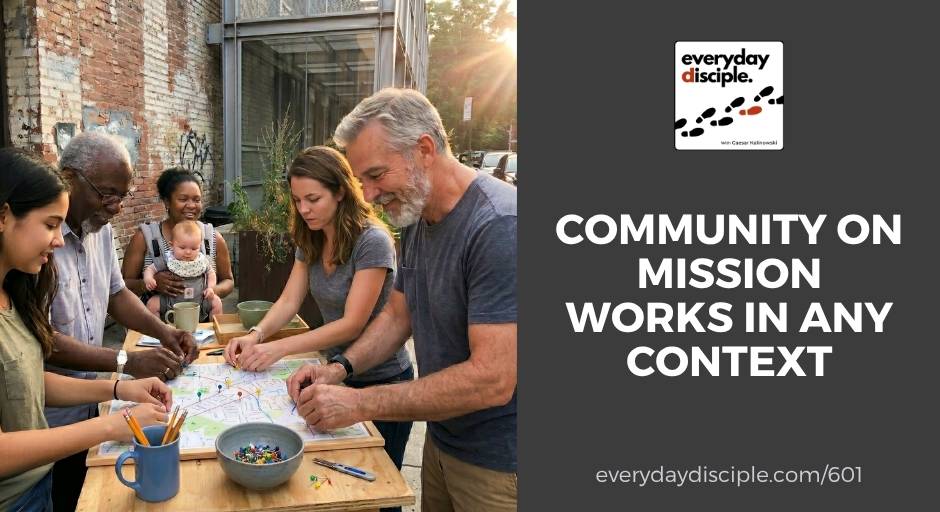
From this episode:
“One thing that is universal about a missional community in any context is that this sort of lifestyle is going to be messy. It is not a weekly Bible study or an hour-long, one-on-one meeting. You’ll need to give your whole life to making disciples the way Jesus did.”
Each week the Big 3 will give you immediate action steps to get you started.
 Download today’s BIG 3 right now. Read and think over them again later. You might even want to share them with others…
Thanks for Listening!
Thanks so much for joining us again this week. Have some feedback you’d like to share? Join us on Facebook and take part in the discussion!
If you enjoyed this episode, please share it using the social media buttons you see at the top of this page or right below.
Also, please leave an honest review for The Everyday Disciple Podcast on iTunes. Ratings and reviews are extremely helpful and greatly appreciated! They do matter in the rankings of the show, and we read each and every one of them.
Links and Resources Mentioned in This Episode:
Coaching and Mentorship in Missional Living by Caesar and his wife Tina
Resources for missional living and group training – Missio Publishing
The Gospel In Everyday Life Workshop Register Now FREE

Transcript
The primary organizing structure of the Church, capital C, is a gospel-centered missional community.
Speaker:Hmm.
Speaker:You just, it's the only model or example that we see in scripture.
Speaker:And you don't have to feel like you are somehow missing out on all that God has for you if you're making missional community life your main thing.
Speaker:Sure.
Speaker:Because that's the 6/22, as we call it.
Speaker:Six days and 22 hours a week, you still live in community.
Speaker:Couple hours a week, we sit together and hear a sermon and listen to tunes.
Speaker:Stare at the back of people's heads.
Speaker:Yeah.
Speaker:Yeah.
Speaker:All that, right?
Speaker:But that's the primary organizing structure.
Speaker:If you're not in a missional community that's, like, intentionally focused on life together and making disciples, I would say that you, in fact, are missing out on most of what God has for us.
Speaker:Welcome to the Everyday Disciple Podcast, where you'll learn how to live with greater intentionality and an integrated faith that naturally fits into every area of life.
Speaker:In other words, discipleship as a lifestyle.
Speaker:This is the stuff your parents, pastors, and seminary professors probably forgot to tell you.
Speaker:And now, here's your host, Caesar Kalinowski.
Speaker:Yeah, here we are.
Speaker:Yeah, we have some, uh, reviews to share today.
Speaker:Yeah, we got a,
Speaker:we got a, uh, a review from DrRBB2.
Speaker:People, it's amazing the names that either iTunes gives you automatically- Yeah ... or something, or people come up with.
Speaker:Yeah, that's right.
Speaker:Persnickety105.-Slice, you know, sla- Slash, whatever.
Speaker:Dot dash slice.
Speaker:I don't know.
Speaker:Uh,
Speaker:DrRBB2 says, "I love the podcast. The hosts aren't afraid to tackle difficult subjects in a thoughtful and balanced way. They keep things moving, which is great because I have a short commute." And which is funny, for those who don't know, we did the 25-minute kinda average episode- Yeah
Speaker:'cause that's the average commute time in America.
Speaker:So we'd say, "Give us your commute." Hey, so today, uh, we're talking about whether or not it's actually possible to start and sustain and carry on a missional community in every context, and this message is coming from, uh, some of the Facebook group con- conversations- Yeah
Speaker:we've had back and forth when we said, "We're getting ready to, to do a new-" A lot of
Speaker:chatter about that.
Speaker:Yeah.
Speaker:We said, "Hey, we're getting ready to do a, a new batch of episodes," and the most common thing people wanted us to talk about was, uh, different situations of how to start a missional community.
Speaker:So, like, how to do it in a f- in a community of less than 5,000 people in the middle of nowhere.
Speaker:How do you do it in a college campus?
Speaker:How do you do it here or there?
Speaker:And so we just thought, "Why don't we do an episode that says, 'Is it even possible?'"
Speaker:And, like, what are the differences- Yeah ... and all that.
Speaker:Yeah.
Speaker:How do you make it work in every context?
Speaker:And unfortunately, I think, and I know, I mean, I won't cast aspersions on any of our listeners or those who wrote that topic, but I, I have been asked that question for years and years over and over.
Speaker:Sure.
Speaker:And unfortunately, too often, what's behind, the thing behind the thing on that question is, is it really possible to do this in, like, a rural setting?
Speaker:Is it really possible to do this in, like, uh, you know, like, um, suburban?
Speaker:You know- Yeah ... everybody just stays in their house with the air conditioning.
Speaker:Um, what's really behind it is, um- I don't wanna do it, and I don't think it'll work.
Speaker:Yeah.
Speaker:Or we tried it and it sucked, and that's why.
Speaker:So it's really possible ... You know?
Speaker:Sure.
Speaker:Often, unfortunately, it, it, it's too much.
Speaker:So, um, is it possible to do missional community in every context?
Speaker:Yeah.
Speaker:Let me start out with a definition here, okay?
Speaker:Okay.
Speaker:Missional community is a family of, of missionary servants, okay?
Speaker:People who understand their identity in Christ- Mm-hmm ... and they believe that, so they're a family of missionary servants sent as disciples who make disciples.
Speaker:And that's a pretty good definition of the church, by the way.
Speaker:But would it be possible, just to back that question up, would it be possible to be a Christian in any context?
Speaker:Huh.
Speaker:And we'll just say to, to our listeners, your context.
Speaker:So I'm not, I'm not looking for an argument of like, well, there's these tribes where, you know.
Speaker:I, I understand- Sure ... there's persecution.
Speaker:I'm not talking about that.
Speaker:Yeah.
Speaker:Where you're sitting today, if you're listening to a podcast- Yeah ... chances are no one's threatening your life.
Speaker:So is it possible to be a Christian, a family of missionary servants?
Speaker:That's who God says we are.
Speaker:Right.
Speaker:Who make disciples.
Speaker:Uh, the answer would have to be yes.
Speaker:Yeah.
Speaker:Okay?
Speaker:So is that possible to believe your identity and then live that out in community with others?
Speaker:Yeah, it is.
Speaker:And y- I think it bears repeating again here the definition of discipleship that we often use here on the podcast.
Speaker:Discipleship's the process of helping people move from unbelief to belief.
Speaker:In every area of life.
Speaker:Yeah, in every area of life, according to the Gospel.
Speaker:So unbelief in what's true about God and myself and how I get to live, to belief about what's true about God and myself and how we get to live, because of Christ.
Speaker:Yeah.
Speaker:That's, that's what discipleship is.
Speaker:So is that possible, to help people move from unbelief to belief in absolutely every context?
Speaker:Yeah.
Speaker:Yeah.
Speaker:Totally.
Speaker:It really is.
Speaker:Yeah.
Speaker:It really is.
Speaker:And now, what people are maybe really asking is some of the rhythms of life in community don't seem to work very well where I'm at.
Speaker:A- and I just ... I, you know, I wanna say that, like, when we first started, like, quote, "doing the missional thing," you know, when we were- Sure ... early church planting, '04, First Soma starting up, all that stuff, as soon as we had some life, growth, multiplication happening, people said, "Well, I'm sure that- that's great there over in the Pacific Northwest, you know, it's a little more urban," blah, blah, blah.
Speaker:"It'll never work over here in this context," fill in the blank.
Speaker:Sure.
Speaker:And we heard that everywhere we went.
Speaker:We heard that in Poland.
Speaker:We heard it in Philly.
Speaker:We heard it in Florida.
Speaker:We heard it on- Oh ... farms.
Speaker:We heard it ... You know?
Speaker:And it, and the truth of the matter is, is it works anywhere because the Spirit of God is in His people, and God's really, really clear on His h- His eternal plan to fill the world with His glory.
Speaker:Right.
Speaker:And how do we do that?
Speaker:By making disciples, helping people move from unbelief to belief so that the world becomes full of Jesus, basically.
Speaker:Mm-hmm.
Speaker:Who He is and what He's like through our lives, through our f- our family, living like God's family.
Speaker:Is that possible everywhere?
Speaker:Yes.
Speaker:Might it look different?
Speaker:We'll talk about that in a little while.
Speaker:Sure.
Speaker:Everywhere?
Speaker:Yeah.
Speaker:Yeah.
Speaker:It might.
Speaker:It might.
Speaker:But it is possible.
Speaker:In fact, next week we're gonna talk about what do you actually do Like, and we're talking more, like conceptually right now, but we'll, we'll even get down to what do you physically, actually... Come on, tell me what to do.
Speaker:Yeah.
Speaker:You know?
Speaker:So like you said, you've traveled the world.
Speaker:I've been around the world as well.
Speaker:You've seen, you know, coming from Chicago, being here in Washington, uh-
Speaker:Training, though, everywhere.
Speaker:I mean- Oh, yeah ... I don't know how many cities.
Speaker:A lot of places, right?
Speaker:35 countries.
Speaker:I, I don't... Something like that.
Speaker:Yeah.
Speaker:Yeah.
Speaker:Um, give us some ideas as to how Missional Communities might look and act differently in a few of the different contexts that you've worked in.
Speaker:What do you see that's the same across the board?
Speaker:What's different?
Speaker:Maybe shed some light into that.
Speaker:Great.
Speaker:Great.
Speaker:Well, first thing I'm gonna say is people are people.
Speaker:Yeah.
Speaker:So what I... And this, these are my beliefs, okay?
Speaker:So you're listening to our podcast, so that's what you get today.
Speaker:Um, but I, I believe people are people, and what I have found is the, the same, the same stuff in our hearts, our human hearts, our fear of man, our love of self, our unbelief of what's true of God and what He's actually accomplished at the cross for us, and our authority, our privilege, all that stuff, that's kinda universal.
Speaker:Hm.
Speaker:Now, it manifests itself, Heath, in some different ways.
Speaker:Okay.
Speaker:Right?
Speaker:But in other words, someone in a rural setting who has maybe a m- quote, unquote, "slower pace" to their life- Sure ... it's more seasonally tied, 'cause maybe they're agriculturally based for their income and all.
Speaker:Right.
Speaker:Will that love of self, fear of man, unbelief in God and all that He's done in every area of their life and through, through the work of Christ, will it manifest, manifest itself differently than, say, someone who lives in Manhattan and works- Hm
Speaker:a very, very high-stress, like, say, job in, as a commodities trader in a, you know?
Speaker:Sure.
Speaker:Yeah, it will.
Speaker:But are the exact same freak-outs and desires and needs for companionship and acceptance and grace and all that, are they there?
Speaker:Absolutely.
Speaker:Yeah.
Speaker:They really, really are.
Speaker:And so that's why I say people are people, and what I have found is so much of what keeps us from making disciples, that's the purpose of a Missional Community, the mission is only and always make disciples, so when we say Missional Community, it's people who are intentionally committing to live as a family on mission together- Okay
Speaker:i.e. the mission of making disciples.
Speaker:So what keeps us from that anywhere and everywhere is all the same things.
Speaker:And, and why it works anywhere and everywhere- Is the exact same reason as when we begin to live in light of belief.
Speaker:God's our dad.
Speaker:Okay, so we get to live as a family.
Speaker:I don't have to impress my family.
Speaker:Dad loves us all the same.
Speaker:I don't have to earn anything.
Speaker:All, all those things have to change.
Speaker:Right.
Speaker:And that's everywhere.
Speaker:So we, like I said, we started this kinda life and started multiplying out communities here in the Pacific Northwest.
Speaker:Tacoma, somewhat of an urban setting- Sure ... but kind of a city of neighborhoods, right?
Speaker:Yep.
Speaker:But then it made it up to the big city, up to Seattle, and down to Portland.
Speaker:And then it was happening in a whole bunch of southern cities.
Speaker:Hmm.
Speaker:Both super rural and sort of more suburban, you know?
Speaker:Yeah.
Speaker:And then once it was there, I remember, you know, back, um, about five, six years ago now, people saying, "This, this would never work in New York.
Speaker:It's way too busy.
Speaker:It'll certainly never work in Manhattan." And then God gave Tina and I the opportunity to move there.
Speaker:Guess what?
Speaker:And train a whole lot of people- Yeah ... and live that way, and try to live that way, and guess what?
Speaker:Worked.
Speaker:It, it was actually never easier because people are the mission.
Speaker:Yeah.
Speaker:Make disciples who make disciples.
Speaker:That's the mission.
Speaker:So anywhere y- you have people, it's gonna be the same, but the rhythms looked pretty differently.
Speaker:Hmm.
Speaker:Like, in other words, like I remember when we th- in, in Manhattan, when Tina and I threw our first happy hour to try to get to know our brand new neighbors.
Speaker:We'd just been there, like, I don't know, a week or two, right?
Speaker:O-
Speaker:okay.
Speaker:Only knew two people at that point.
Speaker:So we invited everybody in our building, we invited anybody we'd accidentally met on the street or at a store on the corner, the wine shop, whatever.
Speaker:We invited everybody to happy hour.
Speaker:Sure.
Speaker:And, uh, every, you know, we're sitting there at s- 7:00, 7:30, 8:00, no one's coming, except my two friends that I knew, right?
Speaker:In Manhattan.
Speaker:Okay.
Speaker:And we're thinking, "Huh. I don't know. Maybe this won't work." And then all of a sudden, ding dong, and about 8:30, quarter to 9:00, people started showing up.
Speaker:Then it filled up, and then we were rocking.
Speaker:Ended up t- literally turning into a dance party.
Speaker:And- Really?
Speaker:... we had so much fun, and around 12:30, quarter to 1:00, people started saying, "I'm so sorry I have to leave so early, but I gotta catch a 5:30 flight."
Speaker:Stuff like that.
Speaker:Sure.
Speaker:And we're like, "Wait a minute." People's needs for connection and, and community and all that- Universal ... were exactly the same here, but guess what?
Speaker:They get off of work really late.
Speaker:Huh.
Speaker:So that's why- It just looks a little different.
Speaker:Yeah ... they looked completely different.
Speaker:Yeah.
Speaker:The topics they wanna discuss were a little bit different.
Speaker:You know, it's like, "Oh, well, my job, uh," but it's like everybody's got a problem with their job.
Speaker:Everybody's got the boss who, you know- Yeah ... wants too much from them and wants them to overcommit and all that kinda stuff.
Speaker:And so we, we have just found that there is not a context- Sure ... that it won't work, but it w- it can look very, very differently.
Speaker:The rhythms of, well, what do you do when you eat or when you s- you know, get together or hang out and all that, so yeah.
Speaker:Yeah, and, and that's something we have talked about multiple times before, is about these, these missional communities living and acting as a family, 'cause that's what the definition is of this.
Speaker:Of the church as family, yeah.
Speaker:Yeah.
Speaker:But I have to imagine that, that everywhere you've been, and I know places I've been, every missional community will have their own, like, unique flavor to them, a little bit salt- They all look so different.
Speaker:Yeah.
Speaker:But not every family in life does the same exact thing, right?
Speaker:So that's the way we can look at it is- I've never seen
Speaker:two families that looked exactly the same.
Speaker:Yeah.
Speaker:That's right.
Speaker:And that's, you're zeroing in on really that's how we begin to identify, like, oh, what do, what do we do?
Speaker:Like we're gonna talk about next week i- uh, in detail.
Speaker:And, and what is this thing really, really all about?
Speaker:So every family or missional com- missional community does everything differently based on... Think about it just like a family- Yeah ... based on age and stage of life- Yeah ... maturity.
Speaker:Just like our own kids in our own nuclear families, right?
Speaker:Like, when, when we have little babies, there's a rhythm to our life.
Speaker:Yep.
Speaker:But when we have teenagers, it's a very different rhythm.
Speaker:Yeah.
Speaker:"Well, your family's broke. It doesn't look like mine." No, we're just different.
Speaker:Yep.
Speaker:We've been doing it longer.
Speaker:Just like a church that's just planting and it's at its first Easter is gonna look, feel, smell, taste, do way different things than that church that's been here for 55 years.
Speaker:Sure.
Speaker:And they've got really a lot of maturity, a lot of gray hair sitting there, a lot of young babies being born.
Speaker:I, it's, it's- Yeah ... all over the map, right?
Speaker:Very different.
Speaker:So it's gonna be very, very different.
Speaker:I think one thing that might be important would be that, that each missional community does figure out this specific DNA that makes them that unique family, right?
Speaker:Mm-hmm.
Speaker:That understands the rhythm of that particular community.
Speaker:How would you best determine the rhythms of that family if you're trying to set a DNA structure to something like a missional community?
Speaker:Well, a- again, think about family life.
Speaker:Like, how, how do you set the rhythms of your family?
Speaker:You know?
Speaker:Like, it, for one, it, it sort of starts to happen, right?
Speaker:Yeah.
Speaker:But it's, it happens in a way that takes into account everybody's rhythms- Mm-hmm ... and their needs.
Speaker:Um, you know, when my grandson Patton or little Caesar, uh, uh, when they're over here, um, because they're babies, they have nap times.
Speaker:Like, I don't- Yeah
Speaker:really get to take a nap very often.
Speaker:But when they have a nap, well, we adjust our schedule a little bit here, and the house gets a little bit quieter, right?
Speaker:Sure.
Speaker:And this and that and all that, right?
Speaker:And so wait a minute, did you just break the family?
Speaker:Is it forever now?
Speaker:That's what we have to do for the next 30 years, we have to do that?
Speaker:We have to stop for a nap time?
Speaker:Well, not once they don't take afternoon naps, we don't.
Speaker:Yeah.
Speaker:And so we tend to often think, oh, you know, um, once... Give me the pattern and we'll do it, and that, that sort of goes back to our do to be- Yeah ... like, mentality and distortion.
Speaker:Like, whatever we do makes us this.
Speaker:Let me just say, if you're in Christ, you are a family.
Speaker:You're his family.
Speaker:Yep.
Speaker:And you are a missionary, and you have been sent, you know, as a servant like Jesus to make disciples.
Speaker:Sure.
Speaker:And so real quickly, um, we've talked about the six rhythms of life that everybody lives in.
Speaker:Yep.
Speaker:And you start thinking about how would we, at our s- Like, what would our DNA for this be?
Speaker:What would our specific version or rhythm of these six rhythms look like?
Speaker:Getting to know each other's stories, getting to know the stories of our neighbors or our People of Peace or community.
Speaker:Um, how do, how do we spend time listening to God?
Speaker:Is it holding hands in a circle and praying?
Speaker:Is it through a prayer circle?
Speaker:Is it through an app?
Speaker:Is it private, and then we come back together and discuss it?
Speaker:How are we listening to God?
Speaker:Uh, eating together, that's one of the six rhythms.
Speaker:Um, how often do we eat?
Speaker:Do we eat meals every day together as a community?
Speaker:Do we have a once-a-week family dinner night?
Speaker:Do we go ahead and say, "Well, you know what works for us, though, is sort of more like a, a happy hour thing."
Speaker:Or- Yeah ... or maybe we have a breakfast club, and we actually get together and have brunch on the weekend.
Speaker:That's what fits our family right now.
Speaker:Yeah.
Speaker:See, right now.
Speaker:But guess what?
Speaker:In two years, your initial community, the rhythms might change, just like when my grandsons quit taking naps.
Speaker:We're not just gonna stop and quiet the household anymore- Sure
Speaker:'cause it's changed.
Speaker:Uh, how are you celebrating?
Speaker:What's the rhythm of your celebrations?
Speaker:Every community is gonna be different.
Speaker:Sure.
Speaker:They're gonna have different rhythms.
Speaker:So, you know, I encourage people to think through those six basic rhythms of story, listen, eat, celebrate, bless, living as a blessing to, in, in a rhythm of blessing, and then recreate or rest to create, like our Sabbath thing.
Speaker:Mm. And you, as you start to engage those six natural rhythms of life that everybody lives in, with the gospel, through our gospel identity, a pattern will emerge.
Speaker:A rhythm will emerge.
Speaker:Yep.
Speaker:And it will change over time, and as you mature, as new people come in.
Speaker:Um, I, you know, people say, like, "Well, we started doing this, and then we started doing that, and now we're starting to get some speed up, and we're starting to get some traction.
Speaker:And then all of a sudden there was all these new people, and they didn't understand any of that, so that's why we're a closed group." Sure.
Speaker:Well, wait a minute.
Speaker:That'd be like saying, uh, you know, our two-year-old is finally, you know, walking and sort of feeding themselves and almost out of diapers.
Speaker:We're never having a kid again.
Speaker:That's terrible Right, you know what I mean?
Speaker:Yeah.
Speaker:It's like, why not?
Speaker:'Cause why I wanna... It's like, we wanna live there now.
Speaker:Well, d- don't you want him to keep maturing, or do you want him to stay right there, almost potty-trained?
Speaker:Or whatever, you know?
Speaker:Yeah.
Speaker:And so remember that just like it can work in every context, every context is gonna have its own rhythms.
Speaker:Our rhythms in Manhattan, everything shifted later.
Speaker:Okay.
Speaker:We had to go to more asynchronous discipleship, a little more online stuff, 'cause people were super busy.
Speaker:Sure.
Speaker:And, uh, even though we're, we lived densely, people in the community might've been two s- train stops away, which felt so close to them.
Speaker:Huh.
Speaker:You know?
Speaker:Like, you know, on, on the subway.
Speaker:Sure.
Speaker:But it was really, like you're not gonna run into them accidentally, you know?
Speaker:So it was- You have to be intentional with that ... there was a lot of intentionality.
Speaker:Like, we had to use the WhatsApp thing, where anytime any of us did anything, we just, boop, put it out to the group.
Speaker:I'm going here to eat.
Speaker:I'm going here to watch this show.
Speaker:Hey, a guy at work I was telling you about, we've been praying about- Yeah ... we're going to see his art, you know, art gallery thing tonight.
Speaker:You know, who wa- who's in?
Speaker:All right.
Speaker:So we, we had to use some different things to make that r- you know... Uh, we had no babies.
Speaker:Then all of a sudden there's babies in the missional community.
Speaker:Oh, the rhythm's changed a little bit.
Speaker:Yeah.
Speaker:Is that a bad thing?
Speaker:Should we close the group?
Speaker:Yeah, kick them out.
Speaker:No.
Speaker:No.
Speaker:No.
Speaker:You don't, you don't need to.
Speaker:So can it work in every... Yes, but if you think it's a program, it'd be like saying, can, can a family- Yeah
Speaker:can you have a family in, in urban setting?
Speaker:Well, absolutely you can.
Speaker:Could you have a family in New York?
Speaker:Absolutely you can.
Speaker:Could you have a family in, in, like, Romania?
Speaker:Well, of course they have- Sure ... families in Romania.
Speaker:Yeah.
Speaker:So once we start to put that lens on it, you go, "Oh, yeah, this can work everywhere," if we treat each other like a family.
Speaker:Yeah.
Speaker:You know, I think one thing that is universal is that this sort of lifestyle is gonna be messy, as you said, right?
Speaker:It is.
Speaker:And anyone who's engaged in a missional community life will know this.
Speaker:Yeah.
Speaker:I was, the first one I- It's super
Speaker:messy 'cause there's so much give and take.
Speaker:Absolutely, man.
Speaker:Just
Speaker:like, is your life messy with four kids at home?
Speaker:Oh,
Speaker:yeah.
Speaker:All the time, yeah.
Speaker:It's a- It's a constant
Speaker:mess
Speaker:... it's
Speaker:a constant mess.
Speaker:The first missional community I was ever in was with VanderStelt, and he even, I remember being, like, at different events he was at, and he's like, "Hey, just a heads-up, this group's falling apart. Like, I'm, I'm out here talking, and, you know, it's messy even in my own situation."
Speaker:Uh- Because family is messy.
Speaker:Absolutely.
Speaker:It just is.
Speaker:It's part of life.
Speaker:And it's easy to fight and disagree and let the little things rise up and be big things.
Speaker:Yeah.
Speaker:Yeah.
Speaker:How would you encourage people who are listening to this show today not to bail when the going gets tough?
Speaker:Yeah, well, I mean, there are gonna- 'Cause I've seen that a lot, right?
Speaker:Our friends are like, "Yeah, we're done with it." Well, that's 'cause we, we come to this thing called missional community and, and unfortunately we map on previous experiences.
Speaker:Like, people are like, "Yeah, we're switching churches.
Speaker:Why is that?" "Yeah, I'm not into the kids ministry over there." Sure.
Speaker:Consumerism.
Speaker:Yeah.
Speaker:Music's too loud.
Speaker:Music's too loud.
Speaker:It's not loud enough.
Speaker:I don't really like the way that guy preaches.
Speaker:So we, we kind of take that, which is pretty icky and pretty consumeristic, and then we map that onto, "You know, I've been in small groups for years." Yeah.
Speaker:It's like, no, we're talking about living like a family that embraces the mess.
Speaker:Yeah.
Speaker:The divine mess.
Speaker:Enters into it.
Speaker:Right.
Speaker:Yeah.
Speaker:Yeah, because we're gonna work on moving from unbelief to belief in every area of life.
Speaker:Yeah.
Speaker:And that only happens in the mess.
Speaker:'Cause if everything was perfect and exactly the way you wanted it, it wouldn't be the way anybody else wants it.
Speaker:Sure.
Speaker:So by its very nature, living as humans together, we're gonna have all of our unbelief and preference and fear of man, all love of self, all that stuff gets sanded down.
Speaker:Sure.
Speaker:Right?
Speaker:If, if I have the remote, I love TV watching.
Speaker:Yeah.
Speaker:If I don't, I may or may not.
Speaker:See?
Speaker:You know what I mean?
Speaker:So that's how it works.
Speaker:And so I say first you have to, like, just, you know, know that a lot of that comes from a consumeristic heart.
Speaker:Sure.
Speaker:"Uh, I don't really dig this whole thing." Why is that?
Speaker:'Cause you're being called to die to self so much, right?
Speaker:Yep.
Speaker:And, and I'll tell you, the other thing is that I have found, especially if you come from a, a, any kind of a church background, I'm not saying you had to be born going to church like I was, but if you've been going to church for a while, uh, which is probably most of our listeners, there's, there's a lot of that we drag into community life, and then we kinda compare and contrast and go, "That's not for me."
Speaker:And we're doing the same thing to everybody on Sunday.
Speaker:It's just that we can do it anonymously.
Speaker:Sure.
Speaker:Whereas in community, you can't get away with it.
Speaker:But there's these small shifts in focus, I call it the focus principle, where you've gotta make these small shifts in focus in your heart and your head to be able to embrace community, and then you start to see, oh, it's beautiful and doable everywhere.
Speaker:Like, we've gotta make a shift from thinking, you know, oh, well, community life, it's all about learning the Bible.
Speaker:We gotta get our Bible literacy up.
Speaker:No, we have to make the shift to, uh, our focus needs to shift to actual gospel fluency.
Speaker:Hm.
Speaker:Like, are we getting together to learn more historical facts about the Bible?
Speaker:Yeah.
Speaker:Or are we getting together to learn how the gospel speaks in every area of life?
Speaker:Yeah.
Speaker:And therefore- The here and now ... moving from unbelief to belief.
Speaker:Uh, we need to make a shift that the gospel is primarily about our afterlife to the kingdoms now, and the gospel is for this life.
Speaker:Yeah.
Speaker:Like, primarily.
Speaker:Yeah.
Speaker:And bonus, heaven.
Speaker:You know?
Speaker:Um, we need to shift our focus on what evangelism and discipleship really are and how they work together.
Speaker:And are they the same thing?
Speaker:Are they different?
Speaker:Is it, you know... Um, we, and we have to remember that discipleship's the mission.
Speaker:Mm. Right?
Speaker:So, um, not a lot of going to church and sitting, unfortunately, in pews on Sunday has a lot to do with discipleship.
Speaker:Yeah.
Speaker:It may be great preaching, it may be great music, it may be the best thing in the world.
Speaker:I've been a part of just amazing churches most of my life, but it's not necessarily accomplishing a whole lot of discipleship on Sunday.
Speaker:And we gotta remember, we need to shift our focus.
Speaker:It's not the consumeristic this or hearing a great message that, or trying to talk your neighbors into coming or saying a prayer, whatever.
Speaker:It's discipleship's the mission, and we, we need to make that- Yep ... that shift.
Speaker:And by the way, I, it's that time of year, as we're entering the fall here, uh, that, um, I'm opening up some coaching slots, where people who wanna learn how to do this stuff- Sure ... learn how to make that- All those shifts and begin to embrace community, um, it, it, it's...
Speaker:I'm opening up some coaching, so if anybody wants to, you know, be coached and have somebody who's been in a lot of contexts and taught a lot of people how to do this and help them kinda work through the nuances of their community, I'd love to help.
Speaker:Now, we don't have a lot of slots.
Speaker:Sure.
Speaker:I only open up, like, three cohorts in the fall, and a handful of people in each.
Speaker:So if anybody's interested, um, they... I, I'd love to have them, you know, check it out.
Speaker:If they wanna check it out, they can just go to everydaydisciple.com/coaching.
Speaker:Yeah.
Speaker:And there'll be some information there.
Speaker:But I'd say y- like, if you're hearing this now, and you go, "Oh, I might be interested in that," you better go now 'cause those slots will fill up.
Speaker:There's just not that many.
Speaker:Sure.
Speaker:Like, we're busy, super busy people.
Speaker:We live in community, but I do offer coaching, and we do it as couples coaching.
Speaker:Yeah.
Speaker:Right?
Speaker:We def- that- Both people on board, yeah.
Speaker:Yeah, so my wife and I will be involved in the coaching, generally with other couples, and singles.
Speaker:Sure.
Speaker:I'm not saying it's exclusively, but, um, you kinda get both my perspective and o- and my wife's perspective, the real missionary in the family, so.
Speaker:Yeah, she's great, man.
Speaker:All right, so let's get to the big three, the big three takeaways, things we want you to walk away with from this episode, and you can get them for absolutely free- Free ... by going to everydaydisciple.com/bigthree.
Speaker:Caesar, what are the big three
Speaker:for this week?
Speaker:Okay, if you get nothing else, here's the first one.
Speaker:The primary organizing structure of the Church, capital C, is a Gospel-centered Missional Community.
Speaker:Hmm.
Speaker:You just... It's the only model or example that we see in Scripture, and you don't have to feel like you are somehow missing out on all that God has for you if you're making Missional Community life your main thing.
Speaker:Sure.
Speaker:Because that's the 6/22, as we call it.
Speaker:Six days and 22 hours a week, you still live in community.
Speaker:Couple hours a week, we sit together and hear a sermon and listen to some tunes.
Speaker:Stare at the back of people's heads.
Speaker:Yeah.
Speaker:Yeah.
Speaker:All that, right?
Speaker:But that's the primary organizing structure.
Speaker:If you're not in a Missional Community that's, like, intentionally focused on life together and making disciples, I would say that you, in fact, are missing out on most of what God has for us.
Speaker:Huh.
Speaker:Okay?
Speaker:Second the- thing, God desires to shape and mature you to be more like Jesus in community with others.
Speaker:Yeah.
Speaker:Like, it was never a s- Lone Ranger thing, or that's how he'd have made disciples.
Speaker:Yep.
Speaker:Your gifts, experience, and talents are waiting to be used by God to shape others.
Speaker:Hmm.
Speaker:And he himself is waiting to do the same in your life via the life-on-life interactions that you'll have with others in community.
Speaker:Yep.
Speaker:I already said, like, you know, your preferences, your fears, uh, self-love, all that, right?
Speaker:Yeah.
Speaker:And this will not happen sitting alone in rows in silence once a week.
Speaker:Yeah.
Speaker:God intended it to be in community because together we're the Body of Christ.
Speaker:Yep.
Speaker:So if you wanna be a mature disciple, you're gonna need to get into a Gospel-centered community living on mission together.
Speaker:Yeah.
Speaker:I agree.
Speaker:And
Speaker:third, um, and, and I kinda just tipped my hand to that, it requires the Gospel together in community on mission- To produce mature disciples.
Speaker:If you, if you lack any one of those three, no gospel and you're just in community hanging out, well, that, that's not the church.
Speaker:Mm-hmm.
Speaker:Uh, you know, if you're not in community but you go like, "Well, I, I hear a good message on Sunday, but, um, and I, I've been to some discipleship classes, but I'm not doing it in community," then you're not gonna m- grow to maturity.
Speaker:So if any one of the three, gospel, community, and mission are miss- are missing, you're gonna see problems and lack maturity, and you're probably in a pretty externally focused as a group.
Speaker:Yeah.
Speaker:I mean, internally focused as a group.
Speaker:Yeah, man, I agree.
Speaker:I've seen it in my own life that, like, you do need to rub up against some other people to be sanded down into the image of Jesus.
Speaker:I mean, it does require- Give yourself away,
Speaker:and that's how you're gonna be mature.
Speaker:Jesus said if you wanna gain your life, lose it, right?
Speaker:Yeah.
Speaker:Lay it down, so.
Speaker:Okay, you get those big three by going to everydaydisciple.com/bigthree.
Speaker:And also, Caesar, that coaching for people that wanna jump into this, this coaching with you, there are limited spots, but you can sign up now by going to everydaydisciple.com/coaching.
Speaker:Yeah, and we, we'll get together biweekly on video.
Speaker:Yeah.
Speaker:And you have, like, literally daily access to me through, through emails and, like, Voxer, which is like a walkie-talkie thing.
Speaker:Yeah, that's what it is.
Speaker:And I'll send you videos and critiques and, I mean, you, I will just walk with you.
Speaker:Yeah.
Speaker:So.
Speaker:So
Speaker:cool, man.
Speaker:Yeah.
Speaker:Sorry.
Speaker:Join us next week w- as we talk about maybe, like, a part two to this.
Speaker:So do missional communities work in every setting, which we talked about today.
Speaker:Next week we're gonna say, what are you actually supposed to do from week to week in one of these settings?
Speaker:Like, is there a specific pattern?
Speaker:Do we make it up as we go?
Speaker:What's the format look like?
Speaker:I'm gonna mail out checklists to everybody, checkboxes, lots of lists to check off.
Speaker:Yeah, to check them off.
Speaker:So join us for that.
Speaker:It's gonna be a fun episode.
Speaker:That'll be fun.
Speaker:We get into more of the nitty-gritty of it.
Speaker:Thanks for joining us today.
Speaker:For more information on this show and to get loads of free discipleship resources, visit everydaydisciple.com.
Speaker:And remember, you really can live with the spiritual freedom and relational peace that Jesus promised every day.