
How to Restart (or Jumpstart) Your Missional Community with Three Simple Rhythms
Every missional community hits a wall eventually.
Maybe it was a busy holiday season that stretched into months. Maybe life got overwhelming — a job change, a move, a new baby. Maybe your group started strong and then slowly, quietly, fizzled out. Whatever happened, you’re looking at your community and wondering: How do we get this back?
Here’s the first thing I want to say: this is completely normal. It happens to the most intentional communities. It doesn’t mean you’ve failed. It means you’re human.
The path back isn’t complicated. It doesn’t require a retreat or a big relaunch event. It requires something far simpler — and far more sustainable: predictable patterns.

Begin Again — And Give Yourself Grace
Before we talk about what to do, let me say something about how to begin.
Don’t beat yourself up. The goal of missional living isn’t perfection — it’s faithful, daily discipleship alongside others. Every journey forward is a series of small, intentional steps. The grace that covers your sin also covers your inconsistency. Pick yourself up, remember that you are deeply loved by God, and begin again.
That’s step one. And it’s enough.
The Secret: Predictable Patterns
What separates thriving missional communities from scattered ones isn’t talent or passion — it’s rhythm.
Specifically, it’s the rhythms that everyone in your community knows you’ll be doing together, at the same time, in the same way, week after week. These predictable patterns become the scaffolding that holds your community life together when motivation runs low or schedules get crowded.
The question isn’t will we do something together eventually? It’s what are the things we do together no matter what?
Worth noting: this same approach works if you’re starting a missional community from scratch. Restart or fresh start — the method is identical.
Think UP, IN, and OUT
Jesus modeled a life with three relational priorities held in constant, healthy tension:
UP — Time with his Father, rooted in prayer and dependence
IN — Time with those he was discipling in close community
OUT — Time with people outside his close circle
The goal is to add one new predictable rhythm in each of these three directions. Not three things on the same night. Not a complete overhaul. Just one new, doable, repeatable rhythm per direction — and let them build from there.
UP: Rhythms That Connect You to God
The foundation of any healthy missional community is a shared rootedness in the gospel. Without it, your community becomes just another social group.
A few UP rhythms worth building in:
Grow together in gospel fluency. Work through The Gospel Primer as a community over eight weeks. It’s one of the most practical tools I’ve found for helping people connect the gospel to every part of everyday life — not just Sunday mornings.
Practice listening prayer. Carve out time not to ask God for things, but to listen. Read one narrative from Scripture together and ask three questions: What do we learn about God here? What might he be saying to us in this story? What will we do about it this week?
These aren’t complicated rhythms. But practiced consistently, they’re genuinely transformative.
IN: Rhythms That Deepen Your Life Together
The IN rhythms are about becoming more than a weekly meeting — they’re about becoming a family.
This shift requires intentionality. Most small groups are designed around information transfer. Missional communities are designed around shared life. And shared life takes more than two hours on a Tuesday night.
Start with dinner. A regular family dinner night — no agenda, no program, just a table and real food and real conversation — is one of the most powerful community-building tools available. I’ve written more about why it works in Why Weekly Family Dinners Are a Game-Changer for Discipleship.
Try the Tangible Kingdom Primer together. It’s the best first-steps resource I know for helping a group take their first real steps outward as a community on mission. Practical, accessible, and deeply formative.
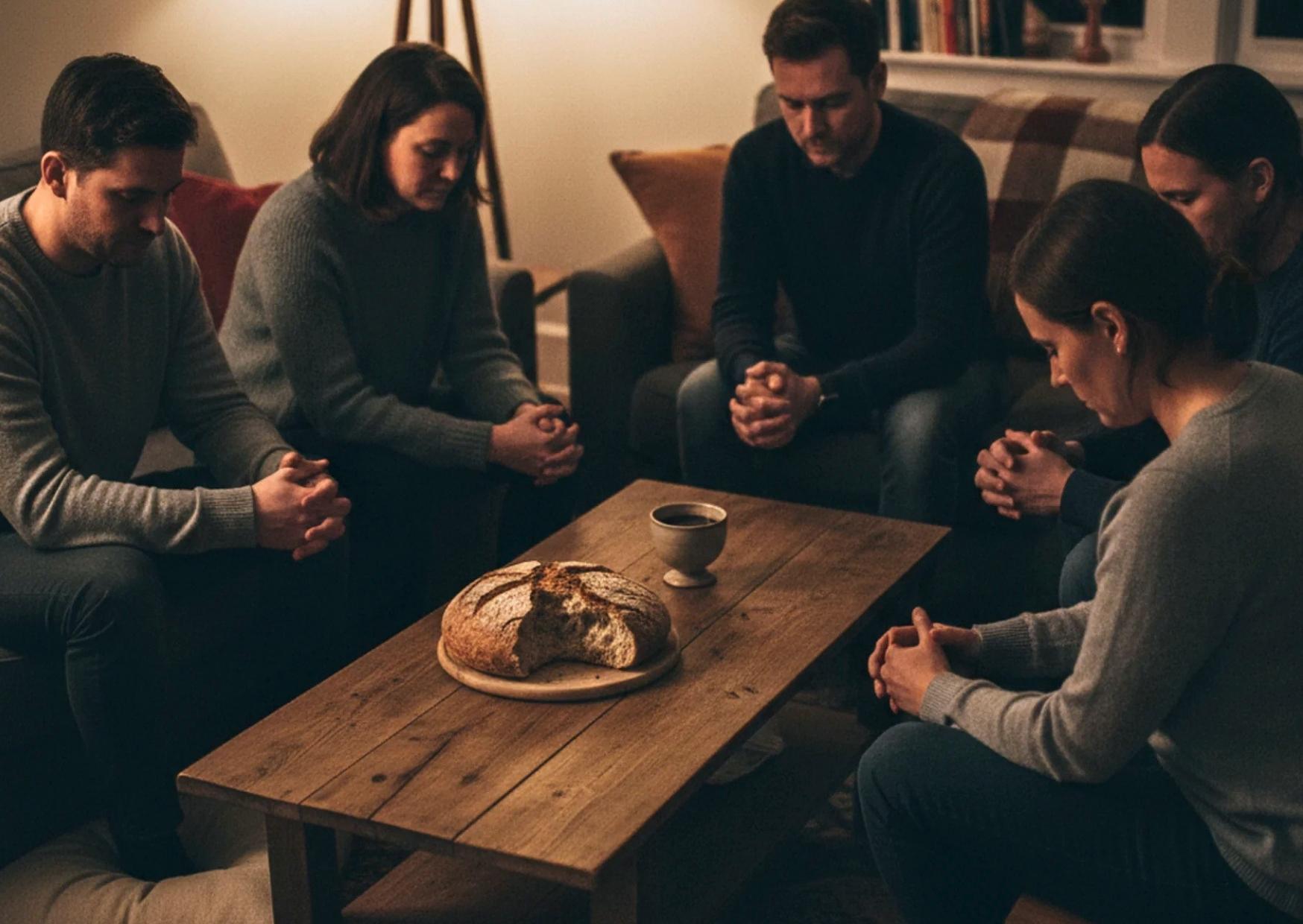
Share communion together. Not just at church on Sunday — but as a community, in someone’s living room. Few things re-center a group around Jesus faster than breaking bread together in his name.
“The life of a healthy missional community cannot happen in just one evening per week.”
OUT: Rhythms That Keep You Facing Outward
Here’s where most communities stall. The OUT rhythms feel harder — more uncomfortable, more dependent on things you can’t control. But they’re also where the real adventure begins.
Become regulars somewhere. Pick two or three local spots — a coffee shop, a park, a neighborhood restaurant — and go back consistently. You’re not running an evangelism program; you’re becoming a familiar, trusted presence. Relationships form in the third and fourth visit, not the first.
Serve consistently, not occasionally. Pick one people group or neighborhood need and show up — week after week. Consistency builds trust in ways that one-time service projects never can.
Open your table. Host a regular Open Table night: an open invitation for neighbors, coworkers, and acquaintances to share a meal with no agenda other than presence and relationship.
If you want to go deeper on what it looks like to love mercy and do justice as a community, The Justice Primer walks your group through exactly that, step by step.
Here’s a helpful episode if you want to hear this unpacked further: Restarting Your Missional Community Rhythms

One Rhythm at a Time — Then Let It Grow
You may have noticed: even these three rhythms can’t happen on the same night. That’s intentional. A missional community is a family, and you can’t do healthy, meaningful family life together for a couple of hours one night a week.
Start with one rhythm in each direction. Put it on the calendar, protect it, and give it time. Over weeks and months, new rhythms form organically, new relationships deepen, and you’ll find yourself in a whole new season of community life — one you didn’t have to manufacture.
If you want to go further — to build a lifestyle of disciple-making that shapes every part of your week, not just your scheduled community time — Discipleship as a Lifestyle is the place to start. It’s our foundational course for building the everyday rhythms that make mission sustainable long-term.
And if you’ve ever wondered how organized rhythms and organic, relational mission can actually coexist without one killing the other, check out When Real Life Meets Mission: Finding Freedom in Organized and Organic Rhythms.
Frequently Asked Questions
Q1: What if only one or two people in our community are motivated to restart — do we need everyone on board first?
You don’t need unanimous enthusiasm. Start with the willing few and let the rhythm create the invitation. Predictable patterns have a way of drawing people in over time better than any kickoff meeting ever will.
Q2: How long should we commit to a new rhythm before deciding if it’s working?
Give it at least 90 days without evaluating it. Community rhythms take time to become genuinely predictable — and most groups quit right before the momentum builds. Commit first, assess later.
Q3: What if our community is geographically scattered and can’t gather weekly in person?
Start with what’s possible. Even one monthly in-person gathering anchored by consistent mid-week connection can form real community. The goal is faithful, repeated contact — not a perfect in-person model.

About the author, Caesar
The author of the top-selling books, The Gospel Primer, Transformed and Small is Big, Slow is Fast. His latest book, SLOW BURN: Relaxing Into Theology hit #1 on Amazon.
"I help those with a high commitment to intentional living in the areas of their family, faith and work acquire the leadership skills and tools necessary to succeed and leave a lasting legacy."