
How To Truly Be Generous
We all know we could be more generous — but for most of us, that just means dropping something in the offering plate or tipping a little extra. Meanwhile, we grip tightly to everything else God’s given us. What if real generosity isn’t really about money at all, but about how loosely we hold everything we’ve been blessed with?
In this episode of the Everyday Disciple Podcast, we’re going to talk with author Marty Duren about living with open hands in every area of life. You’ll discover why the “stuff god,” called mammon, has more grip on us than we realize. And how the gospel frees us to become the most outrageously generous people on the planet.
In This Episode You’ll Learn:
- Why generosity connected only to money falls way short of the truth
- The “stuff god” that secretly competes for your worship
- How the gospel is actually a picture of radical generosity
- Practical ways to start living less selfishly today
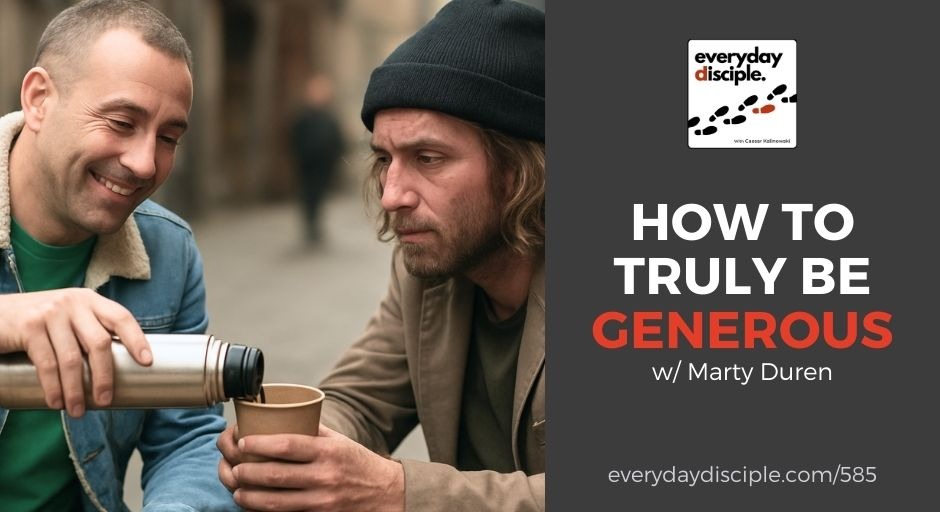
From this episode:
“Most people do have forms of giving and generosity they engage in throughout their lifetime. Let’s let the Gospel shape our intentionality and give us new eyes to connect all of this to God’s glory. And… it is a BLAST to bless people when they least expect it!”
Each week the Big 3 will give you immediate action steps to get you started.
 Download today’s BIG 3 right now. Read and think over them again later. You might even want to share them with others…
Thanks for Listening!
Thanks so much for joining us again this week. Have some feedback you’d like to share? Join us on Facebook and take part in the discussion!
If you enjoyed this episode, please share it using the social media buttons you see at the top of this page or right below.
Also, please leave an honest review for The Everyday Disciple Podcast on iTunes. Ratings and reviews are extremely helpful and greatly appreciated! They do matter in the rankings of the show, and we read each and every one of them.
Links and Resources Mentioned in This Episode:
Coaching and Mentorship in Missional Living by Caesar and his wife Tina
Resources for missional living and group training – Missio Publishing
The Gospel In Everyday Life Workshop Register Now FREE

Transcript
I wanna make sure our, our listeners aren't missing this today.
Speaker:What you're saying, it's not because you are supposed to or because that pleases God and so therefore he, like, he's gonna continue to bless your life and be generous to you.
Speaker:It's because you get to and because of your love for him, you choose to do that.
Speaker:And there you, you get to give first fruits.
Speaker:Sure.
Speaker:But not to, not to earn his love or your salvation or get your attaboy points from God or whatever.
Speaker:And that is, I think so key to the heart of true generosity.
Speaker:Is that God loved us first.
Speaker:We didn't do anything to earn it while we were still sinners, still jacked up middle finger in the air to God.
Speaker:He came and he exchanged places with us.
Speaker:Mm-hmm.
Speaker:That we might be saved and be born a second time to live life with him.
Speaker:He was generous.
Speaker:Unto death with us.
Speaker:Not because he had to, it was supposed to, or because he was trying to prove anything to us.
Speaker:He loved us and so he did it.
Speaker:And we get to be generous.
Speaker:Yep.
Speaker:In that same way.
Speaker:And that what a, what a huge difference in heart.
Speaker:And I think that's actually the thing behind the thing.
Speaker:Hmm.
Speaker:When it comes to such little generosity.
Speaker:Exhibited and experienced through God's family.
Speaker:Welcome to the Everyday Disciple Podcast where you'll learn how to live with greater intentionality and an integrated faith that naturally fits into every area of life.
Speaker:In other words, discipleship as a lifestyle.
Speaker:This is the stuff your parents, pastors and seminary professors.
Speaker:Probably forgot to tell you.
Speaker:And now here's your host Caesar Kalinowski.
Speaker:Well, Heath, what do you got for me today?
Speaker:Hey man, we got special guest Marty Duran.
Speaker:Talk
Speaker:about generosity.
Speaker:What do you got for me?
Speaker:What do I have for you?
Speaker:Are you gonna live generously?
Speaker:That's what we're talking about today.
Speaker:Generous.
Speaker:I'm gonna
Speaker:try.
Speaker:I
Speaker:got 10 bucks for me.
Speaker:You got a sandwich?
Speaker:A
Speaker:little bit of both.
Speaker:I just, yeah, they're, they're on their way.
Speaker:Some pizza, cold pizzas even.
Speaker:I don't care.
Speaker:Let's, let's do, we got lots of
Speaker:free stuff for you.
Speaker:One of the 600 beers you mentioned last week at your place that you go to High
Speaker:Defiance, ma'am.
Speaker:Like, what do you got for me?
Speaker:Like, let's be generous.
Speaker:I'd love to be generous.
Speaker:All right, time to get our special guest Marty on here.
Speaker:Hey Marty.
Speaker:Thanks for joining us today, man
Speaker:Hey, it's good to be here.
Speaker:Me and Marty are doing well.
Speaker:I was gonna ask how you guys are doing.
Speaker:For those of you who don't know who Marty is, he's the executive editor at lifewaypastors.com.
Speaker:and he's also host of the Pastor Talk podcast that has tools designed to help pastors and other church leaders shepherd their flocks well, and if that's not enough, he's an amazing bread baker
Speaker:he sells his bread he just told us off, off air, uh, $60 a loaf.
Speaker:60. Yes, sir. Some hella bread.
Speaker:It's crazy bread.
Speaker:I'm still,
Speaker:I'm still waiting to sell my first loaf.
Speaker:And you're the author of three multi dozen selling books.
Speaker:Yeah, they're really up there.
Speaker:That's, that's, that's cra I saw that and I was like, wow, you too.
Speaker:That's, everybody thinks that if you write books and that you're just rich.
Speaker:Oh my
Speaker:word.
Speaker:And many and many of my friends are authors and even some of 'em, big ones, and they tell me, this is what I, this is what I got last year, you know?
Speaker:Yeah.
Speaker:I'm like, okay.
Speaker:That's right.
Speaker:Don't, we're
Speaker:all, we're all writing 'cause we have to
Speaker:drop it and let it roll down the sidewalk.
Speaker:Yeah.
Speaker:So Marty, the thing that, uh, I had asked you to be, to talk with us about was based off a book I read of yours called The Generous Soul.
Speaker:Yes.
Speaker:And we'll put the link of that in the show notes.
Speaker:Uh, but this concept of generosity and, um, and a generous posture of heart.
Speaker:Um, and so I was wondering if you could just kind of give us a little bit of an overview about.
Speaker:Maybe why you wrote that book and why you find, um, generosity to be so important.
Speaker:Um, oddly enough, one of the reasons that I wrote that book was because I was unemployed
Speaker:and I was simple employee
Speaker:to get people to give you money and donate.
Speaker:I was looking to generate some income
Speaker:that's not, that's not even a lie.
Speaker:And it started kind of based on sermons I had done.
Speaker:So I pulled up all the sermons that I had done.
Speaker:On giving and went through all the texts again, and, and then looked at some, some texts that I had not previously preached sermons on.
Speaker:But it's not a book of sermons, so it's not like you go to it and you feel like that you're in a six part series on giving sure.
Speaker:At least I don't think it feels that way.
Speaker:Uh, but, but it is, uh, dealing with some, the theme of generosity or the theme of, I called it in the book, Missional Giving.
Speaker:Which is,
Speaker:I love that term.
Speaker:Yeah, thanks.
Speaker:Define that a little bit for us.
Speaker:I love that term.
Speaker:Uh, well, it's basically giving as if you are a missionary.
Speaker:So this is one of the things, I don't remember if this is in the book, but it was definitely in my mind.
Speaker:Um, so if, if your church sends out a missionary and you raise the funds and you spend the, you know, the $60,000 whatever to get 'em trained to get 'em on the field, then you're sending them every month you're sending them money.
Speaker:To support them.
Speaker:And so they're there for two years.
Speaker:You send a team over and you find out that, you know, they're not really doing mission work.
Speaker:They're taking all the money that they've invested.
Speaker:If they bought themselves a little shop and they're, you know, selling trinkets to the tourists, but it's not really about being on mission, and so the money is, is being poorly invested.
Speaker:Well, Missional living basically says God has sent all of his people out as as missionaries, wherever you live.
Speaker:So if you're in Seattle, or if you're in, you know Oshkosh, or if you're in Nashville, or if you're in Atlanta, or if you're in Nova Subir Russia, or if you're in Madagascar, if you're a believer, then you have to believe that God in his sovereignty has put you where you are.
Speaker:Yes, you were born there, but God could have moved you somewhere else if he had wanted to.
Speaker:So you're there as a missionary, and part of that responsibility as a missionary is to manage what God has given you in a way that reflects the Kingdom priority.
Speaker:So it's easy for us to criticize the missionary who takes all of the support money and opens the trinket shop and doesn't really actually do gospel work.
Speaker:But we don't think about ourselves in the same way.
Speaker:So if your church sends a missionary out, who's flunking out?
Speaker:How much more does God look at us as the missionaries he sent out?
Speaker:And we don't view the possessions that he is entrusted to us to manage in a way that reflects a Missional orientation.
Speaker:We, we don't look at our funds, we don't look at our property, all of which belongs to God.
Speaker:As if we are just managing it for his kingdom's purposes, we grasp, we grab it.
Speaker:Um mm-hmm.
Speaker:And so, uh, I think Missional giving has to do with, uh, I realize that everything that has my name on it, whether it's a deed or a car title or a checking account, also has the name of Jesus on there.
Speaker:And I'm the minority owner, if you will.
Speaker:He's the majority owner, if you will.
Speaker:And if I've got $20 in my checking account that I think I need to spend on a book.
Speaker:But God thinks I need to give to the guy on the street corner.
Speaker:Then Missional giving says, this is God's money.
Speaker:I'm the channel for him to move his funds around as he sees fit.
Speaker:They're his assets.
Speaker:That's not mine.
Speaker:And so I give the money to the guy on the street corner rather than buying book, and that's kind of the essence of, I think of what I was trying to communicate.
Speaker:Marty we've talked about before, like, do we get to choose to live as either a, a barrel or a conduit?
Speaker:Yeah.
Speaker:Like a barrel is for collecting things.
Speaker:Yeah.
Speaker:For later use, you know, for me or as we can choose to live as a conduit of God's grace and generosity.
Speaker:And then he just keeps the wick open and it flows through a conduit's, like a pipe or a hose or whatever.
Speaker:Do you wanna live as a barrel?
Speaker:Or, or, or, or a conduit.
Speaker:Yeah.
Speaker:I think that's a great metaphor.
Speaker:And, um.
Speaker:The problem is, is that we, we think that living is a bear is the way to joy.
Speaker:Um, we, we, we, we have confused, I think especially in the west and especially in America, we have confused, uh, having things as the signal of God's blessing.
Speaker:Well, certainly that can be a signal of God's blessing, but it can also be a sign of God's challenge.
Speaker:If I entrust you with all of this, you know, are you gonna do.
Speaker:The right thing.
Speaker:Are you gonna live as a conduit with all of these resources that you have at your disposal?
Speaker:And maybe it's, you know, hundreds of millions of dollars.
Speaker:Maybe you're a businessman who's so successful, makes money so fast, you can't even manage all of it.
Speaker:Well, where are you?
Speaker:You know, are you gonna remain a conduit?
Speaker:Or does it then become a fear factor where you're like, I, if I don't hold on to all this, then I'm gonna lose all of it.
Speaker:And then you lose the whole Missional aspect of your, of your finances.
Speaker:Some friends of ours a few years back in a Missional Community, they took those, those big white sticky posties, you know?
Speaker:Mm-hmm.
Speaker:Those ones use at conferences.
Speaker:Yeah.
Speaker:You know, they're giant post those and um, they.
Speaker:They said, Hey, we're gonna, we're gonna do a little experiment.
Speaker:We're gonna write down everything we've, we have, we've been given 'cause we're all born naked.
Speaker:We had nothing.
Speaker:And that's how we'll leave, you know, we won't have anything.
Speaker:Yeah,
Speaker:yeah.
Speaker:Um, let's go ahead and write down everything as a community that we own.
Speaker:That we have.
Speaker:Mm-hmm.
Speaker:And, and they started filling up this, this, uh, this post-it note, you know, and they put down like, you know, okay, we all have this many houses and cars.
Speaker:And, and then they started realizing, oh, we have tools.
Speaker:We have books.
Speaker:Wait a minute, we have education.
Speaker:We have, they ended up the whole, the whole like living room and dining room area was all covered with these giant posties and small print.
Speaker:There was tons of resource.
Speaker:And, and not just stuff Resource Yeah, but like skill and relational resource and all that.
Speaker:And they, and then they sat there and they were overwhelmed by it.
Speaker:And, and I, they were just average people.
Speaker:I imagine any group of 12 or 15 people would've similar post-it notes.
Speaker:And then they said, okay, so why do you think God's poured this into our lives?
Speaker:All this stuff.
Speaker:Now it's certainly we get to enjoy it.
Speaker:He's a good father.
Speaker:But what's, what's gonna bring him most glory?
Speaker:Yeah.
Speaker:And are we living as missionaries in light of all this?
Speaker:Mm-hmm.
Speaker:Look at all this stuff.
Speaker:Look at all this resource.
Speaker:And then he started trying to think about, okay, what do we, what do we do?
Speaker:What do we get to do with all that resource?
Speaker:That's, uh, that's very good.
Speaker:And it's, I think it is a question, uh, that all of us have to ask.
Speaker:Um, poor, poor people can be.
Speaker:Just as focused on the little they have as rich people are focused on the much that they have.
Speaker:So, uh, greed or, uh, what's mine is mine is not just an affliction of the wealthy.
Speaker:It's an affliction of humanity, uh, that often chooses to substitute God's blessings for God.
Speaker:And so, uh, I think it is a danger, one of the ways that God, uh, I think, um, I think it is interesting.
Speaker:That when Jesus had the opportunity to contrast two kingdoms, he contrasted God and stuff.
Speaker:Hmm.
Speaker:Not God and Satan.
Speaker:Wow.
Speaker:Now, mammon was, you know, kind of a, a metaphorical name.
Speaker:It was an idea, but mammon was the stuff God, for lack of a better term.
Speaker:And so he could have, he could have contrasted anything.
Speaker:You can't serve two masters, you could either love one and hate the other, or you know, love hate the one, and despite love the other, whatever, you, you can't serve both of them.
Speaker:You can't serve God.
Speaker:Wow.
Speaker:And I mean, think about the, the entire Greek vocabulary or the entire, uh, Aramaic vocabulary, he could have filled in the blank there.
Speaker:And it was basically stuff you can't serve God and stuff.
Speaker:And so when you think about that, what is.
Speaker:What's the, the big, big difference between God and stuff?
Speaker:God is intangible and stuff is tangible, and so the dichotomy that's there is you.
Speaker:We can only serve God pleasingly by faith because we can't see him.
Speaker:We can only trust him.
Speaker:Yeah, stuff requires no faith whatsoever.
Speaker:I can reach out and open my door handle in my car.
Speaker:I can come in and I can sit down on my sofa.
Speaker:You know, I can, I can go out and I can have my lawnmower.
Speaker:I can't anymore 'cause I sold it, but I can have my weed eater and run around the yard.
Speaker:I can have that, that stuff.
Speaker:I can check my bank account on the app, on my phone, which I can hold in my hand.
Speaker:All of those things are tangible and it becomes very, very easy to trust in the thing that is tangible.
Speaker:Over God who is intangible.
Speaker:And so Jesus just gives us that option right there.
Speaker:You can, you can serve the one you can't see, or you can serve the one you can see, but you can't serve 'em both.
Speaker:Wow.
Speaker:That's good man.
Speaker:Very close friends of mine, uh, Kevin and Tammy Turner.
Speaker:I don't know if they listen to the show this week or not, but uh, I know at least twice in their life because of what you just said, Marty, they.
Speaker:They actually got rid of everything they had.
Speaker:Wow.
Speaker:All their stuff.
Speaker:And they sit, like, I remember one story him telling me like, so we're sitting on this really ripped up couch chair, like a chair, you know, and it was the only thing left because no one would take it.
Speaker:We couldn't give it away.
Speaker:Like even like the Amvets, you know, in Salvation Army wouldn't take it.
Speaker:And we sat in our apartment saying, okay, Lord, now where?
Speaker:You know?
Speaker:Mm-hmm.
Speaker:Like not what, but where, and.
Speaker:Both times in their life, just abundance of how God said, well, my goal is not for you to have nothing.
Speaker:Yeah.
Speaker:But they, they wanted their hands open.
Speaker:Yeah.
Speaker:They wanted their hearts clean.
Speaker:And it's, it's a beautiful picture.
Speaker:I've not had the guts to do it.
Speaker:Alright,
Speaker:so, so Marty, in light of what you just said, why, um, why is living with generosity so often portrayed or even communicated.
Speaker:It's just about your church getting more of our money.
Speaker:It's gotta be much more than that, right?
Speaker:Oh yeah.
Speaker:Absolutely.
Speaker:Now part of that, I think, is there are, there are legitimate critiques about churches that, um, have budgeting strategies that require them to talk about money all the time.
Speaker:Um, I think that's problematic.
Speaker:Um, you know, if your church is building a building so big that the pastor has to talk about money, if every sermon, I think you probably need to take a step back and figure out where you missed God.
Speaker:Sure.
Speaker:But, uh, but some people, so it can be a legitimate beef.
Speaker:For some people it is an excuse because here's the reality.
Speaker:If God says you can serve one or the other, you can serve me or you can serve your stuff.
Speaker:Well, if you're not serving God, then who is your little G God?
Speaker:Your little g God is mammon.
Speaker:So if you come to church and the pastor says you should give 10% or you should give 15, or you should be generous whenever your specific position is on how to interpret tithing and giving in the New Testament.
Speaker:Um, but if the pastor is teaching a series on that, for instance, or if he mentions it every other two or three, you know, Sundays or whatever, just as a reminder and encouragement.
Speaker:A person whose God is their stuff is hearing that person, that pastor talk about their God.
Speaker:He wants me to give my God away.
Speaker:I mean, they would never say that.
Speaker:Don't,
Speaker:don't poke my God.
Speaker:They, God would never say that.
Speaker:They would never verbalize it that way, but that's what it boils down to.
Speaker:Why?
Speaker:Why else would you have such a visceral reaction when somebody says, well, to be obedient?
Speaker:To God, you have to be willing to, to give, to support the kingdom or give to the poor, or give to send missionaries or any of these things that are biblically sound.
Speaker:You know, I'm not talking about giving so the pastor can have a bigger house or another boat.
Speaker:I'm talking about biblically sound stuff.
Speaker:And people still have a visceral reaction against that.
Speaker:Well, it's because we've intruded on their God space and they, they got the wrong one.
Speaker:Wow.
Speaker:That's the, that's the thing behind the thing, isn't
Speaker:it?
Speaker:It is.
Speaker:It really is.
Speaker:Um,
Speaker:that's why we, we see such low, in fact.
Speaker:I mean, I don't, I don't currently work on a staff of a church, but when I did and I was privy to those budgets and helped set 'em pretty large church.
Speaker:Mm-hmm.
Speaker:Um, uh, it was about 5% I think is the national average.
Speaker:Of, of regular church attenders actually even give regularly, you know?
Speaker:Wow.
Speaker:Or something consistent.
Speaker:Yeah.
Speaker:Now I think our, that church did about six, six and a half, so we were like rocking it, you know, but that, that means that most of the people are going like, no, you're not getting my God.
Speaker:Mm-hmm.
Speaker:You're not, you're poking, you're poking my idol here.
Speaker:And, and yeah.
Speaker:You know,
Speaker:I remember years ago, um, uh, I was working in a benevolent situation and.
Speaker:Lady came in and I think they'd come in a couple times before.
Speaker:And so I was, I was curious as to whether, you know, they were consistent with the Lord or obedient to the Lord in their giving.
Speaker:And so I asked her, you know, do you give based on all that you make?
Speaker:And she said, well, yes, after we've paid our car bill and our rent and all of our electric bills and gas bills and bought off our groceries and everything, we're generous with what we have left.
Speaker:And I was like, I, you know, I really don't think that that's what God had in mind.
Speaker:When he said give them the first fruits, it really sounds like you're giving them the last fruits.
Speaker:So yeah, there is that problem that people,
Speaker:oops, no fruit left this month.
Speaker:Oops.
Speaker:Well, that's, you know, that's, and that's what it gets down to.
Speaker:Um, I, I might have had it for years.
Speaker:Sometimes I, I still do it way get paid now as it quite the same as when you get paid every week and you can have a routine.
Speaker:But, uh, there were, there were years that when I got paid, the very first check I wrote.
Speaker:Was our check that went to the ministry of our church and every other bill, whether it was the mortgage or whether it was the lights, or whether it was the car.
Speaker:If I had a different kind of bill, it came after that check.
Speaker:And that was a, for me, it was a practical way of giving the first fruits as a matter of priority of what we wanted to give to God.
Speaker:It was the first check that we wrote every single, every single week that we gave a check.
Speaker:So,
Speaker:wow.
Speaker:And I wanna make sure our listeners aren't missing this today.
Speaker:What you're saying, it's not because you are supposed to or because that pleases God and so therefore he like he's gonna continue to bless your life and be generous to you.
Speaker:It's because you get to and because of your love for him, you choose to do that in you.
Speaker:You get to.
Speaker:Give first fruits.
Speaker:Sure.
Speaker:But not to, not to earn his love or your salvation or get your attaboy points from God or whatever.
Speaker:And that is, I think, so key to the heart of true generosity is that God loved us first.
Speaker:We didn't do anything to earn it while we were still sinners, still jacked up middle finger in the air to God.
Speaker:He came and exchange and he exchanged places with us.
Speaker:Mm-hmm.
Speaker:That we might be saved and be born a second time to live life with him.
Speaker:He was generous.
Speaker:Unto death with us.
Speaker:Not because he had to was supposed to, or because he was trying to prove anything to us.
Speaker:He loved us and so he did it, and we get to be generous.
Speaker:Yep.
Speaker:In that same way.
Speaker:And that what a, what a huge difference in heart.
Speaker:And I think that's actually the thing behind the thing.
Speaker:Mm-hmm.
Speaker:When it comes to such little generosity exhibited and experienced through God's family.
Speaker:Mm-hmm.
Speaker:Yeah.
Speaker:That's good man.
Speaker:Hey, so, uh, Marty, what would you say to somebody who.
Speaker:Can't really afford to give money.
Speaker:What would you say that they might give instead?
Speaker:Um, I would say that they should give them money.
Speaker:Um, in fact, I think Jesus probably said that exact same thing.
Speaker:Um, there's this story.
Speaker:They
Speaker:should give money.
Speaker:Yeah, they should, they should give money.
Speaker:I, I agree with you.
Speaker:Go ahead.
Speaker:I agree with you.
Speaker:Go ahead.
Speaker:Um, there's this, there's this awesome story that people like to talk about, but they don't really like to explore where Jesus is in the temple with this disciples.
Speaker:And this is like the temple complex.
Speaker:So they're not like in the hallway of hallways getting ready to pour blood on the, you know, the alt or anything.
Speaker:Uh, they're in the temple complex where people would come in and give offerings.
Speaker:Scripture says, and I love how it says this, Jesus was watching how they put their money into the offering box and a bunch of people who were rich put in a lot.
Speaker:And then there was this one woman who came in and she was poor and she put in two mites, and you've probably heard half your life the widows mites, and that's where that comes from.
Speaker:Sure.
Speaker:But it was all that she had.
Speaker:Now, what's interesting about this is Jesus is standing there watching her do this.
Speaker:And he's watching how she does this.
Speaker:He calls his disciples over and uses her for an object lesson.
Speaker:He doesn't take up any money.
Speaker:He doesn't tell her, no honey, you don't have enough money.
Speaker:You need to keep that yt.
Speaker:You realize you're gonna starve to death to give your last two mights.
Speaker:He doesn't do any of that stuff.
Speaker:He uses her as an object lesson for his disciples.
Speaker:So if in, in, uh, second Corinthians, I think where Paul.
Speaker:Tells the, the people there who are suffering from extreme poverty, Hey, we're gonna take up an offering for some people who are even worse off than you guys are.
Speaker:They're suffering from a famine and I've got some coat and some, uh, some assistance that are gonna come by there.
Speaker:And not only do you need to give, you need to have your offering ready early so it doesn't look like they're brow beating you for it.
Speaker:So,
Speaker:wow.
Speaker:Yeah,
Speaker:so there, there is, there simply isn't an example that I can find in God's word where there's this trade off for, well, I can't afford to give money, so I'm gonna give time.
Speaker:The reality is, if I'm a believer all of my time, all of money, all of my life, all of everything that I have belongs to God, I am not my own.
Speaker:I am bought with the price.
Speaker:Somebody used to say you, you tithe of your time, your talent, and your treasure.
Speaker:Well, that sounds great and it probably is a good preaching point, but there's not a biblical foundation for the second two of those or the first two of those to stand on.
Speaker:You can make an argument that you tithe of your treasure.
Speaker:You can't make an argument that you tithe of your time and your talent.
Speaker:I mean, what does that mean that you go on the road, you know, in some burlesque show, but 10% of the time that you sing on the street corner hymns.
Speaker:I mean, how does that even work that you tithe of your time or your talent?
Speaker:The reality is, is that all of our time, all of our talents, all of our treasure belongs to God, and we don't get to trade off between the three about what we think we can afford and what we can afford, because God really has the right.
Speaker:To take whatever we are anytime that he wants to because we're bought with that price.
Speaker:So let's just for a second here, and, and I, I guess as we're starting to move towards kind of wrapping up, let's take, let's take for a second, just set aside the giving that's like directly to the kingdom work mm-hmm.
Speaker:To through our churches or through our communities, our congregational life.
Speaker:Um, generosity is a lifestyle, it's a heart.
Speaker:Uh, posture exactly that we've been speaking about.
Speaker:What are some other ways that generosity gets reflected in our life and experienced, uh, actively that's not connected to our local church body?
Speaker:I think, um, being willing to, uh, help people who we run across who are in need.
Speaker:People who need us to, I mean, there is a reality about being generous with our time.
Speaker:Uh, I don't think that you measure it, but if, if you're in the middle of doing something and someone stops and starts a conversation with you, being generous with your time means that I'm willing to, I'm willing to stop what I'm doing.
Speaker:That's my preference and yield to this person who obviously has some kind of need or desire to be in conversation.
Speaker:Um, it, it may mean that like my parents.
Speaker:Who are retired and they spend a lot of their time taking people who are less healthy than they are to the doctor.
Speaker:Uh, my dad drives a man, um, who's in their church, who is blind, and my dad picks him up and takes him different places where he needs to go.
Speaker:And this is, this has been going on for several years.
Speaker:Um, so there, there is a reality that all around us.
Speaker:Is the opportunity to be generous with our lives, to, to live as if, um, other people are more important or to be generous, at least as important as I am.
Speaker:And, you know, their plans and concerns are at least as important as mine.
Speaker:And so if I have an opportunity to, whether it's my neighbor, um, whose, you know, whose leaves from his tree have bluffed over into my yard.
Speaker:Whether it's me raking up his leaves with mine or raking up some of his that aren't mine because, you know, it saves him the time of doing it.
Speaker:Or whether it's cutting someone's yard who, you know, their Walmart broke down or they're out of town for a week and we had a lot of rain and they're grass shot up six pitches and they're gonna come back to the Amazon.
Speaker:Um, you know, there's lots of ways.
Speaker:Just to be generous in life, uh, that may cost us financially or it may cost us personally, but it certainly, I think, gives us the opportunity to display the life and the love of Christ to people who are outside of the kingdom.
Speaker:You know, you mentioned your parents there and some examples and I, I just, I'm sitting here listening and I'm thinking like, okay, so both my parents now have, have, have passed.
Speaker:Um, but they were both very, very strong believers and, and I remember.
Speaker:Thinking, you know, wow.
Speaker:I wish my parents kinda lived more Missional lifestyle and community like we do and you know, and all that stuff.
Speaker:But then I can remember at both my parents two years apart at their, at their funerals, so many people, neighbors and workers and past workers and people they just had met over here serving in this little food baker that like, I mean like loads of people who came and had story after story after story about my parents and how their lives had touched them.
Speaker:And it was always connected to generosity.
Speaker:Mm-hmm.
Speaker:It was always, they did this for us or they gave that, or they paid that bill at the time or they took our kids over and did that.
Speaker:Or we were, we couldn't afford new shoes for the kids getting ready for school or we, they got 'em backpacks or they picked 'em up for years and years and years after school for us and just kept 'em, fed 'em snacks and then they did their homework and eventually that's how we actually started going to church with 'em and met the Lord.
Speaker:And I mean, it was.
Speaker:I I'm no exaggeration.
Speaker:It was just story after story after story and, and it all flowed from generosity.
Speaker:Now that's all on top of they were crazy financial givers, both to their church and, I mean, they had lists of missionaries and photos all over the world and kids and, you know, they supported us when we were church planners.
Speaker:I mean, they just, I, and I'm talking about in retirement.
Speaker:Yeah.
Speaker:They just gave and gave and gave.
Speaker:But, but you know, like you talk about like, scripture doesn't show us tithing time.
Speaker:Per se.
Speaker:Right.
Speaker:But it is a, it is a resource that we've been given.
Speaker:Sure.
Speaker:And it's one of those rare resources that, like, unlike money, we can get more of stuff, we can get more of time.
Speaker:It's very, very fine.
Speaker:Mm-hmm.
Speaker:And, and I think that generosity, like you're talking about with your parents and with mine, it flowed out of them giving themselves their time away.
Speaker:Yep.
Speaker:They gave themselves away just like God has done with us.
Speaker:Yep.
Speaker:So,
Speaker:dude, well, Marty.
Speaker:It's always good talking to you, man.
Speaker:I hopefully we get to do this again.
Speaker:Have you on the show again.
Speaker:Hey, that's awesome.
Speaker:Find another topic to chat about.
Speaker:I'd love to.
Speaker:There's so much we could go into this and get into that and how, how this breaks down in our life, but while this is, this is a lot of good food for thought for myself, Marty.
Speaker:Thank you.
Speaker:And for, for the folks that tune in every week.
Speaker:Thank you.
Speaker:Thank y'all.
Speaker:Hey, if you wanna get a copy of Marty's book, you can grab that on Amazon.
Speaker:It's called The Generous Soul.
Speaker:I'll throw the link right on the show notes there for you.
Speaker:Yeah.
Speaker:Right on the site.
Speaker:And you can just boom, right straight to Amazon and get it for yourself.
Speaker:So that'd be
Speaker:awesome.
Speaker:Yeah.
Speaker:Caesar, uh, it's time to get to the big three, which is the three kind of takeaways we want people to leave with, and the way you get those is by gonna everyday Disciple dot com slash big three.
Speaker:What were your big three takeaways from this week?
Speaker:Wow.
Speaker:Okay, so here we go.
Speaker:I'm gonna try to hit 'em.
Speaker:Head, heart, hands, like we always do, kinda like what we need to know, what we need to believe, and then how we get to start, get started on some new stuff.
Speaker:Sure.
Speaker:Okay.
Speaker:So first, uh, big take.
Speaker:One of the big takeaways for me was that God has given all of us so many resources.
Speaker:Like we were talking about that we weren't born with 'em.
Speaker:Right.
Speaker:And God certainly wants us to be blessed by these things and enjoy them.
Speaker:You know, he's a good father, right?
Speaker:Yep.
Speaker:But how will we then choose to use these resources to bless others and show them God's generosity through the rhythms of our normal life?
Speaker:Hmm.
Speaker:Like not just taking 'em for granted, but, but looking over them and, and, and rehearsing, like, wow, look at that.
Speaker:You know?
Speaker:Yeah.
Speaker:No, that's a good one.
Speaker:Alright, number two.
Speaker:Alright.
Speaker:That, that stuff that Marty was talking about, that you cannot serve God in mammon.
Speaker:And he said, you know, that mammon was basically the stuff.
Speaker:God,
Speaker:yeah.
Speaker:That was good.
Speaker:And what a cool comparison there, right?
Speaker:And for so many people.
Speaker:Okay.
Speaker:And we're speaking specifically about Christians here today.
Speaker:Um, they clearly worship their stuff more than God, as evidenced by how they use it or spend it.
Speaker:So little generosity.
Speaker:And so when you ask those types of people, uh, who worship their stuff, God, um, to, to you, you know, people in our churches to give or be generous, others we're, we're in fact asking them to give away their gods.
Speaker:Mm-hmm.
Speaker:And they're gonna say, no way.
Speaker:So if, if you're one of these people that rarely gives to church and you got all kinds of theological reasons and all that, it's like, you know what?
Speaker:You got a mammon issue.
Speaker:You know, if, if you're one of these people that's like, well, I give to a whole bunch of other things, gener generously.
Speaker:Yep.
Speaker:Um, do you really, consistently and all that.
Speaker:And then great.
Speaker:Awesome.
Speaker:Because you've been given so much.
Speaker:And I know in my own life I slip in and outta sometimes washing stuff.
Speaker:God Sure.
Speaker:So me
Speaker:too.
Speaker:Remember, you can't serve both.
Speaker:Yeah.
Speaker:Like, it doesn't say you can sort of, and sometimes you can, you know,
Speaker:pick and choose.
Speaker:Yeah.
Speaker:Yeah.
Speaker:Okay.
Speaker:That happens.
Speaker:And the third thing is, is I think.
Speaker:Um, that, that I need, and this is my takeaway, but they'll make it as the big three, is I need to remember and rehearse God's abundant generosity in my life.
Speaker:Hmm.
Speaker:And let that motivate my generosity with others.
Speaker:Absolutely.
Speaker:Man,
Speaker:I, I can so focus on lack or what I want next, or I'd like to earn this much next year, or I wish I had that in my life.
Speaker:Um, and it's, you know, it's kinda like that illustration of my, you know, friends I said that they kind of took the giant post and all over.
Speaker:Right.
Speaker:And I wanna suggest, you know, here's the, here's the sort of rubber on the road plan, generosity into your budget and lifestyle.
Speaker:Hmm.
Speaker:Right, like in your, you know, you put your list like, you know, housing, clothes, electric city.
Speaker:Yeah.
Speaker:Like the line item.
Speaker:Put a line item, even if it's a little bit like, you know, every, every month we're gonna set aside 25 bucks and, and we're gonna let the kids help us decide who do we bless with it, or 50 bucks or whatever.
Speaker:Let it grow.
Speaker:Right.
Speaker:But, but plan generosity into your budget, you know, and it's not about the mo the amount, it's kinda like the widow or too much.
Speaker:Sure.
Speaker:It's about living out of the generosity that we've received from God.
Speaker:Magnified in and through Christ, obviously.
Speaker:Wow.
Speaker:Um, with others, with intentionality.
Speaker:Sure.
Speaker:Not just when we get roped into it or someone's, you know, you really should, you know, or the pastor's on you about a giving program or whatever.
Speaker:Um.
Speaker:But, but that we'll do it with intentionality.
Speaker:So that's why I love budgeting it in, you know, it's just like at least some, right?
Speaker:So I always say bounce your last check.
Speaker:You can't take it with you anyway.
Speaker:Live generously.
Speaker:Like, skip the last one.
Speaker:You're like, I used it all.
Speaker:Yeah, it's all in the game.
Speaker:It's all in the kingdoms.
Speaker:See, those are three great takeaways from this episode.
Speaker:And again, you can get those by going to everyday Disciple dot com slash big three.
Speaker:We have to wrap up the show right now, but we wanna invite you also to join our Facebook group.
Speaker:Deeper discussion.
Speaker:Keep the conversation going.
Speaker:Absolutely.
Speaker:Go to Everyday Disciple Podcast up in the search bar on Facebook and join the conversation there.
Speaker:Love that.
Speaker:I love doing that.
Speaker:Whenever we get those, it's never a hassle.
Speaker:It's like, oh man.
Speaker:Great.
Speaker:More comments, let's go.
Speaker:And I know most people, I don't know what the, their statistics out there is like 89% of people never post anything, but they'll sign up.
Speaker:So they wanna read it and it's like, oh, don't
Speaker:engage.
Speaker:Live generously.
Speaker:Yeah, absolutely.
Speaker:Engage.
Speaker:Ask a question, make a comment.
Speaker:Yeah.
Speaker:Share something God said to you when you heard the episode.
Speaker:Really live generously.
Speaker:I with an Everyday Disciple Podcast group on Facebook.
Speaker:It'd be awesome.
Speaker:Thanks for joining us today.
Speaker:For more information on this show and to get loads of free discipleship resources, visit everyday Disciple dot com and remember, you really can live with a spiritual freedom and relational peace that Jesus promised every day.